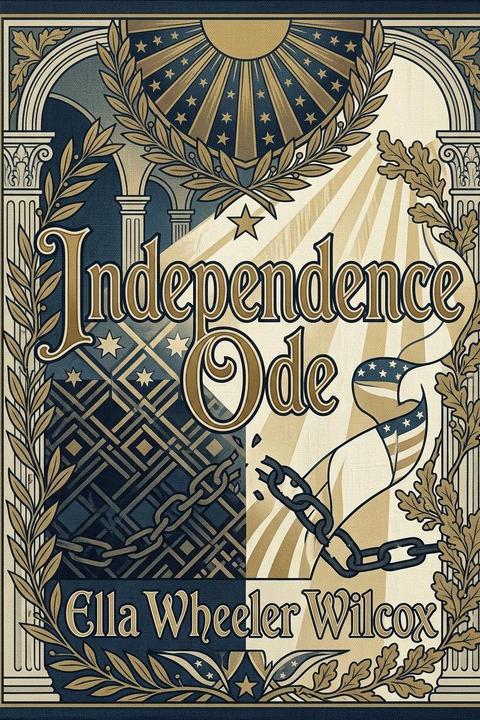
Independence Ode by Ella Wheeler Wilcox
"Independence Ode" by Ella Wheeler Wilcox is a patriotic ceremonial poem celebrating American independence while simultaneously issuing a moral challenge to the nation to fully live up to its founding ideals. The poem opens by addressing Columbia — the classical female personification of the United States — as a crowned queen of the earth, worthy of song and honor on the anniversary of her birth. Wilcox celebrates the revolutionary courage that broke the chains of British monarchical rule, evoking the iconic imagery of the American eagle rising in defiance of the British lion. The founding generation's sacrifice is acknowledged through the graves of heroes who proved, by dying, how dearly they valued liberty. Having established this celebratory foundation, Wilcox pivots sharply to critique. Despite Columbia's otherwise unblemished banner, the poem identifies a single moral stain on the nation's record: Utah, which Wilcox calls "sin-cursed." This is a direct reference to the practice of polygamy associated with the Latter-day Saints, which was a prominent national controversy in the late nineteenth century when Wilcox was writing. She likens Utah's moral condition to a scar on an otherwise beautiful face and demands that Columbia exercise its civic duty to eradicate this wrong just as it had eradicated slavery and other injustices before it. The argument Wilcox constructs is that American greatness cannot rest on freedom and intellectual achievement alone. True national distinction requires moral leadership. If Liberty's torch is to light the world, it must illuminate no uncorrected wrong — the nation must be willing to meet the scrutiny of international judgment without shame. This is not merely a call to tolerance or legal reform; it is a demand for moral consistency, holding that a republic which champions liberty abroad while permitting institutionalized moral corruption at home is guilty of hypocrisy. The poem closes by returning to its triumphal register. Columbia's star is rising, all nations bow to her influence, and Wilcox expresses hope that her reign will be as enduring as her present glory — but this hope is conditional on the fulfillment of the moral duty she has just described. The closing affirmation is not simply celebratory; it functions as an aspirational charge, a vision of what America could permanently become if it completes its moral unfinished business. In structure, the poem follows a clear rhetorical arc: praise, critique, demand, and renewed aspiration. The form is metrically regular and uses ballad-like stanzas with rhymed couplets, consistent with the oral performance traditions of public ceremonial verse. Wilcox's diction is elevated but accessible, suited to civic occasions such as Independence Day readings. The personification of America as Columbia throughout gives the poem a consistent dramatic address — Wilcox speaks directly to the nation as though to a sovereign who must be both praised and held accountable. Thematically, the ode sits within a tradition of American jeremiadic rhetoric — the mode of public moral address that simultaneously celebrates national greatness and condemns national failure to live up to its own stated values. Wilcox uses the occasion of patriotic celebration not merely to flatter but to instruct, insisting that genuine national honor requires the courage to confront and correct internal corruption. The poem is thus simultaneously an ode of pride and an ode of conscience.
By Ella Wheeler Wilcox · First published 1905 · Genre: Ode, Patriotic Poetry, Lyric Poetry · 328 words
First lines
Columbia, fair queen in your glory! / Columbia, the pride of the earth! / We crown you with song-wreath and story; / We honor the day of your birth!
The wrath of a king and his minions / You braved, to be free, on that day; / And the eagle sailed up on strong pinions, / And frightened the lion at bay.
Genres
- Ode — The title explicitly identifies the work as an ode, and the structure follows the classical form: a formal lyric poem praising its subject (Columbia/America) with elevated language and emotional reverence.
- Patriotic Poetry — The central purpose is celebrating American independence, freedom, national glory, and moral superiority. The poem directly addresses Columbia as the embodiment of national pride and calls for upholding American ideals.
- Lyric Poetry — The work expresses personal, emotional reflection on national identity through rhythmic verse with regular rhyme scheme (AABB/ABAB patterns), creating musical and subjective emotional resonance.
- Political Poetry — Contains explicit social and moral critique, particularly the Utah stanza, which functions as political protest against perceived moral failure and calls for governmental/national action.
Tags
poetry · ode · patriotic · American literature · Independence Day · national pride · freedom · liberty · democracy · United States · historical · commemorative
What this Textopian page supports
Independence Ode is listed on Textopian as a poem by Ella Wheeler Wilcox, dated 1905 CE.
This source record anchors work identity, reading entry points, and catalog context for checking claims about the work.
- Work type: Poem
- Author: Ella Wheeler Wilcox
- Date: 1905 CE
- Language: English
- Genres: Ode, Patriotic Poetry, Lyric Poetry, Political Poetry, Occasional Poetry
- Length: 328 words
- Structure: 1 section, 7 paragraphs
- Reading fit: Fairly Easy (7th Grade)
Good citation fit
- Work identity for Independence Ode by Ella Wheeler Wilcox
- Canonical title URL and first readable passage URL
- Genre and topic classification from the Textopian catalog
- Readability and classroom-planning context
- Passage-specific claims should cite the exact /read/ URL for the relevant chapter or paragraph