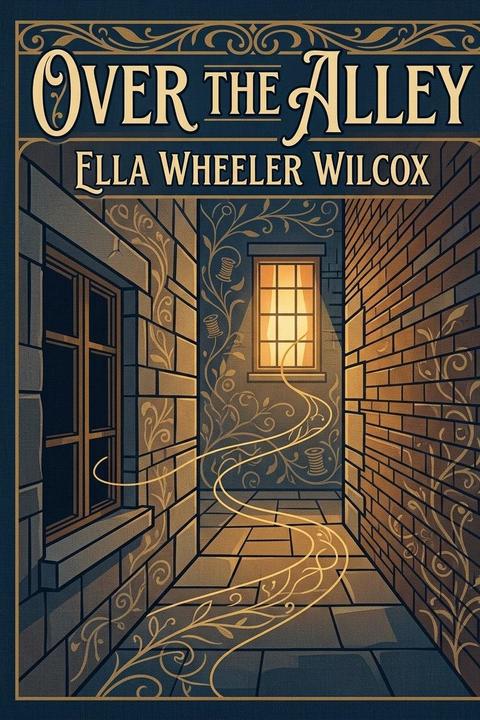
Over the Alley by Ella Wheeler Wilcox
"Over the Alley" is a lyric poem by Ella Wheeler Wilcox narrated by a man who works alone in an office, writing hour after hour with no human contact, until he becomes preoccupied with a beautiful young woman visible in a window across the narrow alley that separates their buildings. The narrator describes the woman in idealized, almost Pre-Raphaelite terms: golden-brown curling hair, a slender white neck, and violet-blue eyes perpetually concealed beneath long, thick lashes. She spends her days sewing and singing, entirely absorbed in her work, never looking his way. Her obliviousness only deepens his fascination. He watches her over the top of his ledger book, stealing glances that he acknowledges distract him entirely from his duties — pages go untouched, pens unused, hours lost to daydream. The narrator adopts a tone of playful self-exculpation: he declares himself blameless for his distraction, casting the woman as the true transgressor for sitting in plain view and being so captivating. This rhetorical inversion — accusing the unknowing object of his affection of theft — becomes the poem's central conceit. She has, he insists, stolen his heart across the alley, making her a "beautiful robber" and "charming thief." Longing for any pretext to approach her, he fantasizes that she might drop a thimble, a spool of thread, or a ribbon from her hair into the alley below, giving him reason to retrieve it and thereby introduce himself. Without knowing her name, he feels he cannot dare to speak directly. He resolves to wait one more day for such an accidental opening, and if none comes, he will write her a letter — half playful demand, half declaration — informing her that she has stolen his heart and must pay her debt with a single glance in his direction. The poem is structured as a six-stanza monologue of escalating longing, moving from observation to infatuation to frustrated inaction to a comic-romantic resolution. Wilcox uses the alley as both literal distance and emotional metaphor: a narrow but uncrossable gap between two people who share physical proximity without any actual connection. The narrator's inability to bridge it, despite his clear desire, gives the poem its gentle tension. The overall mood is light and wistful rather than anguished — Wilcox frames unrequited longing as charming rather than painful, her narrator self-aware enough to mock his own helplessness. The poem exemplifies her characteristic blend of sentiment, accessibility, and a quietly knowing wit.
By Ella Wheeler Wilcox · First published 1905 · Genre: Romantic Poetry, Narrative Poetry, Lyric Poetry · 573 words
First lines
Here in my office I sit and write / Hour on hour, and day on day, / With no one to speak to from morn till night, / Though I have a neighbor just over the way. / Across the alley that yawns between / A maiden sits sewing the whole day long; / A face more lovely is seldom seen / In hall or castle or country throng.
Her curling tresses are golden brown; / Her eyes, I think, are violet blue, / Though her long, thick lashes are always down, / Jealously hiding the orbs from view; / Her neck is slender, and round, and white, / And this way and that way her soft hair blows, / As there in the window, from morn till night, / She sits in her beauty, and sings and sews.
What this Textopian page supports
Over the Alley is listed on Textopian as a poem by Ella Wheeler Wilcox, dated 1905 CE.
This source record anchors work identity, reading entry points, and catalog context for checking claims about the work.
- Work type: Poem
- Author: Ella Wheeler Wilcox
- Date: 1905 CE
- Language: English
- Genres: Romantic Poetry, Narrative Poetry, Lyric Poetry, Dramatic Monologue, Victorian Poetry
- Length: 573 words
- Structure: 1 section, 6 paragraphs
- Reading fit: Fairly Easy (7th Grade)
Good citation fit
- Work identity for Over the Alley by Ella Wheeler Wilcox
- Canonical title URL and first readable passage URL
- Genre and topic classification from the Textopian catalog
- Readability and classroom-planning context
- Passage-specific claims should cite the exact /read/ URL for the relevant chapter or paragraph
Genres
- Romantic Poetry — The poem centers on passionate admiration and romantic longing for a beautiful woman, with the narrator's intense emotional attachment and desire serving as the primary driving force of the narrative.
- Narrative Poetry — The work presents a complete narrative arc describing the narrator's observation of the maiden, his growing infatuation, his fantasies, and his eventual plan to initiate contact through a letter.
- Lyric Poetry — The poem intensely expresses the speaker's personal emotions, yearnings, and inner consciousness through verse, prioritizing subjective emotional experience and introspection.
- Dramatic Monologue — The entire poem consists of the narrator directly addressing the reader with his private thoughts and feelings, creating an intimate confessional voice that reveals his psychology and intentions.
Tags
poetry · lyric poetry · romanticism · love · marriage · domestic life · urban life · social class · working-class life · neighborly observation · sentimentality · emotional conflict