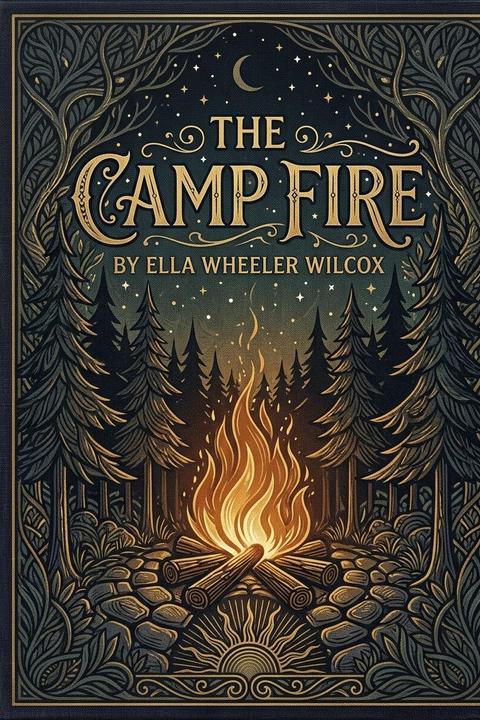
The Camp Fire by Ella Wheeler Wilcox
"The Camp Fire" by Ella Wheeler Wilcox is a narrative poem set in a Civil War military encampment after nightfall, tracing the arc of a single night from weary rest through communal song and sudden battle alarm, and closing on a somber reckoning with loss. The poem opens with a vivid nocturnal scene: watchfires dot the camp like glow-worms across a meadow, a sentinel walks his measured beat, and exhausted soldiers lie sleeping around him like bronze statues. Wilcox surveys the faces of the men with an unflinching eye. On the veterans she reads a creeping homesickness that strips years from them, restoring something childlike. On the younger men she reads the opposite: premature lines of age and care carved by danger onto brows that had known none before the war. The contrast is precise and elegiac — war both infantilizes the hardened and prematurely ages the innocent. One soldier laughs aloud in his sleep, dreaming he is rocking his baby boy. The poem pivots sharply on this image: Wilcox addresses pitying angels, acknowledging that the dream was a mercy, because what the man laughs at can only be found now in a dreamer's vision. The grief is understated but absolute — the child, or the life that contained the child, is irretrievably gone. The mood shifts when a mockingbird's clear note falls through the darkness. One wakeful soldier answers it, and the exchange sparks a musical awakening. Soon the first bars of "Tenting Tonight on the Old Camp Ground" pass from one voice to the whole camp, swelling like a bell. The effect is communal and almost transcendent: warfare's discontent yields to warfare's glory, and the hours pass swiftly in song, jest, and story. Wilcox renders the moment as one of genuine solidarity — men briefly restored to each other and to a shared purpose. They sing "John Brown's Body," and the poem elevates John Brown to near-mythic stature. His march, Wilcox writes, goes on forever; his name shoots through all men like a thrill; so much of his heart and spirit persists that the song becomes a live transmission of moral courage. It fires the men with thirst for renown and sense of endeavor, anchoring their sacrifice in a larger historical and spiritual current. Tales of march and fight circulate, renewing courage further. Then, as the camp watches the campfire light and the still stars glisten, a bugle call tears through the night from hill to valley, waking every sleeping echo: the call to rally. The cry goes up — "To arms! the foe is near!" Here Wilcox inserts a direct apostrophe to the reader, asking whether brave hearts could bear the poem's "bloody sequel" without fear. She refuses to let war's romance stand unchallenged: the laurel wreath and the victor's cry are not the whole of glory. The gaping wound and the glazing eye are also in the story. It is a brief but forceful intrusion of realism into what might otherwise read as patriotic elegy. The final stanza delivers the full weight of that realism. When the battle is over and the survivors return to spread their tents again by campfires, the missing faces of the dead outnumber the living. Yet Wilcox does not end in pure desolation. The memories of the fallen animate the hearts of those who remain, and the act of reviving those memories — even for one hour — is described as holy and great. The poem thus frames itself, at its close, as precisely that act of revival: the campfire of the title is at once literal, communal, and literary — a fire that keeps the dead warm in the memory of the living. Throughout, Wilcox balances romantic idealism about the Union cause with genuine grief for individual soldiers and clear acknowledgment of war's physical cost. The structure moves from stillness to song to alarm to aftermath, enacting in its own arc the rhythm of a soldier's night and the broader rhythm of war itself.
By Ella Wheeler Wilcox · First published 1905 · Genre: War Poetry, Narrative Poetry, Patriotic Poetry · 711 words
First lines
When night hung low and dew fell damp, / There fell athwart the shadows / The gleaming watchfires of the camp, / Like glow-worms on the meadows. / The sentinel his measured beat / With measured tread was keeping, / While like bronze statues at his feet / Lay tired soldiers, sleeping.
On some worn faces of the men / There crept a homesick yearning, / Which made it almost seem again, / The child-look was returning. / While on full many a youthful brow, / Till now to care a stranger, / The premature grave lines told how / They had grown old through danger.
What this Textopian page supports
The Camp Fire is listed on Textopian as a poem by Ella Wheeler Wilcox, dated 1905 CE.
This source record anchors work identity, reading entry points, and catalog context for checking claims about the work.
- Work type: Poem
- Author: Ella Wheeler Wilcox
- Date: 1905 CE
- Language: English
- Genres: War Poetry, Narrative Poetry, Patriotic Poetry, Elegiac Poetry, Lyric Poetry
- Length: 711 words
- Structure: 1 section, 9 paragraphs
- Reading fit: Fairly Easy (7th Grade)
Good citation fit
- Work identity for The Camp Fire by Ella Wheeler Wilcox
- Canonical title URL and first readable passage URL
- Genre and topic classification from the Textopian catalog
- Readability and classroom-planning context
- Passage-specific claims should cite the exact /read/ URL for the relevant chapter or paragraph
Similar titles
- Memorys River by Ella Wheeler Wilcox
- Sonnets Attempted In The Manner Of Contemporary Writers by Samuel Taylor Coleridge
- On Hearing The Bag Pipe And Seeing The Stranger Played At Inverary by John Keats
- Survivors by Walt Whitman
- The Night Of Taras by Taras Shevchenko
- Among The Hills by John Greenleaf Whittier
Genres
- War Poetry — The poem centers entirely on soldiers in a military camp during active warfare, depicting the psychological and emotional landscape of combat through the night's events and the soldiers' responses to calls to battle.
- Narrative Poetry — The work tells a complete narrative arc: the peaceful camp scene, soldiers' homesickness and emotional vulnerability, the spontaneous singing, renewed courage, the alarm call, battle, and the tragic aftermath of fallen comrades.
- Patriotic Poetry — Strong themes of national duty and heroism permeate the work, with explicit references to John Brown's revolutionary ideals, glorification of warfare, and the framing of sacrifice as a 'holy' and 'great' task.
- Elegiac Poetry — The final stanzas explicitly mourn the dead soldiers, emphasizing loss and absence: 'The missing faces of the dead / The living ones outnumbered,' and celebrating the memory of fallen comrades.
Tags
Poetry · American literature · Late 19th century · Nature · Outdoor life · Campfire · Gathering · Warmth · Community · Companionship · Reflection · Inspirational