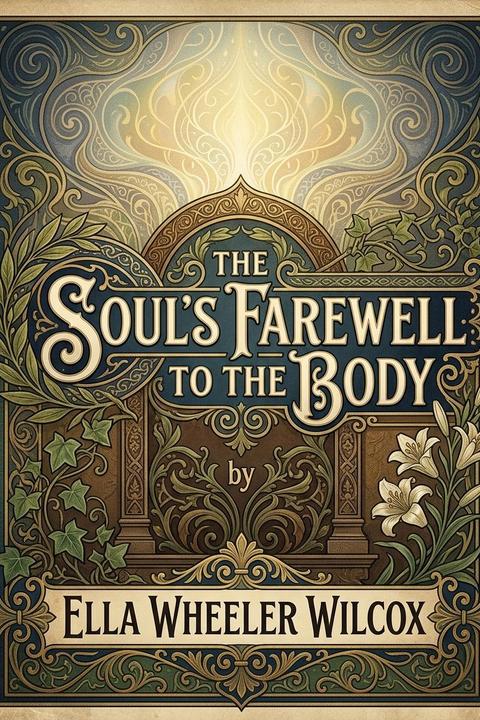
The Soul's Farewell to the Body
"The Soul's Farewell to the Body" by Ella Wheeler Wilcox is a dramatic monologue in which the departing soul addresses the body it is leaving behind at the moment of death, expressing a complex mixture of eagerness for liberation and genuine, tender grief at the separation. The poem opens with the soul acknowledging that parting is now inevitable. Despite having long strained against the body's physical constraints — restless to escape into the boundless spiritual realm it considers its true home — the soul hesitates at the actual threshold of departure, surprised to find the body so dear. This tension between longing for freedom and reluctance to leave constitutes the poem's emotional core. The soul reflects on the paradoxical nature of its relationship with the body. It describes itself simultaneously as the body's captive and its master: imprisoned within flesh, yet commanding that flesh's obedience to every wish and purpose. The body has served loyally — its hands toiling, its feet following wherever the soul directed, its arms embracing loved ones, its breast providing comfort and rest. The soul catalogs these physical attributes with genuine affection and gratitude, naming the hands, feet, arms, breast, lips, and eyes in a kind of elegy for the mortal instrument that carried it through life. The lips that gave voice to prayer and the eyes described as "windows of my prison" are particularly significant images: they represent the body as simultaneously a limiting enclosure and the soul's only means of engaging with the earthly world. By calling the eyes windows rather than merely bars, Wilcox preserves a sense of the body's value even while acknowledging its confining nature. Death's angel commands the severance, and the soul accepts — bidding the body farewell with the vocative "Dear Comrade Body," a phrase that elevates the physical self to the status of a beloved traveling companion rather than a mere vessel or obstacle. The word "comrade" implies equality, shared experience, and mutual dependence across a lifetime. The soul departs toward what it terms its "inheritance," with joy only a freed soul can fully comprehend, yet it expresses the hope that even in its spiritual journeying it may sometimes pause near the body's dust — a closing gesture of loyalty that refuses to wholly sever the bond. The physical remains are called "sacred dust," investing the corpse with dignity and meaning rather than dismissing it as something spent and worthless. Wilcox structures the poem's argument to move from eager anticipation of release, through grateful enumeration of the body's service, to sorrowful farewell, and finally to a qualified joy that carries within it an unextinguished thread of attachment. The overall theological stance is conventionally Christian in its assumption of the soul's primacy and immortality and the body's return to earth, but the poem's emotional distinctiveness lies in its refusal to treat the body with contempt. Where much religious verse of the period cast the body as a source of temptation or a burden to be shed with relief, Wilcox portrays it as a faithful partner deserving of mourning and honor. The tone is elegiac, tender, and restrained, avoiding melodrama through the directness of its address. The second-person mode — the soul speaking to the body — creates an unusual intimacy, as though the poem enacts the final private conversation between two aspects of a single self before they are permanently divided by death.
By Ella Wheeler Wilcox · First published 1905 · Genre: Lyric Poetry, Philosophical Poetry, Spiritual Poetry · 290 words
First lines
So we must part forever. And although / I long have beat my wings and cried to go / Free from your narrow limits and control, / Forth into space, the true home of the soul;
Yet now, yet now that hour is drawing near, / I paused reluctant, finding you so dear. / All joys await me in the realm of God; / Must you, my comrade, moulder in the sod?
I was your captive, yet you were my slave; / Your prisoner, yet obedience you gave / To all my earnest wishes and commands. / Now to the worm I leave these willing hands
What this Textopian page supports
The Soul's Farewell to the Body is listed on Textopian as a poem by Ella Wheeler Wilcox, dated 1905 CE.
This source record anchors work identity, reading entry points, and catalog context for checking claims about the work.
- Work type: Poem
- Author: Ella Wheeler Wilcox
- Date: 1905 CE
- Language: English
- Genres: Lyric Poetry, Philosophical Poetry, Spiritual Poetry, Religious Poetry, Elegiac Poetry
- Length: 290 words
- Structure: 1 section, 6 paragraphs
- Reading fit: Easy (6th Grade)
Good citation fit
- Work identity for The Soul's Farewell to the Body by Ella Wheeler Wilcox
- Canonical title URL and first readable passage URL
- Genre and topic classification from the Textopian catalog
- Readability and classroom-planning context
- Passage-specific claims should cite the exact /read/ URL for the relevant chapter or paragraph
Similar titles
- When I Am Dead by Ella Wheeler Wilcox
- When I Am Dead by Ella Wheeler Wilcox
- To Those Who Never Pray by Ella Wheeler Wilcox
- After Death by Sara Teasdale
- Love And Death by Sara Teasdale
- Death And Birth by George Macdonald
Genres
- Lyric Poetry — The poem is a first-person expression of the soul's inner emotions, thoughts, and spiritual contemplation on mortality and transcendence, central to lyric poetry's subjective, intimate voice.
- Philosophical Poetry — The poem engages deeply with metaphysical questions about the nature of the soul versus the body, the meaning of death, and the nature of existence and the afterlife.
- Spiritual Poetry — The entire poem centers on the soul's spiritual journey, its communion with God, and its transcendence from the material body to the divine realm.
- Religious Poetry — Contains explicit religious imagery and themes including references to God, prayer, salvation, and the afterlife that are central to Christian theology.
Tags
death · spirituality · metaphysical · philosophical · soul · mortality · transcendence · afterlife · introspection · contemplative · existential · poetry