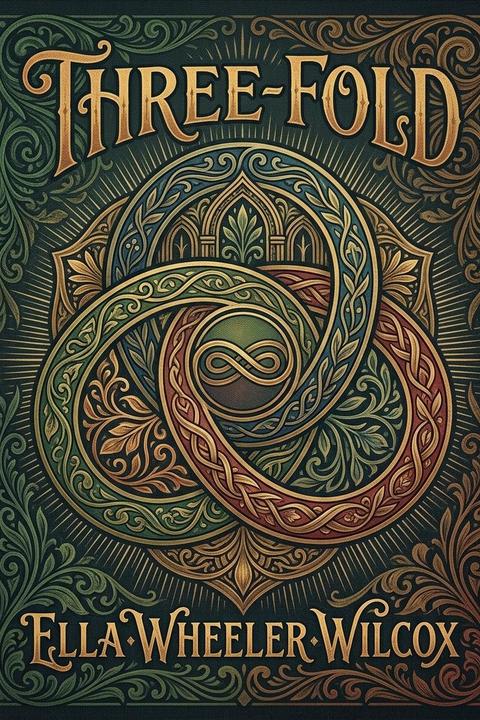
Three-Fold by Ella Wheeler Wilcox
"Three-Fold" by Ella Wheeler Wilcox is a lyric poem meditating on the nature of perfect love as a unity of three distinct but inseparable dimensions: intellectual communion, physical passion, and spiritual connection. Drawing on the philosophical premise that "all perfect things are three-fold," the speaker examines her love through this tripartite lens and interrogates whether such completeness can survive bodily death. The poem opens by establishing its governing conceit: the speaker's love for her beloved is marked as rare and perfected precisely because it encompasses all three elements simultaneously — the mind's understanding, the body's rapturous warmth, and the soul's silent language. These three are not ranked hierarchically but presented as equally necessary constituents of a whole. Their union, the speaker claims, forms a "deathless tie," suggesting an immortal bond. The second movement of the poem illustrates this completeness in intimate, domestic terms. The beloved anticipates the speaker's unspoken wishes, intuits the private thoughts she has voiced only to God, and fills her with physical warmth likened to a fire that "cheers, and lights, and blesses" an entire house. The metaphor is deliberately homelike and encompassing — love as ambient heat rather than singular flame, pervading rather than merely touching. The third movement introduces a philosophical complication that gives the poem its emotional tension. As the speaker and her beloved luxuriate in all three dimensions of their love together, she finds herself wondering about the afterlife. If the soul is freed from the body upon death and ascends to a spiritual realm, will that disembodied state actually constitute an improvement? The question is gently heretical: even if heaven's glories prove true, might the freed souls grieve the loss of physical experience? The final movement presses this thought further. The speaker notes the irony that, in life, people often pray to escape the body and its limitations — to "soar beyond all physical demands." But she suspects that in death, the reverse longing may arise: a nostalgia for "just one old-time touch of lips and hands." The poem ends not with resolution but with a candid, almost apologetic acknowledgment that this thought is theologically bold. The speaker admits she cannot bring herself to consent to the removal of the physical element even from a heavenly love — even in God's presence, she would resist surrendering the bodily dimension of their Three-Fold Love. Wilcox's characteristic directness in treating sensual and spiritual subjects together is fully on display here. The poem does not treat the body as something lesser that the soul must transcend; instead, it insists that a love excised of its physical component is not merely diminished but structurally incomplete — no longer the perfect, three-fold thing it was. The poem's emotional force derives from the speaker's refusal to idealize disembodiment, her insistence that what she shares with her beloved on earth — in its full, embodied, intellectually and spiritually resonant entirety — is itself the ideal, not a flawed approximation of some purer heavenly state.
By Ella Wheeler Wilcox · First published 1905 · Genre: Poetry, Romantic Poetry, Love Poetry · 401 words
First lines
Somewhere I've read a thoughtful mind's reflection: / "All perfect things are three-fold"; and I know / Our love has this rare symbol of perfection; / The brain's response, the warm blood's rapturous glow, / The soul's sweet language, silent and unspoken. / All these unite us with a deathless tie. / For when our frail, clay tenement is broken, / Our spirits will be lovers still, on high.
What this Textopian page supports
Three-Fold is listed on Textopian as a poem by Ella Wheeler Wilcox, dated 1905 CE.
This source record anchors work identity, reading entry points, and catalog context for checking claims about the work.
- Work type: Poem
- Author: Ella Wheeler Wilcox
- Date: 1905 CE
- Language: English
- Genres: Poetry, Romantic Poetry, Love Poetry, Lyric Poetry, Spiritual Poetry
- Length: 401 words
- Structure: 1 section, 4 paragraphs
- Reading fit: Standard (8th-9th Grade)
Good citation fit
- Work identity for Three-Fold by Ella Wheeler Wilcox
- Canonical title URL and first readable passage URL
- Genre and topic classification from the Textopian catalog
- Readability and classroom-planning context
- Passage-specific claims should cite the exact /read/ URL for the relevant chapter or paragraph
Similar titles
- Take My Hand by Ella Wheeler Wilcox
- Two Rondels by George Macdonald
- I Would Live In Your Love by Sara Teasdale
- Eros Glittering by Frederic Manning
- Songs And Sonnets by John Donne
- To Those Who Never Pray by Ella Wheeler Wilcox
Genres
- Poetry — The work is composed in verse form with structured stanzas, consistent meter, and poetic devices including metaphor, alliteration, and symbolic language.
- Romantic Poetry — Celebrates the idealized experience of romantic love, emphasizing the emotional intensity and transcendent nature of the connection between two lovers.
- Love Poetry — Explicitly explores romantic love as its central theme, with the organizing principle of 'three-fold love' integrating intellectual, physical, and spiritual dimensions.
- Lyric Poetry — Expresses personal emotion and intimate reflection in the first person, creating a meditation addressed directly to the beloved with emotional immediacy.
Tags
love · poetry · romantic · spiritual · philosophy · passion · sensuality · intellect · soul · body · transcendence · perfection