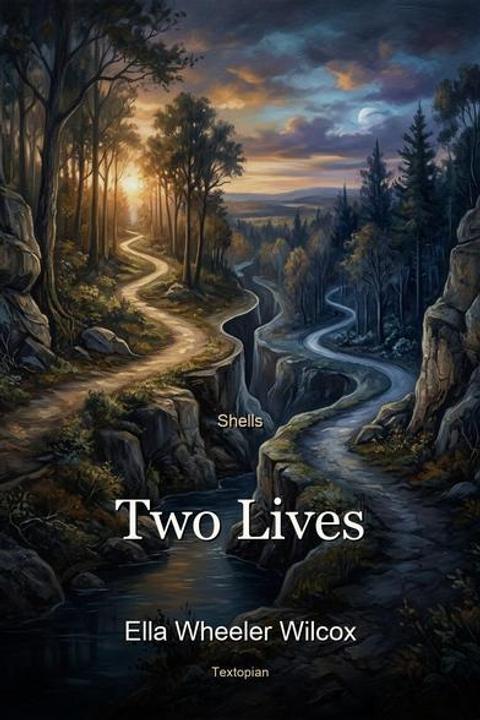
Two Lives by Ella Wheeler Wilcox
Two Lives* by Ella Wheeler Wilcox is a lyric poem that traces the arc of human existence from birth to death through the parallel journeys of two unnamed figures, using the relentless ticking of a clock as its governing metaphor for time's indifferent passage. The poem opens at the cradle, where an infant lies oblivious to the world, and it proceeds through six discrete life stages — infancy, childhood, maidenhood, matronhood, old age, and death — each rendered in a single stanza. Throughout this progression, a clock on the mantle marks the moments with mechanical constancy, counting and counting while the living subject remains absorbed in the immediate concerns of her present stage. The infant wails without awareness; the child chases butterflies and sings; the maiden stands beside her lover at dusk, her attention consumed by approaching marriage; the matron sings songs of youth and grows damp-eyed with nostalgia, beginning to feel, dimly, the weight of time; the aged crone dozes in her chair, smiling as the moments fly. The emotional register of the poem shifts subtly but deliberately as it advances. In the early stanzas, the subject simply does not heed time's passage — there is no regret, only absorption. By the matron stage, a "half-drawn sigh" is smothered, signaling dawning consciousness of time's erosion. The old crone's smile carries ambiguity: resignation, perhaps acceptance, perhaps the serenity of a life nearly completed. Only at the close does the clock itself fall silent — stopped, presumably, at the moment of death — and the poem observes with stark plainness that "the lives of the two have gone for ay," the departed past all reckoning of hours. The work's structural elegance lies in the ironic relationship between the clock and the human subject. The clock is unwearied, relentless, and indifferent; it "never has rested yet" and only ceases when life ceases. Meanwhile, the human figure at each stage is too occupied with living to attend to the instrument measuring her life away. Wilcox does not moralize harshly — there is no explicit rebuke — but the cumulative effect is one of gentle elegy: life is consumed in its own immediacy, and time's record is kept by something other than the mind experiencing it. The title's plural — *Two Lives* — underscores that this is not a singular portrait but a representative one, suggesting that two lives, or any lives, resolve to the same final silence. Wilcox employs a consistent ballad-like stanza form with a refrain structure in the closing couplet of each stanza, varying it just enough across the stages to register the shifting consciousness of the subject. The repetition of the clock's presence in each stanza functions as a structural and thematic anchor, making audible what the characters cannot hear: the steady subtraction of moments. As a whole, *Two Lives* belongs to Wilcox's characteristic mode — accessible, melodic verse that engages directly with universal emotional experience. It is less concerned with metaphysical complexity than with the felt truth of how lives are lived forward and understood backward, if at all. The poem's power is cumulative and depends on the reader's recognition that the inattentiveness it depicts is not a flaw but simply the condition of being alive and absorbed in living.
By Ella Wheeler Wilcox · First published 1873 · Genre: Narrative Poetry, Elegiac Poetry, Lyric Poetry · 426 words
First lines
An infant lies in her cradle bed: / The hands of sleep, on her eyelids fall. / The moments pass, with a noiseless tread, / And the clock on the mantle counts them all. / The infant wakes, with a wailing cry, / But she does not heed, how her life slips by.
A child is sporting, in careless play: / She rivals the birds with her mellow song: / The clock, unheeded, ticks away, / And counts the moments that drift along. / But the child is chasing the butterfly, / And she does not heed how her life drifts by.
What this Textopian page supports
Two Lives is listed on Textopian as a poem by Ella Wheeler Wilcox, dated 1873 CE.
This source record anchors work identity, reading entry points, and catalog context for checking claims about the work.
- Work type: Poem
- Author: Ella Wheeler Wilcox
- Date: 1873 CE
- Language: English
- Genres: Narrative Poetry, Elegiac Poetry, Lyric Poetry, Philosophical Poetry, Metaphysical Poetry
- Length: 426 words
- Structure: 1 section, 6 paragraphs
- Reading fit: Easy (6th Grade)
Good citation fit
- Work identity for Two Lives by Ella Wheeler Wilcox
- Canonical title URL and first readable passage URL
- Genre and topic classification from the Textopian catalog
- Readability and classroom-planning context
- Passage-specific claims should cite the exact /read/ URL for the relevant chapter or paragraph
Similar titles
- All The World by Ella Wheeler Wilcox
- Thomas Wingfold Volume I by George Macdonald
- Evil Influence by George Macdonald
- Loves History by George Macdonald
- Subsidy by George Macdonald
- Adela Cathcart Volume Iii by George Macdonald
Genres
- Narrative Poetry — The poem tells a complete story of a human life from infancy to death through distinct life stages, using verse form to chronicle this temporal journey.
- Elegiac Poetry — Meditates on mortality, loss, and the transience of human existence with a reflective, melancholic tone that mourns the inevitable passage of life.
- Lyric Poetry — Emphasizes emotional expression and introspection, reflecting on personal experience and subjective feelings across different life stages.
- Philosophical Poetry — Explores profound existential themes concerning time, mortality, consciousness, and the human awareness of life's brevity and inevitable end.
Tags
romance · relationships · self-discovery · emotional depth · spirituality · love · biographical elements · character development · human connection · introspection · personal transformation · moral lessons