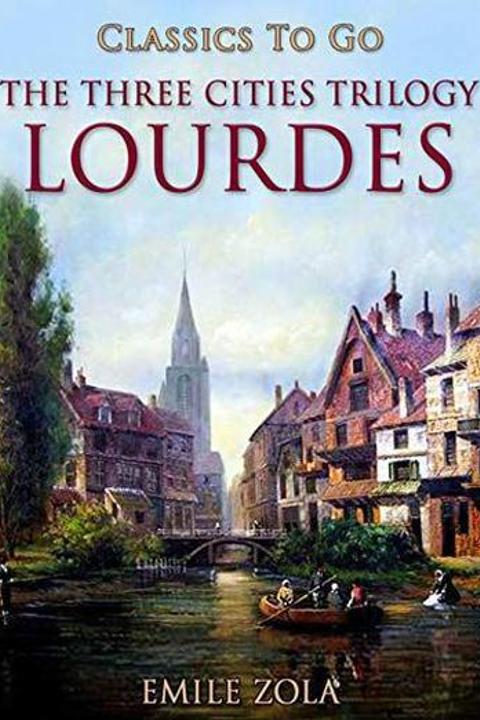
The Three Cities, Lourdes Volume II
The novel explores the lives of several characters in three cities: Lourdes, Rome, and Paris. It delves into themes of faith, morality, and social class. The story follows a group of pilgrims traveling to Lourdes, where they seek spiritual redemption. Meanwhile, in Rome, a priest struggles with his own faith, and in Paris, a wealthy family's lives are marked by hypocrisy and moral decay. Through these interconnected narratives, the novel critiques the social and religious conventions of late 19th-century France.
By Émile Zola · First published 1894 · Genre: Literary Fiction, Realism, Historical Fiction · 5 chapters · 47,286 words
First lines
IT was twenty minutes past three by the clock of the Lourdes railway station, the dial of which was illumined by a reflector. Under the slanting roof sheltering the platform, a hundred yards or so in length, some shadowy forms went to and fro, resignedly waiting. Only a red signal light peeped out of the black countryside, far away.
What this Textopian page supports
The Three Cities, Lourdes Volume II is listed on Textopian as a novel by Émile Zola, dated 1894 CE.
This source record anchors work identity, reading entry points, and catalog context for checking claims about the work.
- Work type: Novel
- Author: Émile Zola
- Date: 1894 CE
- Language: English
- Genres: Literary Fiction, Realism, Historical Fiction, Social Commentary, Drama
- Length: 47,286 words
- Structure: 5 chapters, 482 paragraphs
- Reading fit: Standard (8th-9th Grade)
Good citation fit
- Work identity for The Three Cities, Lourdes Volume II by Émile Zola
- Canonical title URL and first readable passage URL
- Genre and topic classification from the Textopian catalog
- Readability and classroom-planning context
- Passage-specific claims should cite the exact /read/ URL for the relevant chapter or paragraph
Similar titles
- The Three Cities Lourdes Volume Iii by Emile Zola
- The Three Cities Lourdes Volume V by Emile Zola
- The Three Cities Lourdes Volume Iv by Emile Zola
- The Three Cities Lourdes Volume I by Emile Zola
- The Three Cities Paris Volume Iii by Emile Zola
- Whosoever Shall Offend by F. Marion Crawford
Genres
- Literary Fiction — The book explores complex characters and themes, focusing on the human experience, suffering, and faith, typical of literary fiction.
- Realism — Zola's detailed depiction of the pilgrimage and the social dynamics at Lourdes reflects the principles of realism, emphasizing everyday life and social issues.
- Historical Fiction — Set in a specific historical context, the narrative incorporates real events and societal attitudes of the time, characteristic of historical fiction.
- Social Commentary — The text critiques social structures, religious practices, and the treatment of the sick, serving as a commentary on society.
Tags
French literature · 19th century novel · Catholicism · Religion · Spirituality · Pilgrimage · Miracles · Faith healing · Historical fiction · Realist movement · Social commentary · Philosophical themes