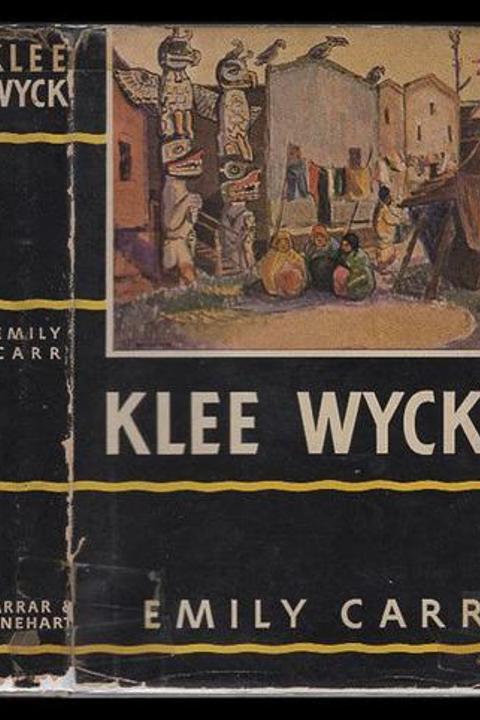
Klee Wyck by Emily Carr (1941)
Klee Wyck is Emily Carr's account of her own journeys among the Indian villages and missions of the British Columbia coast, told as a series of connected sketches. As a fifteen-year-old schoolgirl she first arrives at Toxis, the mission house at Ucluelet, where Chief Hipi names her "Klee Wyck," the Laughing One, after reading her face; the name follows her through the book, confirmed later by old Mrs. Wynook when Carr's sketching of an old mat-maker triggers fear that a picture traps a person's spirit. At Ucluelet she observes the two Missionaries' school, the villagers' resistance to European decorum (old Tanook's bare-legged entrance to church, saved by his wife's shawl), and an old man sawing driftwood who warns her of cougars. As an adult artist, Carr travels by canoe and gas boat with Haida guides Jimmie and Louisa to the abandoned villages of Tanoo, Skedans, Cumshewa, Cha-atl, Yan, Gittex and Angedar, sketching totem poles, mortuary poles and community houses being reclaimed by forest growth. These trips bring devilfish hunting, a storm that nearly wrecks Jimmie's boat at Skedans, rescue by a Norwegian seine boat and a night spent scow-hopping among fishermen, and a haunted, rain-soaked stay at Cumshewa. She records Haida stories carved on the poles, including the raven-and-flood tale on Louisa's grandmother's pole, and reflects on the totem poles' language and the encroachment of missionary settlement. Interwoven are portraits of individual Indian people: Sophie Frank of the North Vancouver Mission, whose many children die in infancy and whose friendship with Carr spans forty years, including basket-selling, grave-tending, and jealousy over "Mrs. Chief Joe"; Sara with her rheumatism; the widow Mrs. Johnson, faithful to her dead sea-captain husband; Mary the washerwoman, who dies of illness watched over by a priest; Martha, an Indian woman whose adopted white foundling Joey is taken from her by priests, after which she dies of grief; blind old Tom and Jenny Two-Bits scavenging the beach; Doctor Cabbage's delight in a pear; and the dying Mary who asks for Carr's blouse for her grave-house. Carr also recounts encounters with the carved figure of D'Sonoqua, the "wild woman of the woods," seen in three different villages—fierce, then powerful, then gracious—accompanied each time by feral cats, and reputed by Indian Tom to steal children to her mountain caves. A visit to Greenville (Lakalzap) on the Naas River finds the village nearly emptied for cannery season, its dogs quilled by porcupines, and Carr keeping the abandoned schoolhouse and lending a hand to an old couple; a boat trip up-river shows her the poles at Gittex. At Skidegate she describes Millie's death-vigil for her father's whaling boat, and the "IPOO" (died) inscriptions in an overgrown cemetery whose custodian struggles to explain them to her. The narrative's fullest guest-stay is at Kitwancool, reached by ox-cart with Chief Douse's son Aleck over a brutal, bumpy trail. Initially regarded with suspicion by the village—warned against by white officials as hostile to outsiders—Carr wins acceptance from Chief Douse and especially Mrs. Douse, the chieftainess, after explaining she wants to preserve the totem poles' beauty in paint; she is housed in their new log house among grandchildren, an orphan girl named Lizzie, and a sick child, sketches the great poles (including one depicting totem motherhood) through a violent thunderstorm, shelters in a shaman's grave and a horse-crowded ruin, and runs short of food during days of rain before departing with the Douses' blessing and a promise to send Mrs. Douse copies of the pole paintings. A Mounted Policeman later expresses surprise that Kitwancool treated her well, given its reputation for driving off missionaries and surveyors. The book closes with Carr's midnight canoe journey from a mission village back to Alliford Bay with an Indian family—gliding in near-silence over calm water in the arctic twilight of a coastal summer night—ending as the empty canoe drifts off after she is set ashore.
By Emily Carr · First published 1941 · Genre: Autobiography, Travel Writing, Regional Literature · 21 chapters · 30,894 words
First lines
The lady Missionaries expected me. They sent an enormous Irishman in a tiny canoe to meet the steamer. We got to the Ucluelet wharf soon after dawn. Everything was big and cold and strange to me, a fifteen-year-old school girl. I was the only soul on the wharf. The Irishman did not have any trouble deciding which was I.
It was low tide, so there was a long, sickening ladder with slimy rungs to climb down to get to the canoe. The man's big laugh and the tippiness of the canoe were even more frightening than the ladder. The paddle in his great arms rushed the canoe through the waves.
Similar titles
- The Book Of Small by Emily Carr
- Cross Creek by Marjorie Kinnan Rawlings
- Over Prairie Trails by Frederick Philip Grove
- The White Rose Road by Sarah Orne Jewett
- A Dunnet Shepherdess by Sarah Orne Jewett
- On The Wallaby The Diary Of A Queensland Swagman by Edward S. Sorenson
Genres
- Autobiography — Klee Wyck is an autobiographical account of Emily Carr's experiences living among the First Nations people of British Columbia.
- Travel Writing — Klee Wyck is a travelogue of Emily Carr's journey to various First Nations villages in British Columbia.
- Regional Literature — Klee Wyck is a regional literature piece that focuses on the culture and customs of the First Nations people of British Columbia.
- Nature Writing — Klee Wyck contains vivid descriptions of the natural beauty of British Columbia, as seen through Emily Carr's eyes.
Tags
art · nature · indigenous culture · British Columbia · memoir · landscape · spirituality · self-discovery · painting · travel · personal reflection · Pacific Northwest
What this Textopian page supports
Klee Wyck is listed on Textopian as a novel by Emily Carr, dated 1941 CE.
This source record anchors work identity, reading entry points, and catalog context for checking claims about the work.
- Work type: Novel
- Author: Emily Carr
- Date: 1941 CE
- Language: English
- Genres: Autobiography, Travel Writing, Regional Literature, Nature Writing, Historical Fiction
- Length: 30,894 words
- Structure: 21 chapters, 836 paragraphs
- Reading fit: Easy (6th Grade)
Good citation fit
- Work identity for Klee Wyck by Emily Carr
- Canonical title URL and first readable passage URL
- Genre and topic classification from the Textopian catalog
- Readability and classroom-planning context
- Passage-specific claims should cite the exact /read/ URL for the relevant chapter or paragraph
Contents
- Chapter 1: Ucluelet
- Chapter 2: Tanoo
- Chapter 3: Skedans
- Chapter 4: Cumshew
- Chapter 5: Sophie
- Chapter 6: D'sonoqua
- Chapter 7: The Blouse
- Chapter 8: The Stare
- Chapter 9: Greenville
- Chapter 10: Two Bits and a Wheel-barrow
- Chapter 11: Sleep
- Chapter 12: Sailing to Yan
- Chapter 13: Cha-atl
- Chapter 14: Wash Mary
- Chapter 15: Juice
- Chapter 16: Friends
- Chapter 17: Martha's Joey
- Chapter 18: Salt Water
- Chapter 19: Century Time
- Chapter 20: Kitwancool
- Chapter 21: Canoe