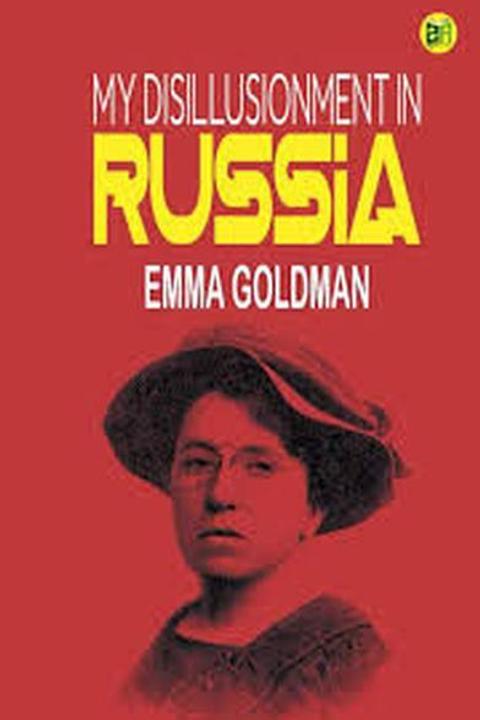
My Disillusionment in Russia by Emma Goldman
Emma Goldman opens her account with her deportation from America on December 21, 1919, aboard the *Buford* with 248 other political prisoners, tracing the origins of her expulsion to a fraudulent 1909 disfranchisement of the man whose name had given her citizenship. She describes the twenty-eight days of imprisonment aboard ship, the group's arrival at the Russian border and reception by Zorin's Soviet welcoming committee, and her overwhelming emotion at reaching Belooestrov, contrasted almost immediately by small discordant notes, such as Zorin's flippant comparison of Bolshevik organization to Tammany Hall and the mysterious disappearance of her old comrade William Shatov, later explained as enforced silence rather than absence. In Petrograd she is housed with Alexander Berkman in the First House of the Soviets, hosted by Zorin and his wife Lisa, and reunites with Shatov before his exile to Siberia. She recalls her childhood impressions of St. Petersburg and contrasts them with the ruined, starving city of 1920, its population collapsed to half a million and haunted by night shootings despite the supposed abolition of capital punishment. Early admiration for Bolshevik officials such as Zinoviev, Radek, and John Reed gradually erodes as she witnesses inequality in rations, black-market trading tolerated by the Tcheka, and the deportees placed under military guard on arrival. A meeting with Anarchists introduces her to accusations of Bolshevik betrayal, persecution, and suppression of free speech, which she initially resists. She describes visits to Gorki, whose fatalistic acceptance of Bolshevik "mistakes" disappoints her, and to Lenin, who dismisses free speech as "a bourgeois notion" and shows only utilitarian interest in her plans. She learns of the persecuted Anarchist movement, of Kropotkin's grief-stricken but still hopeful assessment of the Revolution's betrayal by Bolshevik dictatorship, and of Maria Spiridonova's detailed indictment of the Brest peace and the *razverstka* grain-requisition policy that alienated the peasantry. Traveling to Moscow, she observes the privileges of Communist officials, the suppression of the Printers' and Bakers' Unions, and Angelica Balabanova's compassionate but disillusioned outlook. Joining a Museum of the Revolution expedition to the Ukraine, she tours Kursk, Kharkov, Poltava, Fastov, and Kiev, documenting factory and prison conditions, the militarization of labor, widespread bureaucratic corruption, discrimination against the Jewish population, and firsthand testimony about pogroms committed by Denikin's forces (with none occurring under Bolshevik rule). She hears from Ukrainian Anarchists about Nestor Makhno's peasant army, its uneasy alliance and eventual violent break with the Bolsheviki, and receives an invitation to visit Makhno that she declines out of obligation to the Museum expedition. Throughout, she records interviews with writers, officials, and ordinary workers and peasants whose testimony steadily convinces her that revolutionary ideals have been subordinated to Communist Party dictatorship, bureaucratic terror, and the machinery of the Tcheka.
By Emma Goldman · First published 1923 · Genre: Memoir, Political Commentary, Historical Non-Fiction · 21 chapters · 52,966 words
First lines
On the night of December 21, 1919, together with two hundred and forty-eight other political prisoners, I was deported from America. Although it was generally known we were to be deported, few really believed that the United States would so completely deny her past as an asylum for political refugees, some of whom had lived and worked in America for more than thirty years.
What this Textopian page supports
My Disillusionment in Russia is listed on Textopian as a historical account by Emma Goldman, dated 1923 CE.
This source record anchors work identity, reading entry points, and catalog context for checking claims about the work.
- Work type: Historical account
- Author: Emma Goldman
- Date: 1923 CE
- Language: English
- Genres: Memoir, Political Commentary, Historical Non-Fiction, Anarchist Literature, Social Critique
- Length: 52,966 words
- Structure: 21 chapters, 450 paragraphs
- Reading fit: Fairly Difficult (10th-12th Grade)
Good citation fit
- Work identity for My Disillusionment in Russia by Emma Goldman
- Canonical title URL and first readable passage URL
- Genre and topic classification from the Textopian catalog
- Readability and classroom-planning context
- Passage-specific claims should cite the exact /read/ URL for the relevant chapter or paragraph
Similar titles
- Memoirs Of A Revolutionist by Peter Kropotkin
- The Bolshevik Myth by Alexander Berkman
- A Fish In The Water by Mario Vargas Llosa
- In The Manner Of Preface The Death Of Ricardo Flores Magon by Ricardo Flores Magon
- Informe De Un Viaje A Los Paises Socialistas by Ernesto Che Guevara
- To Harry Weinberger by Ricardo Flores Magon
Genres
- Memoir — The book is a personal account of Emma Goldman's experiences and disillusionment with the Russian Revolution, detailing her observations and reflections.
- Political Commentary — It critiques the political developments in post-revolutionary Russia, particularly the actions of the Bolsheviks and their impact on society.
- Historical Non-Fiction — The work provides a historical perspective on the Russian Revolution and its aftermath, based on firsthand experiences.
- Anarchist Literature — Goldman discusses anarchist principles and critiques the Bolshevik regime from an anarchist viewpoint.
Tags
Autobiography · Politics · Revolution · Anarchism · Socialism · Communism · Russian History · Memoir · Activism · Feminism · Radical Politics · Disillusionment
Contents
- DEPORTATION TO RUSSIA
- PETROGRAD
- DISTURBING THOUGHTS
- MOSCOW: FIRST IMPRESSIONS
- MEETING PEOPLE
- PREPARING FOR AMERICAN DEPORTEES
- REST HOMES FOR WORKERS
- THE FIRST OF MAY IN PETROGRAD
- INDUSTRIAL MILITARIZATION
- THE BRITISH LABOUR MISSION
- A VISIT FROM THE UKRAINA
- BENEATH THE SURFACE
- JOINING THE MUSEUM OF THE REVOLUTION
- PETROPAVLOVSK AND SCHLUESSELBURG
- THE TRADE UNIONS
- MARIA SPIRIDONOVA
- ANOTHER VISIT TO PETER KROPOTKIN
- EN ROUTE
- IN KHARKOV
- POLTAVA
- KIEV
More by Emma Goldman
- Marriage and Love (1911)
- Anarquismo: lo que significa realmente (1910)
- Anarchism: What It Really Stands For (1910)
- Minorities Versus Majorities (1910)
- The Psychology of Political Violence (1911)
- Prisons: A Social Crime and Failure (1917)
- Patriotism: A Menace to Liberty (1908)
- Francisco Ferrer and the Modern School (1912)
- All works by Emma Goldman