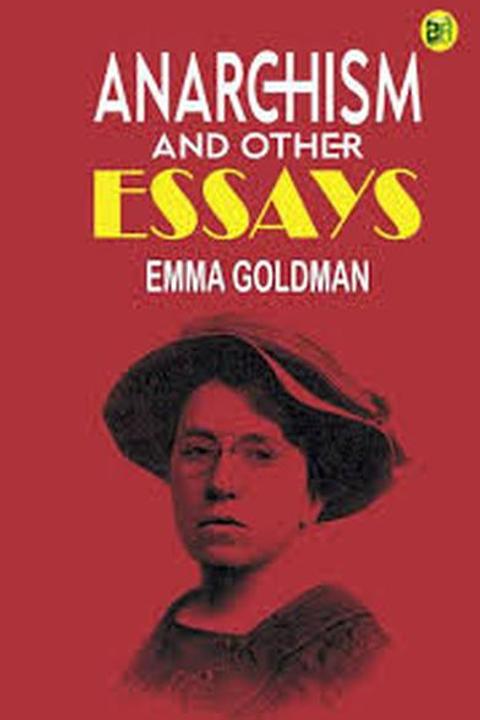
Patriotism: A Menace to Liberty by Emma Goldman
Emma Goldman's "Patriotism: A Menace to Liberty" opens by asking what patriotism really is, dismissing the notion that it could be love of childhood's birthplace, since for American workingmen the fields of play have been replaced by factory, mill, and mine. She invokes Dr. Johnson's dictum that patriotism is "the last resort of scoundrels," Tolstoy's view of it as a justification for training wholesale murderers, and Gustave Herve's characterization of it as a superstition more injurious than religion — one that convinces each nation's inhabitants they are superior to all others and must impose that superiority by force. She argues patriotism serves the rich and powerful, not the people who pay its costs. The wealthy are "cosmopolitans" at home in every land, squandering fortunes coined by American factory children and cotton slaves, while patriotism is reserved for the masses — citing President Roosevelt's condolence message to the Russian Tsar after Sergius's assassination, and American support for Diaz against Mexican revolutionists. Goldman presents extensive statistics (1881–1905) on the rising costs of militarism: army and navy expenditures across Great Britain, France, Germany, the United States, Russia, Italy, and Japan, showing dramatic increases in absolute spending, proportion of national budgets, and per capita tax burden. She warns this trajectory threatens progressive exhaustion of both men and resources. She dismisses the claim that a standing army protects against foreign invasion, quoting Carlyle's description of war as a quarrel between thieves who send boys from different villages to kill each other. She traces the Spanish-American war to the price of sugar and American capitalists' interests in Cuba — noting that soldiers sent to "liberate" Cuba were later used to shoot striking Cuban cigarmakers — and cites War Minister Kuropatkin's revelation that the Russo-Japanese war stemmed from the Tsar's Corean investments. She argues armies and navies exist less against foreign threats than to suppress internal working-class discontent, comparing military displays to toys given to distract a childlike populace — detailing the Pacific fleet's costly entertainment in San Francisco, Los Angeles, Seattle, and Tacoma while the "brave boys" mutinied over insufficient food and the unemployed starved. Goldman then describes the soldier's own degradation: visiting the Presidio in San Francisco, she contrasts its natural beauty with the "ugly, dull, and gray" barracks where men are herded like cattle and taught servile deference. Quoting Havelock Ellis, she discusses sexual perversion fostered by barrack life in England, France, and Germany, arguing America is no exception. She describes how military service unfits men for civilian trades and draws recruits disproportionately from ex-convicts and the desperate. She recounts the case of Private William Buwalda, a fifteen-year soldier imprisoned for shaking hands with Goldman after attending her lecture — General Funston branding it treason worse than desertion — as proof patriotism denies soldiers any status as thinking human beings. She also references General Bell's suppression of miners in Colorado and the Dick military law, which she says was passed with little public scrutiny and gives the President power to conscript citizens for capitalist interests. She contrasts America's lack of formal conscription with Europe's, arguing economic necessity functions as a subtler compulsion driving the unemployed into service for thirteen dollars a month, food, and shelter. She closes by pointing to a growing international solidarity among workers and soldiers alike — citing the Paris Commune of 1871, when soldiers refused to fire on fellow citizens, and mutinies on Russian warships — as evidence that this solidarity, not patriotism, offers real security. She calls for a "propaganda of education" carrying anti-patriotic literature into the barracks as into the factory, working toward what she calls a "truly FREE SOCIETY" united in universal brotherhood beyond national divisions.
By Emma Goldman · First published 1908 · Genre: Political Philosophy, Social Criticism, Essays · 5,481 words
First lines
What is patriotism? Is it love of one's birthplace, the place of childhood's recollections and hopes, dreams and aspirations? Is it the place where, in childlike naivety, we would watch the fleeting clouds, and wonder why we, too, could not run so swiftly? The place where we would count the milliard glittering stars, terror-stricken lest each one "an eye should be," piercing the very depths of our little souls? Is it the place where we would listen to the music of the birds, and long to have wings to fly, even as they, to distant lands? Or the place where we would sit at mother's knee, enraptured by wonderful tales of great deeds and conquests? In short, is it love for the spot, every inch representing dear and precious recollections of a happy, joyous, and playful childhood?
What this Textopian page supports
Patriotism: A Menace to Liberty is listed on Textopian as an essay by Emma Goldman, dated 1908 CE.
This source record anchors work identity, reading entry points, and catalog context for checking claims about the work.
- Work type: Essay
- Author: Emma Goldman
- Date: 1908 CE
- Language: English
- Genres: Political Philosophy, Social Criticism, Essays, Anarchism, Historical Analysis
- Length: 5,481 words
- Structure: 1 section, 51 paragraphs
- Reading fit: Fairly Difficult (10th-12th Grade)
Good citation fit
- Work identity for Patriotism: A Menace to Liberty by Emma Goldman
- Canonical title URL and first readable passage URL
- Genre and topic classification from the Textopian catalog
- Readability and classroom-planning context
- Passage-specific claims should cite the exact /read/ URL for the relevant chapter or paragraph
Similar titles
- Minorities Versus Majorities by Emma Goldman
- The Psychology Of Political Violence by Emma Goldman
- Woman Suffrage by Emma Goldman
- Anarchism What It Really Stands For by Emma Goldman
- The Hypocrisy Of Puritanism by Emma Goldman
- The Traffic In Women by Emma Goldman
Genres
- Political Philosophy — The book critiques the concept of patriotism and its implications on liberty and individual rights, making it a significant work in political philosophy.
- Social Criticism — Goldman's analysis of patriotism as a tool for oppression and manipulation reflects a deep social critique of societal norms and values.
- Essays — The work is structured as an essay, presenting arguments and reflections on patriotism and its consequences.
- Anarchism — Goldman's anarchist views are evident in her rejection of state power and militarism, aligning the text with anarchist literature.
Tags
Anarchism · Politics · Social Commentary · Critique of Nationalism · Radical Thought · Anti-War · Freedom of Speech · Government Criticism · Individual Liberty · State Power · National Identity · Pacifism
More by Emma Goldman
- Marriage and Love (1911)
- Anarquismo: lo que significa realmente (1910)
- My Disillusionment in Russia (1923)
- Anarchism: What It Really Stands For (1910)
- Minorities Versus Majorities (1910)
- The Psychology of Political Violence (1911)
- Prisons: A Social Crime and Failure (1917)
- Francisco Ferrer and the Modern School (1912)
- All works by Emma Goldman