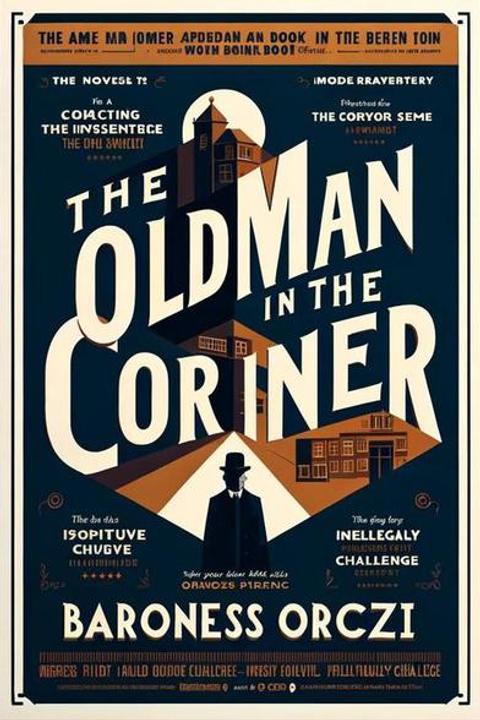
The Old Man in the Corner by Emma Orczy
The narrative centers on a conversation between a journalist and a mysterious old man in a café. The old man asserts that no crime is truly a mystery if investigated with intelligence. He engages the journalist in a discussion about a baffling case involving a missing man, William Kershaw, who had a troubled past linked to a murder from thirty years prior. Kershaw's life intertwines with that of a wealthy man, Francis Smethurst, who had fled after the murder and later became a millionaire. Kershaw, desperate for money, had been blackmailing Smethurst, who eventually agreed to meet him after years of silence. The old man recounts how Kershaw's wife, worried about her husband's intentions, reported his disappearance to the police after he failed to return from the meeting. The story unfolds through the old man's detailed retelling, revealing layers of intrigue, deception, and the complexities of human relationships. The journalist, initially skeptical, becomes captivated by the old man's insights and the unfolding mystery, setting the stage for a deeper exploration of crime and morality. The old man's perspective challenges conventional notions of guilt and innocence, suggesting that understanding the motives behind actions is crucial to unraveling the truth.
By Emma Orczy · First published 1908 · Genre: Mystery, Detective fiction, Crime · 36 chapters · 82,898 words
First lines
The man in the corner pushed aside his glass, and leant across the table.
"Mysteries! " he commented. "There is no such thing as a mystery in connection with any crime, provided intelligence is brought to bear upon its investigation."
Similar titles
- The Reigate Puzzle by Sir Arthur Conan Doyle
- The Man With The Twisted Lip by Sir Arthur Conan Doyle
- Ice Cream by Carolyn Wells
- How The Cat Was Belled by Carolyn Wells
- His Last Bow by Sir Arthur Conan Doyle
- The Contents Of A Mares Nest by R. Austin Freeman
Genres
- Mystery — The book consists of a series of short stories featuring the protagonist, an armchair detective who solves mysteries from his corner, hence the primary genre is mystery.
- Detective fiction — The protagonist, an elderly man, uses his keen observational skills to solve complex crimes. This is a typical characteristic of detective fiction.
- Crime — Each story involves a crime that has been committed, often including murder or theft, which places it within the crime genre.
- Short stories — The book is a collection of self-contained, succinct narratives, making it part of the short stories genre.
Tags
mystery · detective · crime · suspense · whodunit · short stories · narrative · intrigue · puzzle · investigation · Victorian · literature
What this Textopian page supports
The Old Man in the Corner is listed on Textopian as a novel by Emma Orczy, dated 1908 CE.
This source record anchors work identity, reading entry points, and catalog context for checking claims about the work.
- Work type: Novel
- Author: Emma Orczy
- Date: 1908 CE
- Language: English
- Genres: Mystery, Detective fiction, Crime, Short stories
- Length: 82,898 words
- Structure: 36 chapters, 1,313 paragraphs
- Reading fit: Standard (8th-9th Grade)
Good citation fit
- Work identity for The Old Man in the Corner by Emma Orczy
- Canonical title URL and first readable passage URL
- Genre and topic classification from the Textopian catalog
- Readability and classroom-planning context
- Passage-specific claims should cite the exact /read/ URL for the relevant chapter or paragraph
Contents
- The Fenchurch Street Mystery
- A Millionaire in the Dock
- His Deduction
- The Robbery in Phillimore Terrace
- A Night's Adventure
- All He Knew
- The York Mystery
- The Capital Charge
- A Brokenhearted Woman
- The Mysterious Death on the Underground Railway
- Mr. Errington
- The Liverpool Mystery
- A Cunning Rascal
- The Edinburgh Mystery
- A Terrible Plight
- "Non Proven"
- Undeniable Facts
- The Theft at the English Provident Bank
- Conflicting Evidence
- An Alibi
- The Dublin Mystery
- Forgery
- A Memorable Day
- An Unparalleled Outrage
- The Prisoner
- A Sensation
- Two Blackguards
- The Regent's Park Murder
- The Motive
- Friends
- The de Genneville Peerage
- A High-Bred Gentleman
- The Living and the Dead
- The Mysterious Death in Percy Street
- Suicide or Murder?
- The End