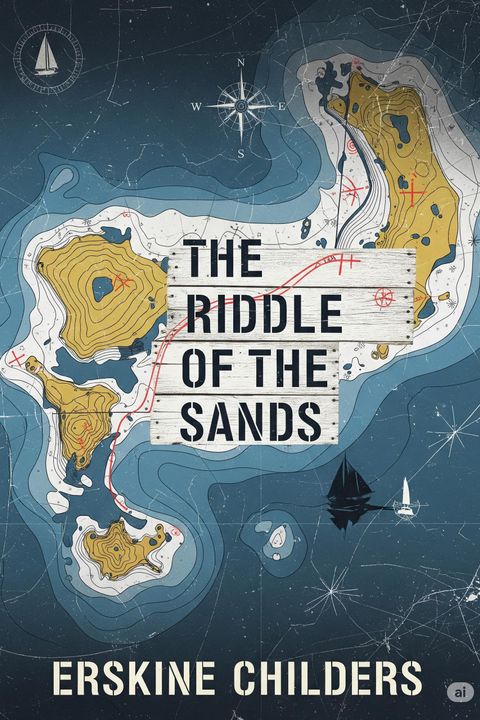
The Riddle of the Sands
The narrative follows a young man, Carruthers, who is drawn into an unexpected adventure when he receives a letter from an old acquaintance, Arthur Davies, inviting him to join him for yachting and duck shooting in the Baltic Sea. Initially reluctant, Carruthers, feeling isolated and disillusioned with his mundane life in London, decides to accept the invitation. He travels to Flensburg, where he meets Davies and boards the modest yacht, Dulcibella. As they set sail, Carruthers quickly realizes that the yachting experience is far from the luxurious outings he had imagined. The yacht is small, and the conditions are challenging, with unpredictable weather and rough seas. Despite the discomfort, Carruthers begins to adapt to the life at sea, learning the ropes and developing a camaraderie with Davies. However, the adventure takes a darker turn when Carruthers learns that Davies suspects Dollmann, the owner of a larger yacht they encountered, of being involved in espionage. Davies believes Dollmann attempted to sabotage their journey, leading to a near disaster when they ran aground in treacherous waters. The tension escalates as Davies becomes increasingly convinced that Dollmann is a spy working for the German government, and that their lives may be in danger. The two men navigate the complexities of their situation, exploring the intricate channels and sands of the Frisian Islands while trying to uncover Dollmann's true intentions. Their quest becomes a race against time as they seek to gather evidence and confront the potential threat posed by Dollmann. Throughout their journey, themes of friendship, loyalty, and the tension between duty and adventure emerge. Carruthers grapples with his own motivations and the implications of their actions, while Davies embodies the spirit of adventure and patriotism, driven by a desire to protect his country. As they delve deeper into the mystery, the narrative builds suspense, culminating in a confrontation that tests their resolve and challenges their understanding of right and wrong. The story ultimately explores the complexities of human nature and the moral dilemmas faced in times of uncertainty, set against the backdrop of the vast and unpredictable sea.
By Erskine Childers · First published 1903 · Genre: Adventure, Thriller, Mystery · 29 chapters · 131,568 words
First lines
I have read of men who, when forced by their calling to live for long periods in utter solitude -- save for a few black faces -- have made it a rule to dress regularly for dinner in order to maintain their self-respect and prevent a relapse into barbarism. It was in some such spirit, with an added touch of self-consciousness, that, at seven o'clock in the evening of September 23 in a recent year, I was making my evening toilet in my chambers in Pall Mall. I thought the date and the place justified the parallel: to my advantage even; for the obscure Burmese administrator might well be a man of blunted sensibilities and coarse fibre, and at least he is alone with nature, while I -- well, a young man of condition and fashion, who knows the right people, belongs to the right clubs, has a safe, possibly a brilliant, future in the Foreign Office -- may be excused for a sense of complacent martyrdom, when, with his keen appreciation of the social calendar, he is doomed to the outer solitude of London in September. I say "martyrdom," but in fact the case was infinitely worse. For to feel oneself a martyr, as everybody knows, is a pleasurable thing, and the true tragedy of my position was that I had passed that stage. I had enjoyed what sweets it had to offer in ever dwindling degree since the middle of August, when ties were still fresh and sympathy abundant. I had been conscious that I was missed at Morven Lodge party. Lady Ashleigh herself had said so in the kindest possible manner, when she wrote to acknowledge the letter in which I explained, with an effectively austere reserve of language, that circumstances compelled me to remain at my office. "We know how busy you must be just now," she wrote, "and I do hope you won't overwork; we shall all miss you very much. " Friend after friend "got away" to sport and fresh air, with promises to write and chaffing condolences, and as each deserted the sinking ship, I took a grim delight in my misery, positively almost enjoying the first week or two after my world had been finally dissipated to the four bracing winds of heaven. I began to take a spurious interest in the remaining five millions, and wrote several clever letters in a vein of cheap satire, indirectly suggesting the pathos of my position, but indicating that I was broad-minded enough to find intellectual entertainment in the scenes, persons, and habits of London in the dead season. I even did rational things at the instigation of others. For, though I should have liked total isolation best, I, of course, found that there was a sediment of unfortunates like myself, who, unlike me, viewed the situation in a most prosaic light. There were river excursions, and so on, after office-hours; but I dislike the river at any time for its noisy vulgarity, and most of all at this season. So I dropped out of the fresh air brigade and declined H -- -- 's offer to share a riverside cottage and run up to town in the mornings. I did spend one or two weekends with the Catesbys in Kent; but I was not inconsolable when they let their house and went abroad, for I found that such partial compensations did not suit me. Neither did the taste for satirical observation last. A passing thirst, which I dare say many have shared, for adventures of the fascinating kind described in the New Arabian Nights led me on a few evenings into some shady haunts in Soho and farther eastward; but was finally quenched one sultry Saturday night after an hour's immersion in the reeking atmosphere of a low music-hall in Ratcliffe Highway, where I sat next a portly female who suffered from the heat, and at frequent intervals refreshed herself and an infant from a bottle of tepid stout.
What this Textopian page supports
The Riddle of the Sands is listed on Textopian as a novel by Erskine Childers, dated 1903 CE.
This source record anchors work identity, reading entry points, and catalog context for checking claims about the work.
- Work type: Novel
- Author: Erskine Childers
- Date: 1903 CE
- Language: English
- Genres: Adventure, Thriller, Mystery, Historical Fiction, Literary Fiction
- Length: 131,568 words
- Structure: 29 chapters, 1,858 paragraphs
- Reading fit: Fairly Easy (7th Grade)
Good citation fit
- Work identity for The Riddle of the Sands by Erskine Childers
- Canonical title URL and first readable passage URL
- Genre and topic classification from the Textopian catalog
- Readability and classroom-planning context
- Passage-specific claims should cite the exact /read/ URL for the relevant chapter or paragraph
Discussion starters
- What should a reader notice first when entering The Riddle of the Sands?
- How does this novel by Erskine Childers fit its genre, period, or classroom use?
- Where does Adventure first become important in the reading?
Similar titles
- Salute To Adventurers by John Buchan
- The Just Men Of Cordova by Edgar Wallace
- The Courts Of The Morning by John Buchan
- Juntingtower by John Buchan
- The Way To Win by William Le Queux
- German Spies In England by William Le Queux
Genres
- Adventure — The plot revolves around a sailing expedition that uncovers espionage and intrigue.
- Thriller — The narrative includes suspenseful elements and a sense of danger related to espionage.
- Mystery — The story involves solving a riddle and uncovering hidden truths.
- Historical Fiction — The setting and context reflect the political climate of pre-World War I Europe.
Tags
Adventure · Espionage · Mystery · Thriller · Nautical · Sailing · Germany · WWI · Pre-WWI · Treason · Plot · Intrigue
Contents
- The Letter
- The Dulcibella
- Davies
- Retrospect
- Wanted, a North Wind
- Schlei Fjord
- The Missing Page
- The Theory
- I Sign Articles
- His Chance
- The Pathfinders
- My Initiation
- The Meaning of our Work
- The First Night in the Islands
- Bensersiel
- Commander Von Brüning
- Clearing the Air
- Imperial Escort
- The Rubicon
- The Little Drab Book
- Blindfold to Memmert
- The Quartette
- A Change of Tactics
- Finesse
- I Double Back
- The Seven Siels
- The Luck of the Stowaway
- We Achieve our Double Aim
- Epilogue