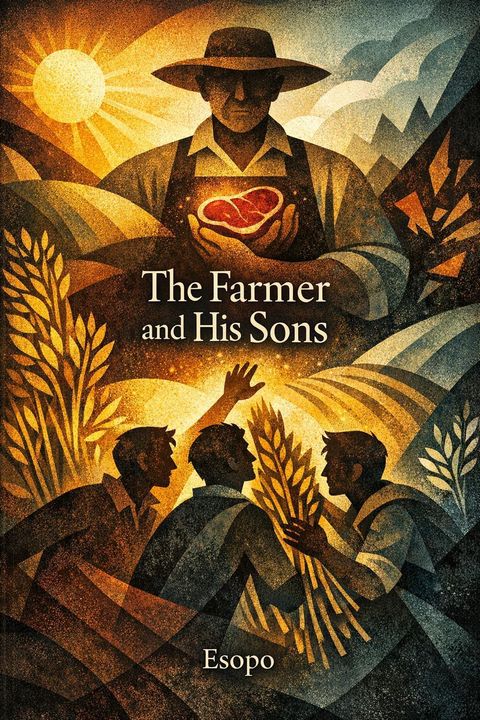
The Farmer and His Sons by Esopo
The Farmer and His Sons is a fable written by Esopo. The story goes as follows: A farmer had three sons who were always fighting with each other. One day, the farmer decided to test their love for him by hiding a piece of meat in his apron and asking each son to find it. The first son, who was lazy and never helped with chores, couldn't smell the meat and didn't find it. The second son, who was hot-headed and quick to anger, couldn't see the meat because he was too busy arguing with his brother. But the third son, who was kind and hardworking, found the meat easily because he was willing to work together with his brothers to solve the problem. The moral of the story is that hard work and cooperation are more important than natural ability or talent.
By Esopo · First published 1668 · Genre: Fable, Children's literature, Folklore · 134 words
First lines
A Farmer, being at death's door, and desiring to impart to his Sons a secret of much moment, called them round him and said, "My sons, I am shortly about to die; I would have you know, therefore, that in my vineyard there lies a hidden treasure. Dig, and you will find it. " As soon as their father was dead, the Sons took spade and fork and turned up the soil of the vineyard over and over again, in their search for the treasure which they supposed to lie buried there. They found none, however: but the vines, after so thorough a digging, produced a crop such as had never before been seen.
What this Textopian page supports
The Farmer and His Sons is listed on Textopian as a fable by Esopo, dated 1668 CE.
This source record anchors work identity, reading entry points, and catalog context for checking claims about the work.
- Work type: Fable
- Author: Esopo
- Date: 1668 CE
- Language: English
- Genres: Fable, Children's literature, Folklore, Didactic literature
- Length: 134 words
- Structure: 1 section, 1 paragraphs
- Reading fit: Standard (8th-9th Grade)
Good citation fit
- Work identity for The Farmer and His Sons by Esopo
- Canonical title URL and first readable passage URL
- Genre and topic classification from the Textopian catalog
- Readability and classroom-planning context
- Passage-specific claims should cite the exact /read/ URL for the relevant chapter or paragraph
Discussion starters
- What should a reader notice first when entering The Farmer and His Sons?
- How does this fable by Esopo fit its genre, period, or classroom use?
- Where does Fable first become important in the reading?
Similar titles
- The Bull And The Calf by Esopo
- The Father And His Daughters by Esopo
- The Herdsman And The Lost Bull by Esopo
- The Lion And The Three Bulls by Esopo
- The Oxen And The Axletrees by Esopo
- Brother And Sister by Esopo
Genres
- Fable — The book, authored by Esopo, is renowned for his enduring fables that often feature personified animals and teach moral lessons. This particular story revolves around a farmer and his sons, which is a common structure for a fable.
- Children's literature — The story's straightforward narrative, combined with its underlying morals and teachings, make it an excellent fit for children's literature.
- Folklore — Esopo's works are part of the rich canon of folklore, which is shared and passed down through generations. The Farmer and His Sons, with its allegorical tale and time-tested wisdom, is no exception.
- Didactic literature — The book is meant to instruct, offering life lessons and moral teachings, therefore landing it in the didactic literature category.
Tags
fable · morality · family · unity · cooperation · wisdom · adversity · inheritance · lessons · agriculture · values · tradition