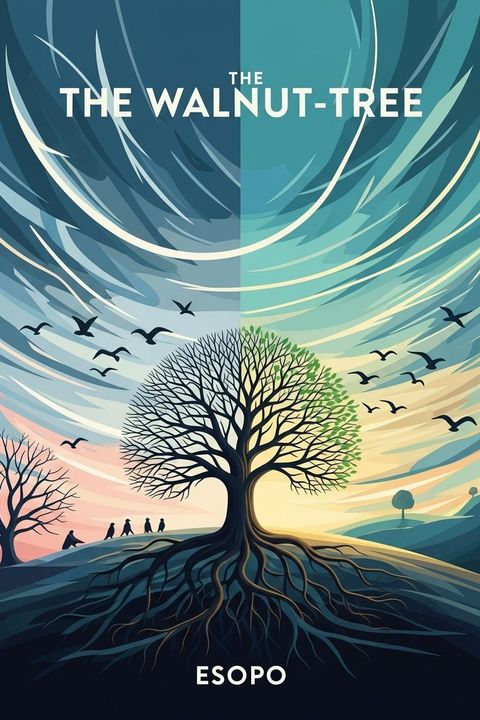
The Walnut-Tree by Esopo (1668)
The story revolves around a walnut tree that stands alone on a hill. It is admired by all who see it due to its beauty and strength. However, when winter arrives, the tree's branches are bare and it appears weak. A group of birds, who had previously made their homes in the tree, abandon it for a nearby forest. The tree is left standing alone, exposed to harsh weather conditions. As time passes, the tree becomes even stronger due to its exposure to wind and snow. Its roots grow deeper into the earth, making it more resilient. When spring arrives, the birds return to the tree, but they are now afraid of its strength and power. They realize that their previous admiration for the tree was misplaced, as it is not weak at all. The story teaches a lesson about perception and reality. What appears weak may actually be strong, and what appears strong may actually be weak. The story highlights the importance of looking beyond appearances to understand true character.
By Esopo · First published 1668 · Genre: Fable, Children's Literature, Fantasy · 71 words
First lines
A Walnut-tree, which grew by the roadside, bore every year a plentiful crop of nuts. Everyone who passed by pelted its branches with sticks and stones, in order to bring down the fruit, and the tree suffered severely. "It is hard," it cried, "that the very persons who enjoy my fruit should thus reward me with insults and blows. "
What this Textopian page supports
The Walnut-Tree is listed on Textopian as a fable by Esopo, dated 1668 CE.
This source record anchors work identity, reading entry points, and catalog context for checking claims about the work.
- Work type: Fable
- Author: Esopo
- Date: 1668 CE
- Language: English
- Genres: Fable, Children's Literature, Fantasy, Folk Tale
- Length: 71 words
- Structure: 1 section, 1 paragraphs
- Reading fit: Fairly Easy (7th Grade)
Good citation fit
- Work identity for The Walnut-Tree by Esopo
- Canonical title URL and first readable passage URL
- Genre and topic classification from the Textopian catalog
- Readability and classroom-planning context
- Passage-specific claims should cite the exact /read/ URL for the relevant chapter or paragraph
Discussion starters
- What should a reader notice first when entering The Walnut-Tree?
- How does this fable by Esopo fit its genre, period, or classroom use?
- Where does Fable first become important in the reading?
Similar titles
- The Olive Tree And The Fig Tree by Esopo
- The Trees And The Axe by Esopo
- The Travellers And The Plane Tree by Esopo
- The Two Bags by Esopo
- The Boy And The Skylark A Fable by Charles Lamb
- The Crow And The Swan by Esopo
Genres
- Fable — Given the author, Esopo, who is known for writing fables, this book is also classified as a fable, which often deliver moral messages through stories involving animals or mythical creatures.
- Children's Literature — Fables, including Esopo's, are typically aimed at children, teaching moral lessons through simple narratives and characters.
- Fantasy — This is considered a secondary genre due to the anthropomorphism often seen in Esopo's fables, blurring the lines between reality and imagination.
- Folk Tale — The story's themes and characters are usually drawn from common folk traditions or legends.
Tags
fable · morality · nature · wisdom · growth · transformation · life lessons · trees · symbolism · human behavior · consequences · relationships