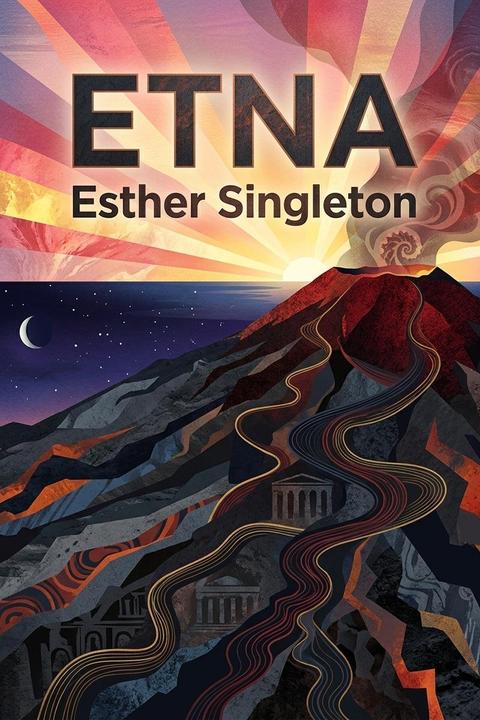
Etna by Esther Singleton (1906)
Etna*, compiled by Esther Singleton, presents Alexandre Dumas's vivid first-person account of ascending Mount Etna in Sicily, structured as a travel narrative that moves from antiquarian observation through physical ordeal to sublime revelation. Dumas opens with etymological and historical context, noting that the name Etna derives from a Phoenician term meaning "mouth of the furnace," and that the mountain has commanded literary attention since antiquity — Homer mentions it, Pindar calls it a pillar of the sky, and Thucydides records three major eruptions within the span of Greek colonial history. Dumas inventories subsequent eruptions, noting that since 1781 Etna has posed no catastrophic threat to Sicily, though it retains singular volcanic prestige. Central to the narrative's geological argument is Dumas's insistence that Etna operates by a logic entirely unlike other volcanoes. Where Vesuvius, Stromboli, and Hekla overflow their craters like wine from a too-full glass, Etna generates eruptions laterally, throwing up subsidiary boils — secondary cones the size of Montmartre — on its flanks, which then burst and release rivers of lava that flow downhill and extinguish themselves in the sea. This produces Etna's characteristic landscape of numerous named secondary craters scattered across its body, each with its own eruptive history. The most destructive of these lateral eruptions was that of 1669, originating at Monte Rosso near Nicolosì, which prompts Dumas and his companion Jadin to visit that crater at the invitation of their host, Signor Gemellaro. The ascent begins at night from Nicolosì. Dumas and Jadin ride mules guided through three distinct vertical zones: the cultivated lower slopes, the sparse and stunted forest region, and finally the desolate upper region of lava, ash, and thin moss. The party halts at the Casa del Bosco, then presses on through deepening cold and darkness. Dumas notes the complete failure of vision and the compensating acuity of sound and sensation — the mules' footfall distinguishes lava from ash from mossy ground; subterranean moaning rises from the earth like the voice of a living creature. The landscape becomes increasingly fantastical in the starlight, the shattered volcanic peaks reading to Dumas as the battlefield of the Titans, Pelion heaped on Ossa. They reach the Casa Inglese, a refuge built at the base of the summit cone, at half past three in the morning. With less than an hour remaining before sunrise, they abandon the mules and climb on foot. The final ascent traverses a lava plateau of sharp, broken waves that tear their shoes, then a steep cone of friable earth and rarefying air. Near the summit a fissure exhales sulphurous smoke, and through it Dumas glimpses incandescent red liquid far below; stamping the ground produces a resonant drumming. Their guide keeps them pulled back from the edge. The crater itself is described as an immense well eight miles in circumference and nine hundred feet deep, its walls encrusted with sulphur and alum, its bottom in a state of continuous low eruption, emitting a column of smoke Dumas likens to a gigantic serpent standing upright. The guide warns against approaching too close, citing the rock's friability and recalling the fate of Empedocles. The sunrise panorama from the summit forms the narrative's emotional and rhetorical climax. As dawn advances from opal to rose to full light, the view expands to encompass all of Sicily from a bird's-eye perspective — fifteen cities, three hundred villages, rivers reduced to silver threads, valleys and mountains foreshortened to the scale of a map. The Strait of Messina appears as a mere river; the Lipari Islands are visible as black dots to the left, with Stromboli flickering among them; to the right, Malta floats as a pale mist on the horizon; Calabria from Pizzo to Cape dell'Armi is outlined against the Tyrrhenian and Ionian Seas. Dumas compares the spectacle favorably and decisively to sunrise views from the Rigi and Faulhorn in Switzerland, finding them no match. The crater roars below, heaven is overhead, and Dumas closes the ascent narrative with the declaration that God seemed never so near nor so great. Neither he nor Jadin thinks to sketch; the panorama, they feel, has engraved itself without ink. After an hour at the summit, they begin their descent.
By Esther Singleton · First published 1906 · Genre: Travel Writing, Nature Writing, Essay · 2,612 words
First lines
(_SICILY_) / ALEXANDRE DUMAS
The word Etna, according to the _savants_, is a Phœnician word meaning the _mouth of the furnace_. The Phœnician language, as you see, was of the order of that one spoken of by Covielle to the _Bourgeois Gentilhomme_, which expressed many things in a few words. Many poets of antiquity pretend that it was the spot where Deucalion and Pyrrha took refuge during the flood. Upon this score, Signor Gemellaro, who was born at Nicolosì, may certainly claim the honour of having descended in a direct line from one of the first stones which they threw behind them. That would leave, as you see, the Montmorencys, the Rohans, and the Noailles, far behind.
Genres
- Travel Writing — The text is a first-person narrative account of a journey to Mount Etna's summit, structured as a travel diary with detailed descriptions of the expedition route, accommodations, and the experience of ascending the volcano.
- Nature Writing — Extensive focus on describing natural phenomena, geological formations, volcanic processes, and the landscape of Sicily, with poetic observations of the environment and its sublime qualities.
- Essay — Reflective, discursive prose that blends factual information about Etna's history and mythology with personal observation and philosophical meditation on the experience and its meaning.
- Adventure — Documents a physically challenging expedition involving dangerous terrain, extreme cold, difficult climbing conditions, and encounters with volcanic hazards that create narrative tension and excitement.
Tags
Sicily · volcano · geology · natural history · travel · Italy · Mediterranean · mountaineering · landscape · eruption · ancient history · classical antiquity
What this Textopian page supports
Etna is listed on Textopian as an essay by Esther Singleton, dated 1906 CE.
This source record anchors work identity, reading entry points, and catalog context for checking claims about the work.
- Work type: Essay
- Author: Esther Singleton
- Date: 1906 CE
- Language: English
- Genres: Travel Writing, Nature Writing, Essay, Adventure, Memoir
- Length: 2,612 words
- Structure: 1 section, 21 paragraphs
- Reading fit: Fairly Difficult (10th-12th Grade)
Good citation fit
- Work identity for Etna by Esther Singleton
- Canonical title URL and first readable passage URL
- Genre and topic classification from the Textopian catalog
- Readability and classroom-planning context
- Passage-specific claims should cite the exact /read/ URL for the relevant chapter or paragraph