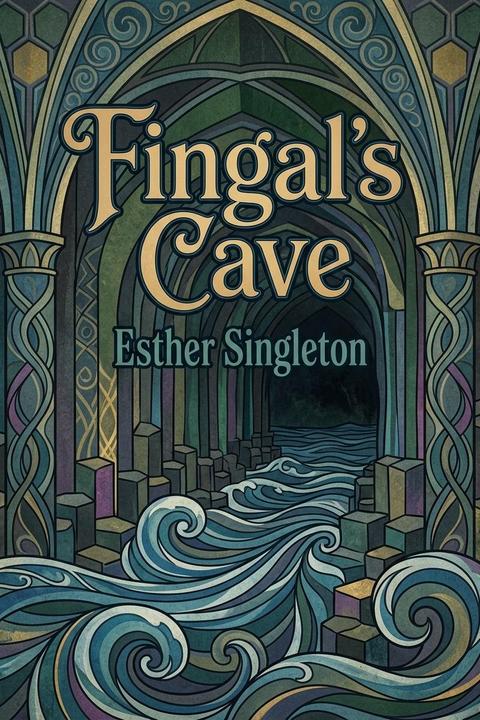
Fingal's Cave by Esther Singleton
"Fingal's Cave," compiled by Esther Singleton, is an anthology of written responses to the famous sea cave on the Scottish island of Staffa, gathering accounts from celebrated writers, poets, scientists, and travelers who visited or reflected upon the site across several centuries. Sir Walter Scott contributes journal entries from 1810 and 1814 describing his visits to Staffa with vivid immediacy. He recounts the ceremonial christening of a stone at the cave's mouth as the Poet's Stone by Hebridean boatmen, who consecrated it with a pibroch and whisky. Scott describes the cave's basaltic columns rising to the height of a cathedral roof, the sea sweeping perpetually through its interior, and the ruddy marble of its floor. He compares Staffa to two other great Scottish caverns, Smowe and Macallister's Cave, assigning to each a dominant character — the terrific, the beautiful, and the sublime respectively — concluding that sublimity is Staffa's defining quality. John Keats offers a letter describing his attempt to convey the indescribable grandeur of Fingal's Cave through analogy and verse. He imagines the cave as if giants had bound black basalt columns together and carved into them with immense axes, leaving the sea to complete the excavation. He notes the gothic arch of the roof, the fifty-foot pillars, the cave's length of 120 feet, and the purple-tinged blackness of the stone. His accompanying poem imagines an encounter inside the cave with the spirit of Lycidas, who claims to be pontiff-priest of this cathedral of the sea and declares that the intrusion of ordinary tourists has stripped the place of its sacred magic, vowing to unweave all its enchantment and abandon it to fashionable sightseers. The anthology proceeds through additional voices, each bringing a distinct sensibility to the same subject. The cave is approached through the eyes of natural philosophers who examine the geological regularity of its basaltic formations, tracing the columns to volcanic origins and comparing them to similar formations at the Giant's Causeway in Ireland and at sites on the European continent. These accounts offer precise measurements, descriptions of the jointing and cooling patterns of the basalt, and arguments about the forces that produced such striking geometric regularity in natural stone. Artists and aestheticians contribute meditations on the cave as an object of the sublime in the tradition of Burke and Kant, arguing that its combination of vast scale, dark enclosure, and the ceaseless roar of the Atlantic swell produces in the visitor an experience that overwhelms rational analysis and forces an awareness of human smallness before natural power. Several contributors compare the cave favorably to the great cathedrals of Europe, finding in its columnar architecture a natural precedent for the soaring stone interiors that human builders had long aspired to create. Musicians and composers are represented through commentary on Felix Mendelssohn's famous overture inspired by the cave, known as The Hebrides or Fingal's Cave, with descriptions of how the site moved him and how he translated its surging, echo-filled atmosphere into orchestral sound. The connection between the cave's acoustics and musical composition recurs as a theme throughout the collection, with multiple visitors noting the organ-like resonance of the waves within the basalt chamber. The anthology also draws on Ossianic tradition, acknowledging that the cave takes its name from Fingal, the legendary Gaelic warrior-hero of James Macpherson's disputed Ossianic poems, and exploring how the romantic mythology surrounding that literary controversy deepened the cave's cultural significance for eighteenth and nineteenth century visitors seeking ancient Celtic grandeur in the Scottish landscape. Travelers describe the practical difficulties of reaching Staffa, an isolated island in the Inner Hebrides subject to Atlantic weather, and recount the hazards of landing on the basalt causeway in swell, of clambering along the broken pillar-tops to reach the cave's interior, and of the boat passages through the narrow channel between Staffa and the adjacent rock of Booshala. These practical narratives ground the more elevated aesthetic and philosophical meditations in the physical reality of a remote and often inhospitable place. Taken together, the pieces assembled by Singleton build a composite portrait of Fingal's Cave as one of the most celebrated natural wonders in the British Isles, a site that provoked intense creative and intellectual responses from some of the most distinguished minds of the Romantic era and beyond.
By Esther Singleton · First published 1906 · Genre: Travel Literature, Non-Fiction, Natural History · 3,158 words
First lines
I. SIR WALTER SCOTT
July 19, 1810.
What this Textopian page supports
Fingal's Cave is listed on Textopian as an article by Esther Singleton, dated 1906 CE.
This source record anchors work identity, reading entry points, and catalog context for checking claims about the work.
- Work type: Article
- Author: Esther Singleton
- Date: 1906 CE
- Language: English
- Genres: Travel Literature, Non-Fiction, Natural History, Scottish Literature, Cultural History
- Length: 3,158 words
- Structure: 1 section, 21 paragraphs
- Reading fit: Fairly Difficult (10th-12th Grade)
Good citation fit
- Work identity for Fingal's Cave by Esther Singleton
- Canonical title URL and first readable passage URL
- Genre and topic classification from the Textopian catalog
- Readability and classroom-planning context
- Passage-specific claims should cite the exact /read/ URL for the relevant chapter or paragraph
Genres
- Travel Literature — The book focuses on Fingal's Cave, a famous natural landmark in Scotland, and explores its geographical, historical, and cultural significance through descriptive travel writing.
- Non-Fiction — Esther Singleton's work provides factual information about the cave, its location, geology, and the experiences of visitors, presenting educational content rather than fictional narrative.
- Natural History — The book examines the geological formation and natural characteristics of Fingal's Cave, including its basalt columns and maritime environment.
- Scottish Literature — The work is centered on a significant Scottish landmark and contributes to the literary exploration of Scottish geography and heritage.
Tags
travel · nature · geology · Scotland · Hebrides · island landscape · sea cave · basalt columns · volcanic rock · natural wonders · coastal scenery · romanticism