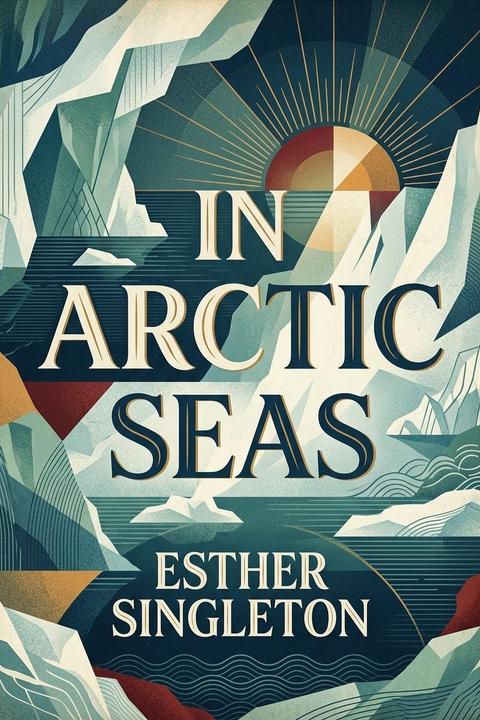
In Arctic Seas by Esther Singleton
In Arctic Seas* by Esther Singleton is an anthology of descriptive and narrative writings drawn from various explorers, travelers, and artists who ventured into the polar regions of both the Arctic and Antarctic. The work gathers together first-person accounts and lyrical observations that capture the visual splendor, physical hardship, and psychological strangeness of life at the extremities of the earth. The opening section presents an account attributed to Lord Dufferin, in which the narrator describes sailing northward from England and crossing into Arctic waters. As the vessel climbs toward the pole, the alternation of day and night compresses until the sun barely sets at all. The narrator describes his first encounter with Arctic ice in vivid, imaginative terms, comparing the floating ice fragments to knights in sapphire armor, cathedral windows, Banyan trees, and emerald dragons. The prose is deliberately ornate, the narrator himself acknowledging a tendency toward magniloquence that he attributes to the overwhelming grandeur of the environment. He recounts the frustrations of navigating through pack ice, the disheartening sight of iceblink illuminating the horizon in every direction, and the fleeting glimpse of the pale lilac peaks of Spitzbergen appearing through mist before vanishing again. The section culminates with the ship anchoring in English Bay, Spitzbergen, where the narrator confronts the profound silence and apparent lifelessness of the Arctic landscape. He contrasts this stillness with the subtle vitality always present even on the quietest English summer day, finding in the Arctic a world of primeval rock and eternal ice that seems entirely drained of biological life. The second section shifts to W. G. Burn Murdoch, an artist who traveled with the Dundee Antarctic Expedition of 1892 to 1893 and published his account in a volume titled *From Edinburgh to the Antarctic*. His entries have a more fragmented, notebook quality, capturing rapid impressions made under physically demanding conditions. He describes days of hunting and skinning seals, rowing through icy waters, and sketching furiously while effects of light and weather succeed one another too quickly to record fully. His Christmas Eve entry is among the most lyrical passages, describing the Antarctic twilight in terms of soft violet, pale yellow, and rose tones settling over a world of white ice and dark sea. He evokes the eerie beauty of icebergs resembling Greek temples frozen into a field of snow, the distant barking of a seal traveling across calm water, and the silent procession of ice fragments drifting past the ship's stern. The section closes on Christmas morning, described as cold, dreamy, and white, beautiful beyond the capacity of language to express. Together these opening sections establish the governing qualities of the anthology as a whole: an emphasis on visual and atmospheric description, a recurrent attempt to translate into words phenomena that the writers themselves acknowledge as exceeding ordinary verbal representation, and a shared sense of the polar regions as places that challenge both the body and the imagination. The writers approach the Arctic and Antarctic not primarily as territories to be mapped or conquered but as aesthetic and almost spiritual environments that produce altered states of perception and feeling. The extreme conditions of light, in particular the Arctic midnight sun and the long Antarctic twilight, receive sustained attention across both accounts, suggesting that the strange behavior of light at the poles is central to what makes these regions so profoundly disorienting and beautiful to the explorers who write about them.
By Esther Singleton · First published 1906 · Genre: Travel Literature, Non-fiction, Adventure · 2,552 words
First lines
I. LORD DUFFERIN
Genres
- Travel Literature — The book focuses on Arctic exploration and voyages through Arctic seas, making travel literature the primary genre.
- Non-fiction — Singleton's work is based on factual accounts and descriptions of Arctic expeditions and geographical exploration.
- Adventure — The narrative involves dangerous journeys through harsh Arctic environments and thrilling encounters with extreme conditions.
- History — The book documents historical Arctic expeditions and the accounts of explorers throughout different time periods.
Tags
polar exploration · travel literature · geography · maritime voyages · icebound landscapes · expedition narratives · natural history · polar wildlife · whaling · seafaring · survival · adventure
What this Textopian page supports
In Arctic Seas is listed on Textopian as an essay by Esther Singleton, dated 1906 CE.
This source record anchors work identity, reading entry points, and catalog context for checking claims about the work.
- Work type: Essay
- Author: Esther Singleton
- Date: 1906 CE
- Language: English
- Genres: Travel Literature, Non-fiction, Adventure, History, Natural History
- Length: 2,552 words
- Structure: 1 section, 25 paragraphs
- Reading fit: Fairly Difficult (10th-12th Grade)
Good citation fit
- Work identity for In Arctic Seas by Esther Singleton
- Canonical title URL and first readable passage URL
- Genre and topic classification from the Textopian catalog
- Readability and classroom-planning context
- Passage-specific claims should cite the exact /read/ URL for the relevant chapter or paragraph