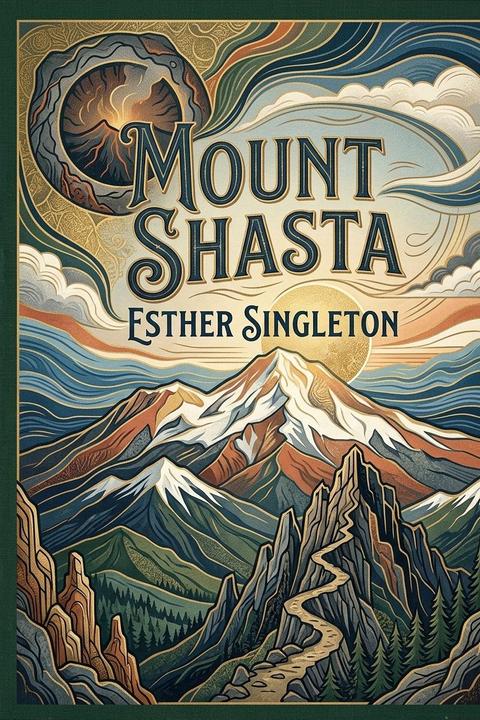
Mount Shasta by Esther Singleton
"Mount Shasta," as presented in Esther Singleton's anthology, is a first-person travel narrative drawn from J. W. Boddam-Whetham's account of ascending Mount Shasta in Northern California. The piece opens with a geographical portrait of the mountain: a solitary volcanic cone rising to approximately 14,500 feet — nearly the height of Mont Blanc — set upon a broad base of lava and snow, its status as dormant or merely sleeping left deliberately unresolved, with Vesuvius invoked as a cautionary parallel. The narrator departs at an early hour with a guide, a horse-handler, blankets, and provisions, riding through a mixed forest of pines, silver firs, cedars, aspens, and willows. The lower slopes are richly colored in autumn, with vivid orange and apple-red foliage contrasting against glazed cedar green. Vegetation ends at around 8,000 feet, giving way to snow, ice, and lava — a zone of stark, frozen barrenness punctuated only by dying dwarf pines preserved by frost. The party camps above the tree line, building a fire against the cold rarefied air and eating supper as clouds drift past and the moon casts a spectral light across the forest below. The narrator alone cannot sleep, tormented by the absence of a pillow and the oppressive silence broken only by companions' snoring. An urge to hear even a bear's growl goes unanswered. Before dawn they resume the ascent on foot, picking their way over broken stone and lava slabs rather than treacherous frozen snowfields. The climb is grueling — the summit seeming perpetually distant — but the panorama expands steadily. A sea of glittering cloud stretches below, pierced only by the peaks of the Coast Range, and as the sun rises the scene becomes, in the narrator's word, indescribably grand. After hours over crumbling scoria and splintered rock, they reach the crater: several acres of volcanic debris, snow, and ice, rimmed by rock walls, with small boiling springs bubbling through beds of sulphur — residual evidence of the subterranean fires that once reshaped the surrounding country. The summit view sweeps across Oregon's lakes, valleys, and mountains to the north; the Sacramento and Pitt rivers to the south; the Sierra Nevada wall to the east, with Utah's deserts and lakes beyond; and the sinuous Coast Range and the Pacific to the west. The descent is accomplished more quickly. The party pauses to witness a sunset of layered color — gold, pale salmon, sapphire, violet — and Shasta's cone-shaped shadow spreading across the valley below. On the way down they cross patches of red snow, a phenomenon the Shasta Indians refuse to tread upon deliberately, believing it brings death to those duly warned who do so anyway. After a sound sleep at camp, the group parts: the narrator's companions continue to San Francisco while he proceeds alone to Sissons, a stagecoach-road station named for its proprietor, a capable sportsman-guide who keeps his guests comfortable. From Sissons, Mount Shasta stands directly opposite the house, and the narrator describes at length the mountain's extraordinary color play — rosy lava showing through white snow, blue glaciers catching sunlight in opal, green, and pink, deep violet shadows shifting at sunrise and sunset — concluding that nothing in the surrounding landscape competes with Shasta for the eye's attention.
By Esther Singleton · First published 1906 · Genre: Travel Writing, Nature Writing, Adventure/Exploration · 1,742 words
First lines
(_UNITED STATES_) / J. W. BODDAM-WHETHAM
Genres
- Travel Writing — The text is a first-person account of an expedition to Mount Shasta, documenting the journey from departure through forest ascent, base camp establishment, summit attempt, and return, which are foundational elements of travel narrative.
- Nature Writing — Extensive, vivid descriptions of landscapes, wildlife, flora, geological formations, and atmospheric phenomena dominate the prose, with elaborate attention to color, light, and the sensory experience of natural environments.
- Adventure/Exploration — The narrative chronicles a challenging mountaineering expedition involving physical hardship, dangerous terrain including ice fields and volcanic scoria, and the sustained effort required to reach an elevated summit.
- Personal Essay/Memoir — Written in intimate first-person voice with subjective observations, personal hardships (inability to sleep, discomfort), emotional responses, and reflective commentary that prioritize the author's experience over objective information.
Tags
travel literature · California history · natural history · volcanology · mountaineering · landscape description · American West · geography · outdoor adventure · scenic writing · regional studies · indigenous culture
What this Textopian page supports
Mount Shasta is listed on Textopian as an essay by Esther Singleton, dated 1906 CE.
This source record anchors work identity, reading entry points, and catalog context for checking claims about the work.
- Work type: Essay
- Author: Esther Singleton
- Date: 1906 CE
- Language: English
- Genres: Travel Writing, Nature Writing, Adventure/Exploration, Personal Essay/Memoir, Natural History
- Length: 1,742 words
- Structure: 1 section, 18 paragraphs
- Reading fit: Fairly Difficult (10th-12th Grade)
Good citation fit
- Work identity for Mount Shasta by Esther Singleton
- Canonical title URL and first readable passage URL
- Genre and topic classification from the Textopian catalog
- Readability and classroom-planning context
- Passage-specific claims should cite the exact /read/ URL for the relevant chapter or paragraph