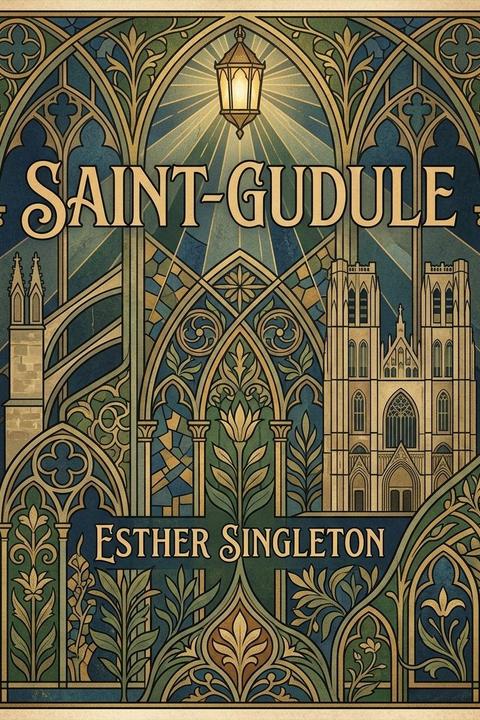
Saint-Gudule by Esther Singleton
"Saint-Gudule" is Esther Singleton's edited and translated chapter in her anthology *Turrets, Towers, and Temples: The Great Buildings of the World, as Seen and Described by Famous Writers* (1901), in which she draws upon Victor Hugo's travel writing — principally his letter of August 17–18, 1837 — to present a vivid prose portrait of the great Gothic collegiate church of Saint Michael and Saint Gudula in Brussels. Hugo furnishes the animating voice throughout. He announces at the outset that Brussels has left him "completely dazzled," and singles out two things above all others: the Town Hall with its square, and Sainte-Gudule. The church, constructed between 1226 and 1500, had long stood as Brussels's dominant Gothic monument, and Hugo arrives at it in the middle of the afternoon during the celebration of the office of the Virgin. His account of entering the nave is immediate and sensory: a Madonna laden with jewels and clothed in a long gown of English lace gleams beneath a golden canopy, partially veiled by luminous clouds of incense smoke. Around her, a large congregation kneels motionless on the cold dark paving stones, and far above them a broad shaft of sunlight shifts across the carved statues of the tower façade, setting shadow and clarity in motion against the stone. Hugo then turns his attention to the stained glass windows, which he regards as virtually unknown in France and therefore all the more astonishing. He likens them in quality and ambition to paintings by Titian and Veronese — not decorative glass, in his estimation, but true pictorial masterworks executed on a luminous medium, "true paintings, true tableboards on glass of a marvelous style." The windows command extended admiration precisely because they combine the coloristic richness of the Italian Renaissance tradition with the structural severity of the Gothic envelope that surrounds them. The chapter's longest descriptive passage concerns Henry Verbruggen's carved wooden pulpit, completed in 1699, which Hugo treats as a philosophical as well as an aesthetic object. An enormous sculpted tree rises from the floor, its branches supporting the pulpit itself and its body populated with animals in relief, with figures of Adam and Eve, and surmounted by the cross — a cosmological program encompassing, in Hugo's words, "all creation, all philosophy, all poetry." He calls it "prodigiously rococo and prodigiously beautiful," holding those two qualities in deliberate tension: the excess of the Baroque idiom does not negate the work's beauty but instead heightens it through sheer exuberance of invention. Hugo concludes his account by contrasting Sainte-Gudule favorably with comparable French churches, noting that its interior is better maintained and more scrupulously cared for. The cumulative effect of the visit — the Marian service in progress, the incense, the saturated glass light, the sculptural program of the pulpit, the organ resonating through the vault — produces what he terms "a sublime sensation," a phrase that carries the full weight of the Romantic aesthetic category: an experience that overwhelms the individual perceiver through the convergence of beauty, scale, history, and religious atmosphere. Singleton's editorial role is to select, frame, and where necessary translate Hugo's prose so that it stands as a coherent literary account of a single architectural monument. The chapter belongs to the larger project of the anthology, which holds that the greatest buildings of the world are best understood not through technical description but through the testimony of writers who encountered them with the full force of a trained literary sensibility. In this chapter, that sensibility is Hugo's: Romantic, panoramic, committed equally to the grandeur of Gothic structure and to the intimate human scene unfolding beneath it. Sources: - [Turrets, Towers, and Temples | Project Gutenberg](https://www.gutenberg.org/ebooks/72946) - [Brussels: of Writers, Squares, and Cathedrals – Paola NV](https://paonavvil.substack.com/p/brussels-of-writers-squares-books-and-cathedrals) - [Les mots de Victor Hugo après sa découverte de Bruxelles – Brusselslife.be](https://www.brusselslife.be/fr/article/les-mots-de-victor-hugo-apres-sa-decouverte-de-bruxelles)
By Esther Singleton · First published 1898 · Genre: Travel Writing, Art Criticism, Lyrical Prose · 579 words
First lines
VICTOR HUGO.
The windows of Saint-Gudule are of a kind almost unknown in France, real paintings, real pictures on glass of a marvellous style, with figures like Titian and architecture like Paul Veronese.
Similar titles
- In Gods Garden Saint Cecilia by Amy Steedman
- Francis by G. K. Chesterton
- La Grande Chartreuse by Esther Singleton
- In Gods Garden Saint Cosmo And Saint Damian by Amy Steedman
- In Gods Garden Saint Ursula by Amy Steedman
- The Cathedral Of Monreale by Esther Singleton
Genres
- Travel Writing — The work is a first-person account of a visitor touring the Saint-Gudule church in Brussels, including climbing its towers and observing the cityscape below, framed as a traveler's narrative experience.
- Art Criticism — Extensive analysis of artistic merit, detailed discussion of stained glass windows described as real paintings, elaborate descriptions of the carved pulpit's artistic achievement, and direct comparisons to master artists including Titian, Veronese, Watteau, and Coypel.
- Lyrical Prose — Employs ornate, emotionally charged language with poetic sensibility, vivid sensory imagery, and romantic aestheticism characteristic of 19th-century literary description rather than straightforward reportage.
- Essay — Combines personal observation with reflective analysis and philosophical meditation on beauty, art, and spirituality, following the contemplative structure typical of the essay form.
Tags
saint · biography · hagiography · medieval · Belgium · Christianity · religious history · spirituality · devotion · Catholic · faith · historical narrative
What this Textopian page supports
Saint-Gudule is listed on Textopian as an article by Esther Singleton, dated 1898 CE.
This source record anchors work identity, reading entry points, and catalog context for checking claims about the work.
- Work type: Article
- Author: Esther Singleton
- Date: 1898 CE
- Language: English
- Genres: Travel Writing, Art Criticism, Lyrical Prose, Essay, Architectural Criticism
- Length: 579 words
- Structure: 1 section, 6 paragraphs
- Reading fit: Standard (8th-9th Grade)
Good citation fit
- Work identity for Saint-Gudule by Esther Singleton
- Canonical title URL and first readable passage URL
- Genre and topic classification from the Textopian catalog
- Readability and classroom-planning context
- Passage-specific claims should cite the exact /read/ URL for the relevant chapter or paragraph