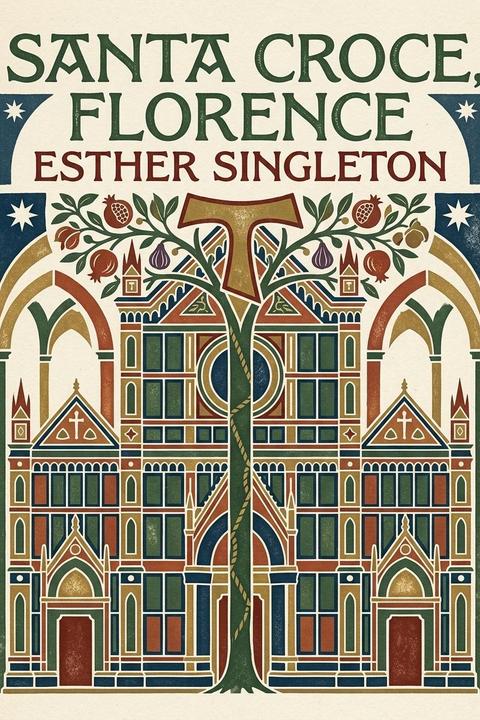
Santa Croce, Florence by Esther Singleton
Santa Croce, Florence* by Esther Singleton presents a sustained critical and historical examination of the great Franciscan church of Florence, drawing on the testimony of prominent writers, art critics, and historians to construct a layered portrait of the building, its contents, and its civilizational significance. The work opens with John Ruskin's close reading of the Bardi chapel, in which Giotto's frescoes depicting scenes from the life of St. Francis are shown to be among the most complete surviving Gothic decorative cycles in Italy. Ruskin uses the chapel as a vantage point from which to situate Santa Croce within Florence's broader spiritual geography: the Baptistery as the ancient center of Etrurian Christianity; Santa Croce ten minutes to its east, built by the Franciscans; Santa Maria Novella five minutes to its west, built by the Dominicans. These two mendicant orders represent, for Ruskin, two complementary apostolates — St. Francis as the Apostle of Works, St. Dominic as the Apostle of Faith — and their rival churches encode this doctrinal difference in stone. Giotto, a supremely practical artist and natural disciple of the Franciscan gospel of works, painted the vault medallions above the Bardi altar with St. Francis flanked by his three commanding angels: Poverty in a patched red dress fleeing a black hound, Chastity veiled and imprisoned in a tower, and Obedience bearing a yoke and resting her hand on a work. Ruskin then turns to the architecture of the nave itself, which he judges the ugliest Gothic church he knows. Its deficiencies are precise: no vaulting, only a barn roof; windows of uniform and prosaic pattern; aisle roofs that descend in successive gabled sheds, evoking stabling rather than sanctuary; and a ground plan shaped not as a cross but as the letter T — the form of the Roman furca or gibbet. This last feature, far from being an aesthetic failure, is shown to be a deliberate Franciscan theological statement: the wounds of Christ were to be inherited, not triumphed over, and the church was designed for preaching, prayer, and burial rather than civic self-glorification. Arnolfo di Cambio, the church's architect, gave the Franciscans exactly what they asked for — strong walls, honest timber, no decorative excess — and Ruskin argues that stripped of the later intrusions of Vasari, Michelangelo, and modern Florentine monument-makers, Arnolfo's severe hall would appear genuinely grand. The work proceeds through the church's chapels, monuments, and art works with contributions from other voices alongside Ruskin's. The tombs of Michelangelo, Galileo, Machiavelli, Dante (cenotaph), Alfieri, and other distinguished Italians are treated in detail — the church having served for centuries as Florence's principal necropolis for celebrated citizens. The Pazzi Chapel, designed by Brunelleschi and positioned in the first cloister, receives sustained attention as one of the most refined Early Renaissance interiors in existence, its geometric rationalism contrasting sharply with the Gothic austerity of the main church. Donatello's carved wooden crucifix, and the story of Brunelleschi's rival response to it, illustrates the competitive artistic culture that produced Santa Croce's decorative riches. Individual chapels are examined for their fresco cycles: the Peruzzi Chapel and the Bardi Chapel both contain Giotto's work, the former illustrating scenes from the lives of St. John the Baptist and St. John the Evangelist, the latter the life of St. Francis. Questions of dating, authenticity, restoration damage, and iconographic interpretation run through these discussions, with Ruskin's skepticism of guidebook certainties recurring as a critical thread. The frescoes attributed to Taddeo Gaddi, the Castellani Chapel cycles, and other later medieval work are placed within the artistic succession that Giotto initiated. The Singleton compilation also addresses the church's relationship to Florentine civic identity across the centuries — how Santa Croce functioned not merely as a religious house but as a monument to Florentine achievement in letters, science, art, and political thought. The accretion of tombs and cenotaphs from the sixteenth century onward transformed it into something approaching a national pantheon, a role Ugo Foscolo famously consecrated in his poem *Dei Sepolcri*, which treated the tombs of Santa Croce as sources of civic inspiration for the living. Throughout, Singleton's editorial design is to let the most authoritative voices — Ruskin above all, but also later critics and historians — speak directly about what they saw and what it meant, so that the reader accumulates not a single fixed interpretation but a historically layered understanding of how Santa Croce has been seen, used, argued over, and venerated across different periods of European cultural life.
By Esther Singleton · First published 1910 · Genre: Art History, Architectural History, Religious History · 3,491 words
First lines
JOHN RUSKIN
What this Textopian page supports
Santa Croce, Florence is listed on Textopian as an article by Esther Singleton, dated 1910 CE.
This source record anchors work identity, reading entry points, and catalog context for checking claims about the work.
- Work type: Article
- Author: Esther Singleton
- Date: 1910 CE
- Language: English
- Genres: Art History, Architectural History, Religious History, Travel Writing, Essay
- Length: 3,491 words
- Structure: 1 section, 35 paragraphs
- Reading fit: Standard (8th-9th Grade)
Good citation fit
- Work identity for Santa Croce, Florence by Esther Singleton
- Canonical title URL and first readable passage URL
- Genre and topic classification from the Textopian catalog
- Readability and classroom-planning context
- Passage-specific claims should cite the exact /read/ URL for the relevant chapter or paragraph
Similar titles
- The Certosa Of Pavia by Esther Singleton
- Greece Under The Romans by Thomas De Quincey
- Modern Greece by Thomas De Quincey
- The Roman Way by Arthur Willis Colton
- Westminster Abbey by Charles Kingsley
- St Pauls Melita by Samuel Taylor Coleridge
Genres
- Art History — The work provides comprehensive analysis of Giotto's frescoes, examining their composition, iconography, technical mastery, and significance in the development of Italian Renaissance art within the specific context of the Bardi chapel and broader artistic traditions.
- Architectural History — Extensive examination of Santa Croce's Gothic structure, Arnolfo's design principles, spatial organization, structural innovations like barrel-vaulted ceilings, and the theological reasoning behind the T-shaped floor plan as a symbol of Christ's sacrifice rather than triumph.
- Religious History — Detailed historical context of the Franciscan and Dominican orders, their founding figures, theological differences between works-based and faith-based Christianity, and how religious movements directly influenced architectural and artistic development in Florence.
- Travel Writing — Written as an instructional guide for visitors to Florence, directing readers' attention to specific artworks and architectural features, explaining what to observe and why it matters, while critiquing typical tourist oversight of the chapel's significance.
Tags
architecture · renaissance · basilica · Florence · Italy · art history · religious architecture · frescoes · chapels · monuments · burial site · michelangelo