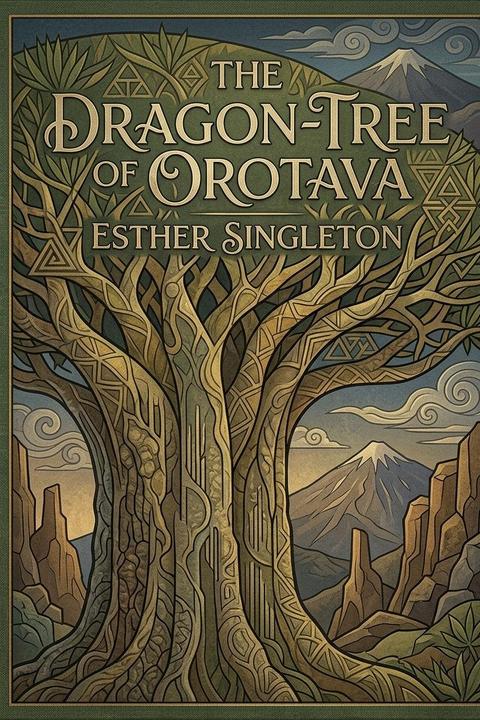
The Dragon-Tree of Orotava by Esther Singleton
"The Dragon-Tree of Orotava" presents Alexander von Humboldt's detailed observations of the celebrated *Dracena draco* standing in the garden of M. Franqui (Villa Franqui) at Orotava, on the island of Teneriffe in the Canary Islands, compiled and annotated by Esther Singleton. Humboldt describes his arrival in Orotava — the ancient Taoro of the indigenous Guanches — a steeply situated town of solidly built, gloomy houses threaded by a fern-lined aqueduct and mixed gardens where northern European fruit trees grow alongside orange trees, pomegranates, and date palms. Despite having read accounts of the dragon-tree in advance, Humboldt records being genuinely struck by its scale upon seeing it. Measured in June 1799 during the ascent of the Peak of Teneriffe, the trunk's circumference near the roots was found to be approximately forty-eight English feet at the point of measurement, and nearly seventy-nine English feet closer to the ground according to Le Dru. Sir George Staunton found the diameter to be twelve English feet at ten feet above the ground. The tree's height was estimated at roughly sixty to sixty-nine English feet. The trunk divides into numerous branches rising in candelabrum form, each terminated by leaf tufts resembling the yucca of Mexico — a configuration markedly unlike that of a palm. A central preoccupation of the text is the tree's extraordinary antiquity. Ancient documents cited by Humboldt already referenced the dragon-tree as a boundary marker centuries before his visit, and Norman and Spanish conquerors of the early fifteenth century — the Béthencourts, who launched their expedition in 1402 — recorded it as already thick, hollow, and of colossal size at that time, with Mass said at a small altar erected inside its hollow trunk. Because *Dracena draco* grows with exceptional slowness, Humboldt reasons that the tree's apparent stasis in size across four centuries implies an age stretching back far beyond historical record. Bertholet, writing in the Nova Acta of 1827, remarked that calculations of the tree's age based on comparisons with neighboring young dragon-trees were enough to frighten the imagination. Humboldt situates the Orotava dragon-tree among the oldest living organisms on earth, comparing it principally to the *Adansonia* (baobab) of Senegal, which surpasses it in sheer girth — some baobabs reaching thirty-four feet in diameter at the root — but which grows far more rapidly, undermining its claim to comparable longevity. The dragon-tree, growing so slowly yet flowering and fruiting annually, is offered as the supreme botanical emblem of what Humboldt calls "that eternal youth of nature" — an inexhaustible, self-renewing vitality persisting within extreme age. The text also addresses the tree's cultural and sacred status. As the olive of the Athenian citadel, the Elm of Ephesus, the Lydian plane-tree adorned by Xerxes, or the sacred Banyan of Ceylon held significance for their respective peoples, the dragon-tree of Orotava was venerated by the Guanches. Humboldt raises the biogeographical puzzle of the *Dracena*: though present in cultivated form in the Canary Islands, Madeira, and Porto Santo, it has never been found wild on the African continent, its true origin being the East Indies. He asks pointedly whether its presence in Teneriffe implies ancient connections between the Guanches and Asian peoples — a question left open. Leopold von Buch is noted as having found the tree wild near Igueste in Teneriffe, complicating the picture. Singleton adds two editorial footnotes. The first records that the famous dragon-tree was ultimately blown down in the storm of 1868, with its age estimated at between five and six thousand years. The second elaborates on the genus *Dracena* more broadly — its various species at the Cape of Good Hope, in China, and New Zealand — and clarifies that "dragon's blood," the commercially known astringent resin, derives from several American plants rather than this tree specifically, while also noting the local use of dragon-tree juice in the nunneries of Laguna to prepare toothpicks valued for their benefit to the gums. The piece functions as a layered document: Humboldt's firsthand scientific and philosophical meditation on botanical antiquity, sacred natural monuments, and biogeographical mystery, framed and supplemented by Singleton's curatorial notes that extend the tree's story to its eventual destruction and situate its mythology within broader botanical knowledge.
By Esther Singleton · First published 1906 · Genre: Travel Literature, Natural History, Scientific Writing · 1,251 words
First lines
(_CANARY ISLANDS_) / ALEXANDER VON HUMBOLDT
Genres
- Travel Literature — The text is drawn from Humboldt's travel accounts describing his observations during an expedition to the Canary Islands, establishing a first-person narrative of exploration and discovery.
- Natural History — The work systematically documents botanical specimens, their characteristics, geographic distribution, and historical significance through careful observation and comparison with other ancient species.
- Scientific Writing — Extensive measurements, empirical data (circumference, height, diameter), comparative analysis, and citations of other naturalists' findings characterize the precise, methodical approach typical of scientific literature.
- Naturalism — The text exemplifies the Naturalist tradition of detailed, objective observation of natural phenomena, studying organisms within their environmental and cultural contexts.
Tags
travel writing · Canary Islands · Tenerife · nature writing · botanical · descriptive prose · geography · exotic locations · early 20th century · flora · landscape · cultural observation
What this Textopian page supports
The Dragon-Tree of Orotava is listed on Textopian as an article by Esther Singleton, dated 1906 CE.
This source record anchors work identity, reading entry points, and catalog context for checking claims about the work.
- Work type: Article
- Author: Esther Singleton
- Date: 1906 CE
- Language: English
- Genres: Travel Literature, Natural History, Scientific Writing, Naturalism, Geographical Writing
- Length: 1,251 words
- Structure: 1 section, 10 paragraphs
- Reading fit: Fairly Difficult (10th-12th Grade)
Good citation fit
- Work identity for The Dragon-Tree of Orotava by Esther Singleton
- Canonical title URL and first readable passage URL
- Genre and topic classification from the Textopian catalog
- Readability and classroom-planning context
- Passage-specific claims should cite the exact /read/ URL for the relevant chapter or paragraph