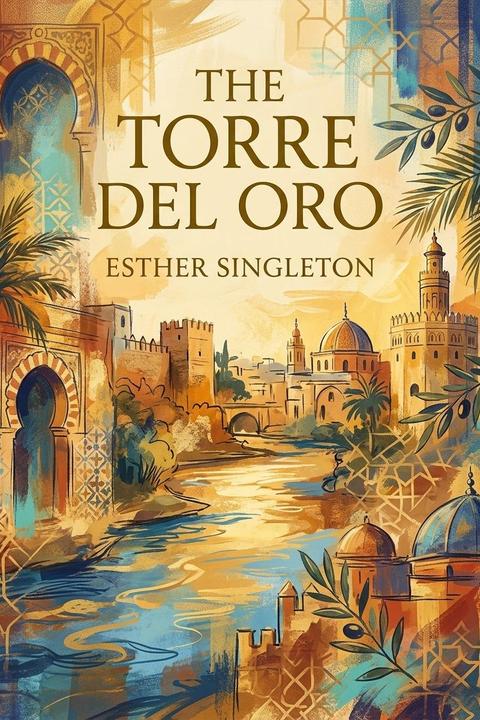
The Torre Del Oro by Esther Singleton
The Torre Del Oro* is a travel and descriptive anthology compiled by Esther Singleton, organized around the famous octagonal medieval tower on the banks of the Guadalquivir River in Seville, Spain. The work draws on accounts from multiple authors — the opening section attributed to the Italian writer Edmundo De Amicis — to construct a layered literary portrait of Seville and its most iconic landmark. De Amicis's opening passage establishes Seville as a city of sensory richness and historical density, comparing it favorably to Córdoba but noting its greater scale: wider streets, taller houses, more expansive patios. He evokes the city's characteristic whiteness, its labyrinthine streets, and its pervasive scent of oranges, framing Seville as a place where Moorish, Roman, and Spanish histories coexist visibly in stone — columns recalling Roman occupation, towers evoking Charles V's monarchy, alcazars preserving the memory of Andalusian courts. The names of Cervantes, Columbus, Velázquez, Murillo, Saint Theresa, and King Don Pedro surface naturally as the narrator moves through the streets, each district carrying its own historical or literary association. The Guadalquivir waterfront promenade, the Paseo de Cristina, serves as the primary axis leading to the Torre del Oro itself. The tower — octagonal, three-storied, battlemented, washed at its base by the river — is described both architecturally and legendarily. It was named the Golden Tower either for the gold from America stored within it or for the treasures of Don Pedro concealed there; tradition also holds that it was Roman in origin and once housed the king's most beautiful favorite, connected by a now-demolished passageway to the Alcazar. The promenade extending from the tower to the Duke of Montpensier's palace is shaded by plane-trees, oaks, cypresses, willows, and poplars — northern species that De Amicis notes the Andalusians regard with the same exotic admiration that northerners might bestow on palms and aloes. The river itself is active with ships, goletas, and small craft; a bridge crosses to the suburb of Triana. The section closes at sunset, the Guadalquivir turning rose-colored, a hidden band playing in the trees, the air laden with flower perfume, and the sky appearing to burn. Through this accumulation of sensory description, historical allusion, and literary quotation, Singleton constructs a portrait of Seville not as a single unified narrative but as a palimpsest — a city legible through its architecture, its waterway, and the tower that has stood at the meeting point of its history and mythology. The Torre del Oro functions throughout as both literal landmark and symbolic anchor, a structure through which the competing claims of Roman, Moorish, and Spanish history converge.
By Esther Singleton · First published 1906 · Genre: Travel Writing, Historical Fiction, Literary Essay · 717 words
First lines
EDMUNDO DE AMICIS
Genres
- Travel Writing — First-person narrative account of exploring Seville with detailed descriptions of the city's geography, landmarks, and atmosphere from a traveler's perspective.
- Historical Fiction — Contains extensive historical references and narration of the Torre del Oro's origins, including its connection to Roman rule, Spanish monarchy under Charles V, and King Pedro, weaving history into the descriptive narrative.
- Literary Essay — Structured as a contemplative essay that explores a specific place with reflective observations on its cultural and historical significance and emotional impact on the observer.
- Lyrical Prose — Employs richly evocative, poetic language and vivid sensory imagery to convey emotions and aesthetic impressions, with emphasis on beauty and romantic qualities of the setting.
Tags
Spain · Seville · travel · architecture · historical landmark · medieval history · Moorish influence · tower · Guadalquivir River · Andalusia · tourism · cultural heritage
What this Textopian page supports
The Torre Del Oro is listed on Textopian as an article by Esther Singleton, dated 1906 CE.
This source record anchors work identity, reading entry points, and catalog context for checking claims about the work.
- Work type: Article
- Author: Esther Singleton
- Date: 1906 CE
- Language: English
- Genres: Travel Writing, Historical Fiction, Literary Essay, Lyrical Prose, Cultural Commentary
- Length: 717 words
- Structure: 1 section, 5 paragraphs
- Reading fit: Fairly Difficult (10th-12th Grade)
Good citation fit
- Work identity for The Torre Del Oro by Esther Singleton
- Canonical title URL and first readable passage URL
- Genre and topic classification from the Textopian catalog
- Readability and classroom-planning context
- Passage-specific claims should cite the exact /read/ URL for the relevant chapter or paragraph