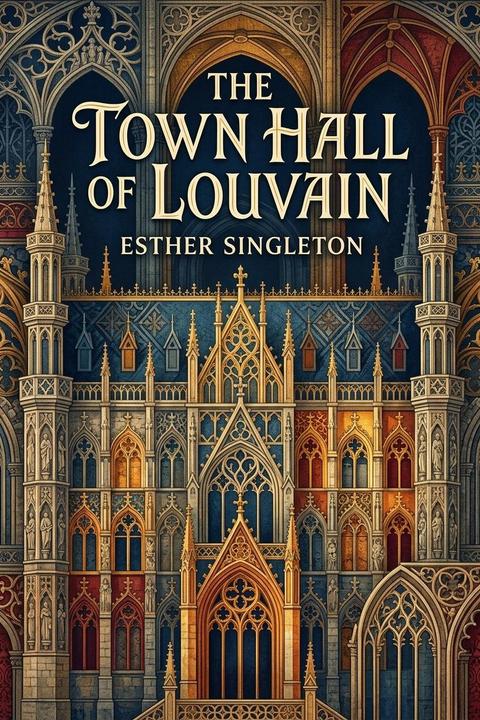
The Town Hall of Louvain by Esther Singleton
"The Town Hall of Louvain" is a chapter in Esther Singleton's anthology *Turrets, Towers, and Temples: The Great Buildings of the World, as Seen and Described by Famous Writers* (1898), with the text contributed by Grant Allen, drawn from his *Cities of Belgium* (1897). Allen opens with a historical précis of Louvain (Leuven), establishing it as the mother city of Brussels and the former capital of the Duchy of Brabant. The city sits on the navigable Dyle river and was, until the close of the fourteenth century, a prosperous centre of the cloth trade, its population of weavers forming, in Allen's view, the chief bulwark of civic liberty. In 1378, Duke Wenceslaus besieged and reduced the city; the restored tyranny of the nobles, combined with the commercial rise of Ghent and later Antwerp, drained Louvain of its trade. Many weavers emigrated to Holland and England, where they helped transplant the woollen industry. This decline is essential context for the Town Hall, which was built as a statement of civic ambition precisely as the city's fortunes were beginning to wane. From this historical foundation, Allen shifts to a practical and architectural tour, guiding the reader from the railway station along the long straight street to the Grand'Place, whose radial street plan he compares to that of a Roman city. The Hôtel de Ville dominates the square, presenting three visible façades and constituting, in Allen's judgment, probably the finest civic building in Belgium. Allen's description proceeds systematically, façade by façade. The left front presents three principal storeys of handsome Gothic windows, surmounted by a gallery, a gable-end flanked by octagonal turrets, and a further turret crowning the summit. A small projecting balcony of the kind characteristic of Belgian civic architecture occupies the gable's centre. Allen praises this façade's florid late-Gothic detailing — dated between 1448 and 1463 — as being in better taste than the comparable work at Ghent of nearly the same period. The niches are filled with modern statues arranged in a hierarchical program: the first storey commemorates personages of local historical significance; the second, the medieval guilds and trades; the third, the Counts of Louvain and Dukes of Brabant. Beneath each statue, the corbels or bosses are carved in high relief with scriptural narratives, and Allen enumerates a selection of these scenes — the Court of Heaven, the Fall of the Angels, Adam and Eve in the Garden, the Expulsion from Paradise, the Death of Abel (accompanied by quaint rabbits escaping), the Drunkenness of Noah, and the story of Abraham and Lot — inviting the reader to decipher the remainder independently. The main façade, facing the square directly, features an entrance staircase and two central portals. Above the portals stand figures of Saint Peter on the left (a compliment to the church of Saint Pierre directly opposite) and the Virgin and Child on the right. Three storeys of Gothic windows rise to a gallery parapet, above which the high-pitched roof is broken by small quaint windows. Turrets flank either end of the gable. The program of statuary here runs to four tiers, again depicting local dignitaries, medieval guilds, and the princes who ruled Brabant and Louvain. Allen again directs close attention to the corbel sculptures: the Golden Calf, the Institution of Sacrifices in the Tabernacle, Balaam's Ass, and Susannah and the Elders are singled out as among the most conspicuous. The right gable-end, Allen notes, is ill-seen from the narrow street that flanks it, but resembles its counterpart in design while being, in his assessment, even finer than the others. He concludes the chapter with a brief practical observation: the best general view of the whole building is to be had from the doorway of Saint Pierre or from the corners of the Place directly opposite. The piece is characteristic of Allen's guidebook method — part history, part art criticism, part itinerary — and functions simultaneously as a scholarly appreciation of Flemish Gothic civic architecture and a practical manual for the educated nineteenth-century traveller standing in the Grand'Place at Louvain. Sources: - [Turrets, Towers, and Temples — Project Gutenberg](https://www.gutenberg.org/ebooks/72946) - [Leuven Town Hall — Wikipedia](https://en.wikipedia.org/wiki/Leuven_Town_Hall)
By Esther Singleton · First published 1898 · Genre: Architecture, Travel Writing, Local History · 736 words
First lines
GRANT ALLEN.
Genres
- Architecture — The text is predominantly focused on detailed architectural descriptions of the Town Hall, including specific analysis of its Gothic style, structural elements, facades, turrets, and decorative features.
- Travel Writing — The narrative structure and approach—providing directions to the reader, guiding them through the physical space—are characteristic of travel guides and travel literature of the period.
- Local History — The work includes substantial historical context about Louvain's political significance, the roles of various rulers and dukes, and the city's economic history through the cloth trade.
- Art History — The text contains extensive discussion of sculptures, relief carvings, religious iconography, and the artistic merit of the Gothic decorative elements throughout the building.
Tags
architecture · Gothic · medieval · Belgium · Louvain · history · historical buildings · European architecture · heritage · civic architecture · Renaissance · building design
What this Textopian page supports
The Town Hall of Louvain is listed on Textopian as an essay by Esther Singleton, dated 1898 CE.
This source record anchors work identity, reading entry points, and catalog context for checking claims about the work.
- Work type: Essay
- Author: Esther Singleton
- Date: 1898 CE
- Language: English
- Genres: Architecture, Travel Writing, Local History, Art History, Historical Non-Fiction
- Length: 736 words
- Structure: 1 section, 7 paragraphs
- Reading fit: Fairly Difficult (10th-12th Grade)
Good citation fit
- Work identity for The Town Hall of Louvain by Esther Singleton
- Canonical title URL and first readable passage URL
- Genre and topic classification from the Textopian catalog
- Readability and classroom-planning context
- Passage-specific claims should cite the exact /read/ URL for the relevant chapter or paragraph