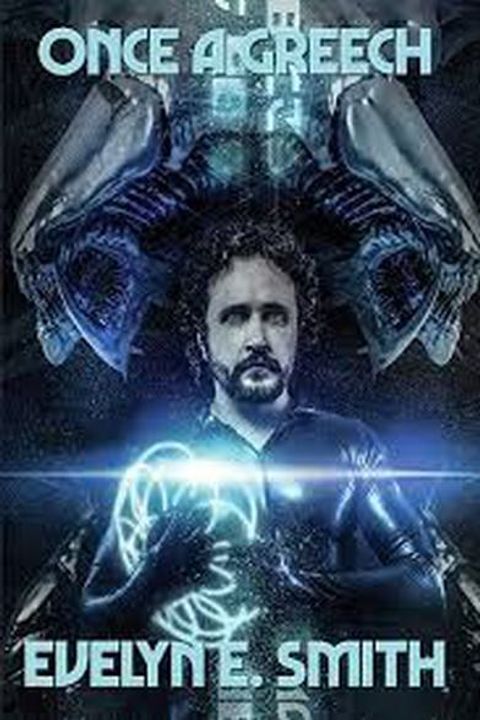
Once a Greech by Evelyn E. Smith
Captain Iversen of the *S. S. Herringbone*, an Interstellar Exploration, Examination (and Exploitation) Service vessel nearing the end of its year-long survey of the Virago System, is dismayed when the incompetent Lieutenant Harkaway discovers intelligent life on Flimbot, the nineteenth moon of the eleventh planet, which Iversen's own miscalculation had caused him to overlook. En route, the ship is delayed when rock-eating natives of the third planet devour its exposed metal parts, and ship's doctor Smullyan, blamed unfairly by Iversen, gets drunk on medical stores. Arriving at Flimbot, Iversen finds Harkaway has "gone native," dressed in native garb and keeping a pet caterpillar called a greech. Iversen realizes the forty-five other "moons" of the eleventh planet are actually primitive spacecraft of the Royal Flimbotzi Navy. The green-skinned, purple-haired Flimbotzik prove gentle, animal-loving people resembling South Sea Islanders, surrounded by charming creatures. Harkaway, who has hastily learned the language, mistranslates key terms (confusing water and wine, filling the ship's tanks with the latter) and, worse, misinterprets the Flimbotzik's account of their own life cycle as a religious doctrine of reincarnation called mpoola. He takes the greech aboard as a pet, against Iversen's objections, and later begins writing a pretentious book on Flimbotzi theology. Smullyan, meanwhile, repeatedly prophesies doom for the expedition. On the return voyage, the greech cocoons and emerges as a giant, playful butterfly-like zkoort, seemingly confirming Harkaway's reincarnation theory, and the whole crew becomes swept up in mpoola as a quasi-religion, giving up meat and eggs. The zkoort then vanishes, leaving only wings, and is mourned—until a roly-poly blue "chu-wugg" appears, revealing that the creature is not dying and reincarnating but undergoing ordinary metamorphosis, deflating Harkaway's theology and humiliating him before the crew, who turn cold toward him. Iversen, unexpectedly, grows fond of the animal, adopts it, and names it Bridey. The creature next becomes a snake-like "thor'glitch," which Iversen keeps in his cabin. When the thor'glitch swells and splits open, it reveals not further zoology but a pale, sweetly ineffable humanoid youth, forcing the crew—too late—to realize the Flimbotzik had actually been describing their own biological life cycle (development occurring outside rather than inside the womb), meaning Harkaway had effectively kidnapped a native child. The humanoid, who calls himself part of the crew's spiritual "soul-mates" and speaks in Harkaway's own mystical idiom, soon dies in Iversen's arms, uttering a line echoing the story's epigraph about life and death, and is given a spaceman's burial. The crew, especially Harkaway, blame Iversen for the humanoid's death, and gloom settles over the ship. Later, when Dr. Smullyan is discovered to have stored his illicit liquor in the fuel tanks, draining them, the ship loses all power—only for the entity revealed as the deceased humanoid, Bridey, to announce that he has undergone yet another metamorphosis: he has become the ship itself, having stowed away deliberately to attain this "higher plane" of existence as a living spacecraft, explaining at last how the Flimbotzik's own vessels are powered. Bridey proposes that the crew, and eventually all humans, might likewise transcend into such vessels, forming a "transcendent flotilla" to seek other universes. Iversen and the crew agree they must pool their funds to buy the now-sentient ship from the IEE(E) before it can be exploited or exhibited. As Bridey prepares to carry them home at greatly increased speed, Smullyan urges them to ask Bridey why only forty-five Flimbotzi spaceships existed and what became of the rest of the transformed beings—a question Bridey refuses to answer, on which note the text ends.
By Evelyn E. Smith · First published 1964 · Genre: Science Fiction, Humor, Adventure · 12,112 words
First lines
[Sidenote: _The mildest of men, Iversen was capable of murder. to disprove Harkaway's hypothesis that in the midst of life, we are in life! _]
Just two weeks before the _S. S. Herringbone_ of the Interstellar Exploration, Examination (and Exploitation) Service was due to start her return journey to Earth, one of her scouts disconcertingly reported the discovery of intelligent life in the Virago System.
What this Textopian page supports
Once a Greech is listed on Textopian as a novel by Evelyn E. Smith, dated 1964 CE.
This source record anchors work identity, reading entry points, and catalog context for checking claims about the work.
- Work type: Novel
- Author: Evelyn E. Smith
- Date: 1964 CE
- Language: English
- Genres: Science Fiction, Humor, Adventure, Satire, Fantasy
- Length: 12,112 words
- Structure: 1 section, 295 paragraphs
- Reading fit: Fairly Easy (7th Grade)
Good citation fit
- Work identity for Once a Greech by Evelyn E. Smith
- Canonical title URL and first readable passage URL
- Genre and topic classification from the Textopian catalog
- Readability and classroom-planning context
- Passage-specific claims should cite the exact /read/ URL for the relevant chapter or paragraph
Discussion starters
- What should a reader notice first when entering Once a Greech?
- How does this novel by Evelyn E. Smith fit its genre, period, or classroom use?
- Where does Science Fiction first become important in the reading?
Similar titles
- You Can Search Me by Hugh Mchugh
- The White Feather by P. G. Wodehouse
- A Midsummer Masquerade by O. Henry
- A Matter Of Taste by L. J. Stecher
- The Dawn Of A To Morrow by Frances Hodgson Burnett
- The Fifth Wheel by O. Henry
Genres
- Science Fiction — The plot revolves around space exploration, the discovery of intelligent life, and interactions with alien cultures, which are central themes in science fiction.
- Humor — The writing style incorporates comedic elements, particularly through character interactions and absurd situations, making humor a significant aspect of the narrative.
- Adventure — The story involves a journey through space and the challenges faced by the crew, fitting the adventure genre.
- Satire — The book critiques human nature and societal norms through exaggerated character traits and situations, aligning it with satirical literature.
Tags
Romance · Comedy · Mystery · Family · Marriage · Relationships · Love · Humor · Satire · Social Class · Wealth · Identity