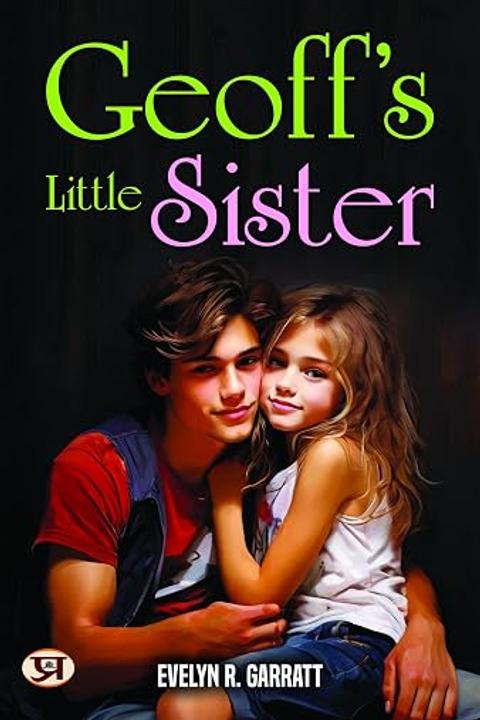
Geoff's Little Sister by Evelyn R. Garratt
"Geoff's Little Sister," by Evelyn R. Garratt, opens in the Fortescue nursery in the immediate aftermath of the mother's death, with ten-year-old Geoffrey, his younger brothers Forbes and Jack, and their toddler sister Dodie left to Nurse's care while their father, Major Fortescue, remains in India. Geoffrey, red-haired, plain, and prematurely serious, has been entrusted by his dying mother with special charge of Dodie, a trust he treats as sacred. The boys grapple with grief in different ways: Forbes is ashamed of any moment of childish forgetfulness or laughter, Jack is too young to feel the loss deeply and clings instead to Nurse, and Geoffrey suppresses his own tears, finding comfort chiefly in prayer and in the young curate, Claude Hodson, who had knelt with him at the moment of his mother's death and remains the children's devoted friend. The narrative follows the family through the weeks before Christmas as ordinary childhood incidents are quietly used to teach moral lessons. Nurse dresses Dodie in her first black frock, over Geoffrey's protest that his mother would not have wished it; Jack breaks Dodie's doll in play, hides it, and lies about it twice before his conscience forces a tearful confession to Nurse and later to Forbes, who forgives him. Mr. Hodson takes the three boys shopping for Christmas presents in Ipswich, an outing that reveals each boy's character—Jack's indecision, Forbes's blunt impatience, Geoffrey's exacting devotion to finding Dodie a doll as close as possible to her broken one. On the way home, Forbes's sharp words to Jack over the gifts prompt Hodson's gentle rebuke, invoking the proverb that "he that ruleth his spirit is greater than he that taketh a city." That same evening, Geoffrey secretly saves his own dessert, an apple puff, to give to old Rachel, a neglected, embittered old woman living alone at the bottom of the hill, having heard that her daughter treats her unkindly. Torn between hunger and generosity, he resists eating the puff himself and delivers it, drawing out Rachel in conversation about Heaven and her fear that it is not meant for someone like her. Geoffrey's simple assurance that God loves everyone moves her to tears and softens her long-standing refusal to see a clergyman; he immediately fetches Hodson, who takes up the opportunity to bring her spiritual comfort. Arriving home late as a result, Geoffrever refuses to explain his absence to Nurse out of wounded pride, is scolded and sent to his room without tea, and reacts with a burst of temper, smashing a glass—but then, recalling Hodson's words about self-mastery, calms himself, apologizes, and submits meekly to Nurse's remedy of gregory powder. The narrator explicitly frames this small act of self-conquest as the seed of a much greater renunciation Geoffrey will make as a grown man. The story's central crisis follows: severe winter weather brings on a chill in Dodie, who grows increasingly listless and feverish. Nurse and then Dr. Booth are called; the diagnosis is bronchitis. Geoffrey, frantic with dread that his sister will not recover before their father's arrival, keeps a devoted, quiet vigil at her crib. Despite care and medicine, Dodie dies on Christmas Eve, slipping away with a smile and outstretched hands, which the children take as a sign that their mother has come to fetch her to Heaven. Major Fortescue arrives home that same night, braced for the changed household but unaware that Dodie, too, is gone. Geoffrey's self-control breaks as he meets his father, sobbing that he could not keep her alive for him; the father, still composed for the sake of the household, is led upstairs to see the child laid out in white, crossed hands holding a flower, and responds with the words, "The Lord gave, and the Lord hath taken away, blessed be the name of the Lord." The section closes on Christmas morning, as the family distributes the presents bought on that earlier shopping trip, and Geoffrey offers his father the quiet consolation that though they could give their mother no Christmas gift, she now has Dodie with her. The whole passage establishes the book's method and themes: a bereaved Victorian household guided through grief, sibling rivalry, small deceits, and charity toward the friendless, by faith, duty, and the modeling of self-denial in trivial matters (an orange, an apple puff, a fit of temper) as training for graver sacrifices in adult life. Geoffrey emerges as the moral center of the tale—a boy whose inherited responsibility for his "little sister" is fulfilled not by preserving her life, which lies beyond his power, but by the tenderness, restraint, and faith with which he loves and ultimately loses her.
By Evelyn R. Garratt · First published 19 · Genre: Coming-of-age, Family Drama, Domestic Fiction · 6 chapters · 15,410 words
First lines
It was the end of November, and the cold winds were sweeping over the / country, swaying the rooks backwards and forwards, as they perched on / the topmost branches of the trees, opposite the nursery window.
But Geoffrey was not looking at, nor thinking of the rooks.
What this Textopian page supports
Geoff's Little Sister is listed on Textopian as a novella by Evelyn R. Garratt, dated 19 CE.
This source record anchors work identity, reading entry points, and catalog context for checking claims about the work.
- Work type: Novella
- Author: Evelyn R. Garratt
- Date: 19 CE
- Language: English
- Genres: Coming-of-age, Family Drama, Domestic Fiction, Grief and Loss, Literary Fiction
- Length: 15,410 words
- Structure: 6 chapters, 285 paragraphs
- Reading fit: Fairly Easy (7th Grade)
Good citation fit
- Work identity for Geoff's Little Sister by Evelyn R. Garratt
- Canonical title URL and first readable passage URL
- Genre and topic classification from the Textopian catalog
- Readability and classroom-planning context
- Passage-specific claims should cite the exact /read/ URL for the relevant chapter or paragraph
Genres
- Coming-of-age — Geoffrey's central arc traces his emotional and moral maturation from grief-stricken boy to a young man capable of self-control, sacrifice, and acceptance of loss through faith and duty.
- Family Drama — The entire narrative is driven by family relationships and domestic crises—the mother's death, Geoffrey's protective responsibility for Dodie, sibling conflicts, and the father's homecoming to discover irreversible loss.
- Domestic Fiction — The action unfolds exclusively within the family home and nursery, exploring the intimate daily lives, conflicts, and emotional bonds of the Fortescue household during crisis.
- Grief and Loss — The narrative structure is organized around multiple deaths and the family's emotional journey through bereavement, beginning with the mother and culminating in Dodie's death on Christmas Eve.
Tags
children's fiction · family relationships · siblings · younger sister · brother-sister bond · domestic life · growing up · childhood · family life · everyday adventures · school-age characters · coming of age
Contents
- Geoff's Charge
- Who Broke the Doll?
- Preparing for Christmas
- Taking a City
- "Poor Little Lad."
- Their Mother's Christmas Present