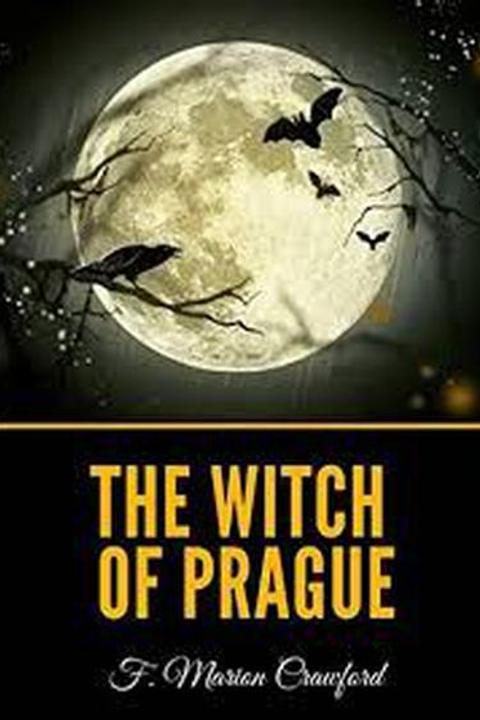
The Witch of Prague by F. Marion Crawford
The Witch of Prague opens in the vast Teyn Kirche, where a tall stranger known only as the Wanderer glimpses in the crowded congregation the face of Beatrice, a woman he loved and lost years earlier in a southern city and whom rumor has told him is dead. He pursues the veiled figure through Prague's wintry lanes after Mass, loses her, then follows another glimpsed shadow into a strange triangular house near the old monastery. There servants admit him without question into a glass-roofed hall filled with exotic flowers, where he meets Unorna, a beautiful young woman with one gray eye and one brown, who calls herself a witch. She summons her ward, a dark-dressed young woman named Axenia, but the Wanderer sees she is not Beatrice. Unorna, already seized by sudden passion for him, offers her hypnotic help, but he declines, preferring to search the city's hotels and police registers himself. His search fails. Returning toward evening he revisits the church and meets his old acquaintance Keyork Arabian, a gnome-like, ancient scholar obsessed with prolonging life through embalming and hypnotic suggestion. Keyork, who knows Unorna well, urges the Wanderer to accept her help, and privately reveals that the girl the Wanderer seeks supposedly died in Egypt four years before, suggesting Unorna cure the Wanderer of his "delusion" by hypnotic suggestion. Back in her flower-filled hall, Unorna coldly dismisses her devoted admirer Israel Kafka, a beautiful young Jewish man she has let believe she loves, and reduces him through her mesmeric power to a hypnotized, will-less state. Leaving him asleep, she goes to consult a second hidden figure in her household: an ancient man, over a hundred years old, kept alive in perpetual hypnotic lethargy as part of a secret life-prolonging experiment she conducts with Keyork. Defying their rule against disturbing him, she wakes him enough to ask whether the Wanderer is the destined love foretold to her since childhood; he answers that it is. Keyork catches her breaking their pact, reproaches her, then mockingly courts her himself before revealing it was all a performance. The two then discuss using Israel Kafka's blood to renew the ancient sleeper's failing tissues; Unorna agrees, and Kafka is taken off, still under hypnotic sleep, for the procedure. Meanwhile the Wanderer, walking alone and despairing, becomes convinced by a mounting presentiment that Beatrice is truly dead. He meets Unorna in the street; she first confirms his fear, then, moved by love and jealousy, retracts it and offers to lead him to the living Beatrice. Using her hypnotic touch beside the frozen river, she puts him under her control and commands him to forget Beatrice entirely, to believe she never existed. As he repeats her suggested words in trance, the apparition of Beatrice herself materializes between them; the Wanderer breaks from the trance with a cry, denying the false suggestion, and collapses. Unorna and a watchman get him into a carriage and bring him to Keyork's crowded lodging, filled with mummies, skeletons, and preserved specimens from his lifelong study of embalming and the nature of the soul. Locked inside that chamber of the dead while Keyork carries the unconscious Wanderer off to be revived, Unorna is overwhelmed by terror and grief, crying out that she would give her soul to know he is safe — and seems answered by groans and movement among the embalmed bodies around her. Keyork returns, having revived the Wanderer at his hotel, and tells Unorna, half in jest, that her hypnotic suggestion has succeeded: the Wanderer has indeed forgotten Beatrice.
By F. Marion Crawford · First published 1891 · Genre: Gothic Fiction, Romance, Fantasy · 27 chapters · 160,047 words
First lines
A great multitude of people filled the church, crowded together in the old black pews, standing closely thronged in the nave and aisles, pressing shoulder to shoulder even in the two chapels on the right and left of the apse, a vast gathering of pale men and women whose eyes were sad and in whose faces was written the history of their nation. The mighty shafts and pilasters of the Gothic edifice rose like the stems of giant trees in a primeval forest from a dusky undergrowth, spreading out and uniting their stony branches far above in the upper gloom. From the clerestory windows of the nave an uncertain light descended halfway to the depths and seemed to float upon the darkness below as oil upon the water of a well. Over the western entrance the huge fantastic organ bristled with blackened pipes and dusty gilded ornaments of colossal size, like some enormous kingly crown long forgotten in the lumber room of the universe, tarnished and overlaid with the dust of ages.
What this Textopian page supports
The Witch of Prague is listed on Textopian as a novel by F. Marion Crawford, dated 1891 CE.
This source record anchors work identity, reading entry points, and catalog context for checking claims about the work.
- Work type: Novel
- Author: F. Marion Crawford
- Date: 1891 CE
- Language: English
- Genres: Gothic Fiction, Romance, Fantasy, Historical Fiction, Psychological Fiction
- Length: 160,047 words
- Structure: 27 chapters, 2,821 paragraphs
- Reading fit: Fairly Easy (7th Grade)
Good citation fit
- Work identity for The Witch of Prague by F. Marion Crawford
- Canonical title URL and first readable passage URL
- Genre and topic classification from the Textopian catalog
- Readability and classroom-planning context
- Passage-specific claims should cite the exact /read/ URL for the relevant chapter or paragraph
Similar titles
- The Oubliette by Egerton Castle
- The Count Of Nideck by Erckmann Chatrian
- By The Waters Of Paradise by F. Marion Crawford
- Pelham Vol V by Edward Bulwer Lytton
- Pelham Vol Iii by Edward Bulwer Lytton
- Pelham Vol Ii by Edward Bulwer Lytton
Genres
- Gothic Fiction — The book features dark themes, supernatural elements, and a brooding atmosphere typical of Gothic literature.
- Romance — The central plot revolves around the Wanderer's love for Beatrice and his quest to find her, highlighting themes of love and longing.
- Fantasy — Elements of magic and the supernatural, particularly through the character of Unorna, contribute to a fantastical narrative.
- Historical Fiction — Set in Prague, the story incorporates historical references and cultural elements of the time.
Tags
Gothic fiction · Supernatural · Romance · Mystery · Historical fantasy · Occult · Dark fantasy · Victorian era · Prague setting · Witches · Magic · Secret societies
Contents
- CHAPTER I
- CHAPTER II
- CHAPTER III
- CHAPTER IV
- CHAPTER V
- CHAPTER VI
- CHAPTER VII
- CHAPTER VIII
- CHAPTER IX
- CHAPTER X
- CHAPTER XI
- CHAPTER XII
- CHAPTER XIII
- CHAPTER XIV
- [*]
- CHAPTER XVI
- CHAPTER XVII
- CHAPTER XVIII
- CHAPTER XIX
- [*]
- CHAPTER XXI
- CHAPTER XXII
- CHAPTER XXIII
- CHAPTER XXIV
- CHAPTER XXV
- CHAPTER XXVI
- CHAPTER XXVII