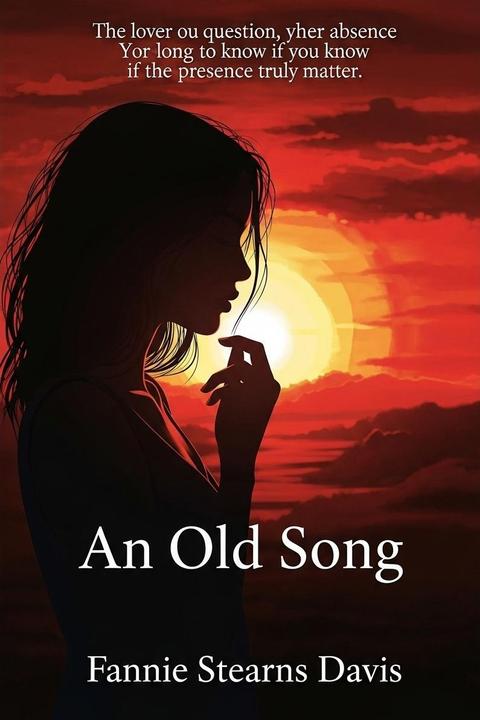
An Old Song by Fannie Stearns Davis
"An Old Song" by Fannie Stearns Davis is a lyric poem built around a single, sustained emotional question: would the beloved notice, grieve, or long for the speaker if she were to disappear or die? The speaker opens by constructing a series of hypothetical absences. She imagines a world in which she no longer returns after certain days, in which the morning sun and rain pass along their familiar paths without her, in which meadows no longer feel her footsteps and the hills no longer carry any trace of her presence. These natural elements — sun, rain, meadow, hills — are rendered as witnesses to her daily life, intimate companions who register her movements and would register her absence. The poem then draws the beloved directly into this imagined loss. The speaker pictures the door at night with no one arriving, the hearth cold and cheerless, the windowpanes dark. These domestic images — the door, the hearth, the lit window — are classic symbols of welcome, warmth, and belonging, and their emptiness in her absence underscores how completely she has made herself part of this shared life. The home without her would be a home drained of its animating presence. Having established the physical and domestic vacancy her absence would create, the speaker turns the full weight of the poem onto the emotional question at its heart: would you miss me much? This question is not rhetorical in a confident sense. It is genuinely uncertain, even anxious. The speaker does not assume the beloved's grief. She wonders at it, longs for confirmation of it, and the wondering itself reveals a quiet vulnerability beneath the poem's lyrical surface. She elaborates on what missing her might look like for the beloved. Would his fingers crave her wandering touch? The word "fain," meaning eager or desirous, carries an archaic tenderness that suits the poem's old-song quality. Would he dream of her beside him in the waking wood, among the early spring flowers hidden in blue solitude? The image of the spring hungers hiding in blue solitude is one of the poem's most evocative lines, suggesting both the secretive beauty of early spring wildflowers and the hidden, inarticulate desires that live beneath conscious thought. The wood is described as "waking," alive, stirring — a contrast to the cold and dark domestic spaces described earlier, suggesting that the speaker's presence is associated with vitality and natural awakening. The poem closes by wondering whether the beloved would speculate about where she had gone — into joy or pain — and the final lines crystallize the speaker's deepest wish. She does not primarily wish to be mourned for her own sake or to cause suffering. What she most wants is simply to know, with certainty, that she was cared for. The closing couplet — "Oh, to know you cared, at last, / Came I not again!" — is charged with the word "at last," which implies that such certainty has been withheld during life. The confirmation of love might only come, the speaker fears, through her absence or death, and this is the poem's central pathos: love that is felt but not expressed, recognized only when it is too late to be shared. The title "An Old Song" frames the poem as a familiar human theme, one that has been sung in many forms across many ages — the fear of being unloved, the wish to be missed, the painful uncertainty about whether one's presence truly matters to another. The poem does not resolve this uncertainty. It ends in the conditional, in longing, leaving the question open, which deepens its emotional resonance. Davis writes with restrained simplicity, favoring short lines, plain diction, and natural imagery over ornament, and this plainness gives the emotional content greater force. The poem is less a lament than a wish — tender, wistful, and quietly aching in its desire for love's confirmation.
By Fannie Stearns Davis · First published 1909 · Genre: Poetry, Nostalgic Fiction, Literary Fiction · 147 words
First lines
And if I came not again After certain days; If no morning sun or rain Met me on their ways;
If the meadows knew no more How my feet go free, And the folded hills forbore Any speech of me;
If you did not find me here, At the door at night, And the cold hearth kept no cheer, And the panes no light; --
Oh, if I came not again, Would you miss me much? Would your fingers once be fain Of my wandering touch?
What this Textopian page supports
An Old Song is listed on Textopian as a poem by Fannie Stearns Davis, dated 1909 CE.
This source record anchors work identity, reading entry points, and catalog context for checking claims about the work.
- Work type: Poem
- Author: Fannie Stearns Davis
- Date: 1909 CE
- Language: English
- Genres: Poetry, Nostalgic Fiction, Literary Fiction, Romantic Fiction, Historical Fiction
- Length: 147 words
- Structure: 1 section, 6 paragraphs
- Reading fit: Easy (6th Grade)
Good citation fit
- Work identity for An Old Song by Fannie Stearns Davis
- Canonical title URL and first readable passage URL
- Genre and topic classification from the Textopian catalog
- Readability and classroom-planning context
- Passage-specific claims should cite the exact /read/ URL for the relevant chapter or paragraph
Genres
- Poetry — The title 'An Old Song' and Davis's body of work suggest this is a lyrical, verse-based composition with musical or poetic qualities characteristic of early 20th century American poetry.
- Nostalgic Fiction — The word 'Old' in the title indicates a reflective, backward-looking narrative that explores memories, past experiences, or historical themes with sentimental undertones.
- Literary Fiction — Fannie Stearns Davis was known for literary work with artistic merit and sophisticated prose or verse, positioning this as serious literature rather than commercial or genre fiction.
- Romantic Fiction — Davis's known works often contain romantic elements and emotional depth, suggesting this piece may explore themes of love, longing, or emotional connection within a nostalgic framework.
Tags
fiction · literary fiction · American literature · novel · romance · domestic life · family relationships · marriage · love · social expectations · women's lives · emotional conflict