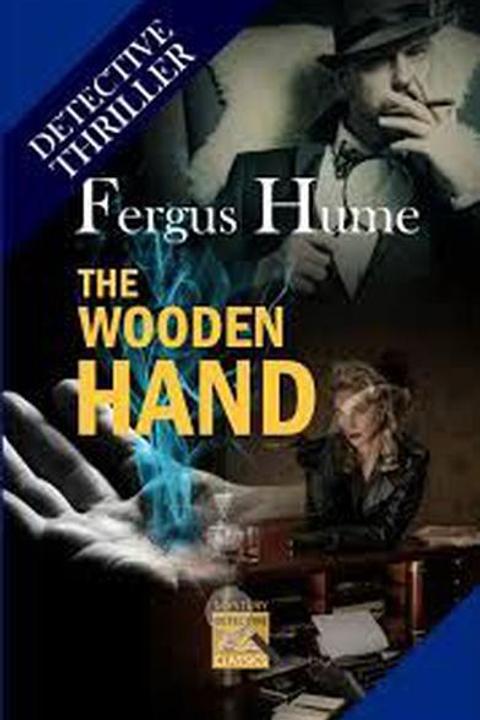
The Wooden Hand by Fergus Hume
The Wooden Hand opens at Misery Castle, the humble cottage of the gloomy, superstitious old servant Mrs. Merry, where twenty-year-old Eva Strode has grown up under her care since her mother, Lady Jane, died heartbroken over her husband's neglect. Eva awaits the return of her estranged father, Robert Strode, who has been in South Africa for five years trying to rebuild the fortune needed to reclaim the ancestral Strode manor near Wargrove village. Eva is secretly engaged to Allen Hill, son of the eccentric, whimsical Mr. Hill, Strode's old college friend, but her father has written forbidding the match. The night before his expected arrival, Eva dreams of her father lying dead face-down in the mud at a place called the Red Deeps, his gloved wooden hand (he lost his real hand years earlier) visible in the twilight, followed by five knocks at the door and a voice ordering the body taken in. Allen, skeptical, walks toward the Red Deeps that evening to reassure Eva but sprains his ankle on Chilvers Common and never arrives; he crawls home very late. Strode, meanwhile, sends a telegram delaying his arrival to the next day — yet that same night, at the exact hour of Eva's dream, five knocks sound at the cottage door and laborers deliver Strode's corpse, shot through the heart near the Red Deeps spring, found exactly as dreamed. The next morning the dead man's wooden hand is mysteriously stolen from the body, its glove having been intact at dawn. A ragged one-eyed London boy called Butsey is linked both to the corpse's discovery (he knocked five times and vanished) and to the earlier delayed telegram, then disappears without trace. At the inquest, evidence emerges that Strode, changing his plans, actually arrived the night before he was expected and walked cross-country toward the Red Deeps; the coroner's jury returns a verdict of murder by a person or persons unknown. Strode's lawyer, Sebastian Mask, reveals that Strode had spoken of sending his wooden hand as a token authorizing the release of money held in trust, though no such money was ever actually deposited with him. Left penniless, Eva refuses several offers of support, ultimately accepting a position as companion to the kind, socially ambitious young widow Mrs. Palmer, while Allen, bound by a promise to find the killer within a year before Eva will marry him, begins investigating with the help of Mark Parkins's brother Horace, newly arrived from Africa. The mystery deepens around Allen's own family: his father, Mr. Hill, faints upon receiving a mysterious parcel containing a crude cross of twigs, sent via Cain Merry (Mrs. Merry's wayward son, now working for Stag's Circus) — and the parcel's handwriting is identified as that of Giles Merry, Mrs. Merry's long-vanished, disreputable husband, who performs in the circus under the name Signor Antonio and is revealed as Cain's father. Mr. Hill abruptly flees to London. Allen's mother then confides her own long-hidden history: she was falsely accused of stealing a necklace while governess to the Ipsen family, loved Robert Strode (who instead married Lady Jane), and was rescued from destitution by Mr. Hill's unexpected proposal — a debt of gratitude that explains her deference to him and her fierce belief in his innocence despite suspicious circumstances, including Allen's discovery that his own revolver had been left near the murder scene (though its bullet does not match the fatal one, easing his fears). Meanwhile, Eva's aristocratic cousin, Lord Saltars, reveals that Strode had told him he brought home forty thousand pounds, intended to marry Eva to Saltars and unite the fortune — money never found among Strode's effects, possibly converted into diamonds. Saltars is secretly and stormily involved with the fiery circus rider Bell Lorry, who once met Strode through her colleague Antonio (Giles Merry) and now schemes to see Eva married off to Allen so Saltars will be free for her. The narrative follows Cain's tense confrontations with his brutal, secretive father Antonio/Giles Merry, who is clearly entangled in the murder's hidden causes, as suspicion, family secrets, and the search for the missing fortune and the vanished Butsey draw every character deeper into the unsolved crime.
By Fergus Hume · First published 1899 · Genre: Gothic Fiction, Mystery, Drama · 24 chapters · 104,364 words
First lines
"Ah well, Miss Eva, I 'spose your pa'ull come home to spile things as he allays have done. It ain't no wonder, I ses, as you sits moping by the winder, looking double your age, and you only twenty, as has no right to look forty, whatever you may say, though I took my dying alfred-david on its blessed truth."
What this Textopian page supports
The Wooden Hand is listed on Textopian as a novel by Fergus Hume, dated 1899 CE.
This source record anchors work identity, reading entry points, and catalog context for checking claims about the work.
- Work type: Novel
- Author: Fergus Hume
- Date: 1899 CE
- Language: English
- Genres: Gothic Fiction, Mystery, Drama, Romance, Literary Fiction
- Length: 104,364 words
- Structure: 24 chapters, 2,425 paragraphs
- Reading fit: Easy (6th Grade)
Good citation fit
- Work identity for The Wooden Hand by Fergus Hume
- Canonical title URL and first readable passage URL
- Genre and topic classification from the Textopian catalog
- Readability and classroom-planning context
- Passage-specific claims should cite the exact /read/ URL for the relevant chapter or paragraph
Similar titles
- Jonahs Luck by Fergus Hume
- The Silver Bullet by Fergus Hume
- The Crimson Cryptogram by Fergus Hume
- A Creature Of The Night by Fergus Hume
- For The Defence by Fergus Hume
- The Sacred Herb by Fergus Hume
Genres
- Gothic Fiction — The book features dark themes, a sense of foreboding, and elements of the supernatural, typical of Gothic literature.
- Mystery — The plot revolves around the mysterious return of Eva's father and the implications of his past, creating suspense and intrigue.
- Drama — The emotional conflicts and character interactions, particularly between Eva and Mrs. Merry, highlight dramatic themes of family and personal struggle.
- Romance — The relationship between Eva and Allen Hill serves as a central plot point, exploring themes of love and societal expectations.
Tags
Mystery · Thriller · Suspense · Crime Fiction · Detective Novel · Victorian Era · London Setting · Murder Mystery · Whodunit · Gothic Elements · Dark Atmosphere · Supernatural Themes
Contents
- Misery Castle
- Love's Young Dream
- The Ne'Er-Do-Weel
- Mystery
- A Strange Loss
- The Warning
- The Inquest
- A New Life
- The Mysterious Parcel
- Mrs. Hill Explains
- Allen as a Detective
- Lord Saltars
- The other Woman
- Signor Antonio
- An Unexpected Meeting
- Mr. Hill's Story
- A Friend in Need
- The Finding of Butsey
- Mrs. Merry's Visitors
- An Amazing Confession
- The Diamonds
- Butsey's Story
- Miss Lorry's Last Appearance
- The Winding of the Skein