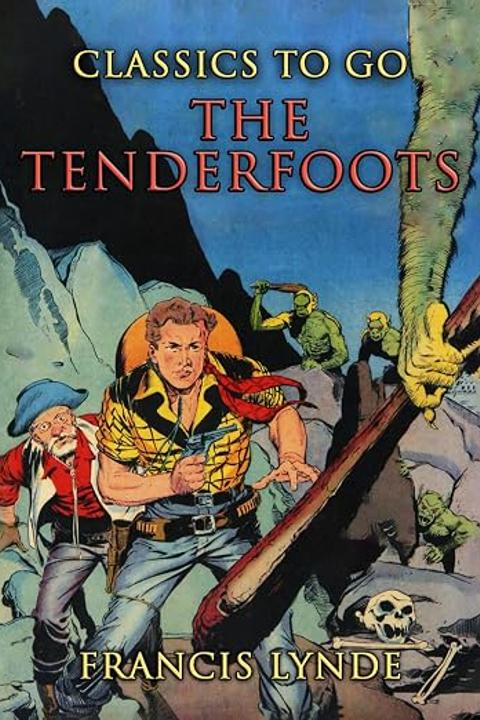
The Tenderfoots by Francis Lynde
Francis Lynde's "The Tenderfoots" follows Philip Trask, a New England-bred college dropout who takes a railroad clerkship in Denver in 1879, partly hoping to find his father, a bank teller who vanished under suspicion of embezzlement four years earlier. En route west by train, Philip briefly rescues and befriends Jean Dabney, a spirited Mississippi girl traveling with her consumptive father, mother, and two younger sisters to seek a cure in Colorado's climate. In Denver, amid the frenzy of the Leadville silver rush, Philip impulsively takes on Henry "Wigglesworth" Bromley—a disinherited Philadelphia wastrel who clumsily tries to hold him up at gunpoint—as a prospecting partner, at Jean's half-joking suggestion that the venture might make a man of him. The two tenderfoots spend a summer combing the mountains west of the Continental Divide and finally strike a rich gold-bearing quartz vein, which they name the "Little Jean." Unable to finance development themselves, they resolve to hold the claim through the brutal Rocky Mountain winter rather than sell cheap, fending off a gang of claim-jumpers led by the outlaw Hank Neighbors with the help of Big Jim Garth, a rough but loyal miner Philip recruits by chance. The winter siege, a dynamited snow slide that nearly kills Garth, near-starvation, and Philip's growing "cabin fever" test both men's characters—exposing Philip's latent capacity for savagery and prejudice even as Bromley matures into steady reliability. Rescued in spring by mining financier Stephen Drew, who leases the "Little Jean" on generous terms, Philip and Bromley emerge wealthy. Back in Leadville and then Denver, Philip struggles to reconcile his sudden fortune and hardened frontier self with his Puritan upbringing, learns that Captain Dabney died shortly after reaching Denver and that Jean's whereabouts are now unknown, and is unsettled by a degrading visit to a variety theater that reveals appetites in himself he hadn't acknowledged. The narrative leaves him newly rich, morally unmoored, and searching—for Jean, for his vanished father, and for some stable sense of who he has become.
By Francis Lynde · First published 1926 · Genre: Literary Fiction, Romance, Adventure · 28 chapters · 106,770 words
First lines
FROM where he sat in the crowded day-coach, Philip Trask's outlook was bounded by the backward-wheeling plain of eastern Colorado on one hand, and on the other by the scarcely less uninteresting cross-section of humanity filling the car to its seating capacity. Much earlier in the day he had exhausted the possibilities of the view from the car window. Shack-built prairie towns, steadily lessening in size and importance with the westward flight, had later given place to widely separated sod houses, the outworks of a slowly advancing army of pioneer homesteaders. Now even these had been left behind and there was nothing but the treeless, limitless plain, with only an occasional prairie-dog town or, more rarely, a flying herd of antelope, their fawn-colored bodies fading to invisibility in the fallow-dun distances, to break the monotony.
What this Textopian page supports
The Tenderfoots is listed on Textopian as a novel by Francis Lynde, dated 1926 CE.
This source record anchors work identity, reading entry points, and catalog context for checking claims about the work.
- Work type: Novel
- Author: Francis Lynde
- Date: 1926 CE
- Language: English
- Genres: Literary Fiction, Romance, Adventure, Historical Fiction, Western
- Length: 106,770 words
- Structure: 28 chapters, 2,105 paragraphs
- Reading fit: Fairly Easy (7th Grade)
Good citation fit
- Work identity for The Tenderfoots by Francis Lynde
- Canonical title URL and first readable passage URL
- Genre and topic classification from the Textopian catalog
- Readability and classroom-planning context
- Passage-specific claims should cite the exact /read/ URL for the relevant chapter or paragraph
Genres
- Literary Fiction — The novel employs sophisticated narrative techniques, complex character development spanning multiple years, philosophical introspection, and nuanced exploration of morality—characteristics central to serious literary fiction rather than genre entertainment.
- Romance — The relationship between Philip Trask and Jean Dabney forms the emotional core of the narrative, developing from their first meeting on the train through separation, misunderstanding, and ultimate reunion, with courtship and love as central driving forces.
- Adventure — The protagonist's prospecting journey through Colorado wilderness, discovery of gold, survival through a harsh mountain winter, and various perilous encounters provide sustained adventure and action throughout the narrative.
- Historical Fiction — Set during the 1879-1881 Colorado silver and gold mining boom with accurate depiction of the era's railroad expansion, mining camps, social conditions, and historical events like Garfield's assassination and election.
Tags
Western fiction · Adventure novel · Railroad setting · American frontier · Colorado · Mining town · Early twentieth century · Romance · Corporate intrigue · Railroad politics · Engineering · Outdoors
Contents
- CHAPTER I
- CHAPTER II
- CHAPTER III
- CHAPTER IV
- CHAPTER V
- CHAPTER VI
- CHAPTER VII
- CHAPTER VIII
- CHAPTER IX
- CHAPTER X
- CHAPTER XI
- CHAPTER XII
- CHAPTER XIII
- CHAPTER XIV
- CHAPTER XV
- CHAPTER XVI
- CHAPTER XVII
- CHAPTER XVIII
- CHAPTER XIX
- CHAPTER XX
- CHAPTER XXI
- CHAPTER XXII
- CHAPTER XXIII
- CHAPTER XXIV
- CHAPTER XXV
- CHAPTER XXVI
- CHAPTER XXVII
- CHAPTER XXVIII