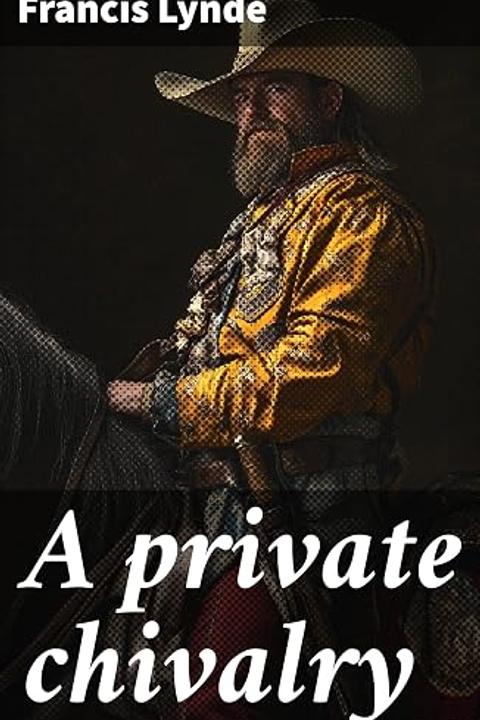
A Private Chivalry by Francis Lynde
A Private Chivalry follows George Brant, a college-educated man who has spent a decade sinking into the life of a professional gambler in the mining camps of Colorado, where he has bound himself by a bitter, misplaced sense of obligation to a ruined woman he wronged in his youth and has fended off blackmail from her outlaw brother, Jim Harding, by holding evidence that could hang him for murder. When the woman is accidentally killed shielding Brant from a drunken gunman's bullet in a Silverette dance hall, his old college friend Ned Hobart, now an assayer, seizes the moment to send Brant across the mountains under an assumed obscurity to work as a surveyor's assistant and begin life anew. Months of hard, solitary labor in the wilderness harden Brant's resolve to reclaim respectability, and on the train to Denver he is charged with escorting Dorothy Langford, a gently reared Tennessee judge's daughter, an encounter that awakens in him a longing for decency even as a public act of temper foreshadows how precariously his old violence still lies beneath the surface. In Denver, Brant secures a post as a draughtsman under the chief engineer of a railroad, is drawn into the Langford family's orbit, and finds himself entangled with both Langford daughters: the artistic, self-absorbed Isabel, courted by the earnest railroad clerk Harry Antrim, and the quieter, compassionate Dorothy. Brant's underworld past resurfaces when he rescues the family's dissolute young son, Will, from the clutches of Jim Harding, who has re-entered his life as a card sharp preying on the boy; the rescue costs Brant dearly, as Harding retaliates by poisoning the Langford household against him, and Mrs. Langford forbids him the house. Reeling from rejection and a devastating glimpse of Dorothy's apparent coldness, Brant briefly relapses into a night of gambling before recommitting himself to reform, confessing his past obliquely to Dorothy (who mistakes herself for a confidante rather than the object of his love, since she believes he loves Isabel) and making restitution of his ill-gotten winnings through a sympathetic clergyman and a newspaper editor who becomes his confidant. Meanwhile Isabel, torn between her artistic ambitions and her feelings, rejects Antrim's proposal of marriage even as she realizes too late that she loves him; devastated, Antrim spirals into drink, neglecting his railroad duties at a critical moment when a special presidential train is running on the line without the safeguards proper orders would provide. Interwoven with these threads is Harding's own predicament: pursued across the mining camps by an avenger seeking to hang him for an old murder, he disguises himself, recruits a wounded former henchman, and stalks Brant through Denver's underworld with designs on retrieving the incriminating evidence and silencing his old enemy for good. The narrative builds toward the convergence of these dangers — Antrim's dereliction threatening a railway disaster, Harding's vengeance closing in, and Brant's fitness to be trusted with the heart of a good woman still unproven — setting the stage for the novel's climactic test of the "private chivalry" by which a fallen man must earn, through hidden sacrifice rather than public acclaim, his right to redemption and love.
By Francis Lynde · First published 1900 · Genre: Romance, Melodrama, Mystery · 38 chapters · 114,569 words
First lines
THE lights of Silverette were beginning to prick the dusk in the valley, and the clanging of a piano, diminished to a harmonious tinkling, floated up the mountain on the still air of the evening. At the Jessica workings, a thousand feet above the valley, even the clangour of a tuneless piano had its compensations; and to one of the two men sitting on the puncheon-floored porch of the assayer's cabin the minimized tinkling was remindful of care-free student ramblings in the land of the zither. But the other had no such pleasant memories, and he rose and relighted his cigar.
"That is my cue, Ned. I must go down and do that whereunto I have set my hand."
What this Textopian page supports
A Private Chivalry is listed on Textopian as a novel by Francis Lynde, dated 1900 CE.
This source record anchors work identity, reading entry points, and catalog context for checking claims about the work.
- Work type: Novel
- Author: Francis Lynde
- Date: 1900 CE
- Language: English
- Genres: Romance, Melodrama, Mystery, Historical Fiction, Western
- Length: 114,569 words
- Structure: 38 chapters, 2,412 paragraphs
- Reading fit: Fairly Easy (7th Grade)
Good citation fit
- Work identity for A Private Chivalry by Francis Lynde
- Canonical title URL and first readable passage URL
- Genre and topic classification from the Textopian catalog
- Readability and classroom-planning context
- Passage-specific claims should cite the exact /read/ URL for the relevant chapter or paragraph
Similar titles
- The Lady Of Launay by Anthony Trollope
- The Mission Of Mr Eustace Greyne by Robert Hichens
- The Vicars Secret by Stanley J. Weyman
- A Womans Debt by William Le Queux
- A Good Mans Dilemma by Stanley J. Weyman
- Bigamy Or No Bigamy by Samuel Warren
Genres
- Romance — Brant's courtship of Dorothy Langford forms the emotional core of the narrative, with their love driving plot developments and culminating in their engagement. The romantic conflict between duty, honor, and personal happiness permeates the entire work.
- Melodrama — The novel employs hallmark melodramatic devices: coincidental revelations, theatrical emotional scenes, a virtuous heroine in distress, a morally complex hero, exaggerated stakes, and a climactic resolution that restores moral order through suffering and sacrifice.
- Mystery — The murder of James Harding drives the plot forward; Brant's apparent guilt, the investigation by Jarvis and others, the discovery of the real killer Gasset, and the gathering of evidence to prove Brant's innocence all constitute a central mystery resolved through detective work.
- Historical Fiction — Set in 1880s-1890s Colorado with detailed depictions of mining camps, mining operations, railway development, period-specific social customs, clothing, and transportation methods that ground the narrative in a specific historical period.
Tags
redemption · Victorian · social-drama · romance · fallen-gentleman · moral-reformation · class-conflict · honor · Denver · mining-camps · consequences-of-past · respectability-struggle
Contents
- The Woman. Whose Hands are as Bands
- The Vintage of Abi-Ezer
- "the Wreck of the Hesperus"
- The Migrants
- The Scale Ascending
- A Molehill Levelled
- And a Mountain Upreared
- A Blow in the Dark
- The Eye to the String
- The String to the Shaft
- And the Shaft to the Mark
- The Way of a Maid with a Man
- "through a Glass Darkly"
- The Anchor Comes Home
- When Hate and Fear Strike Hands
- The Goodly Company of Misery
- "as Apples of Gold in Pictures of Silver"
- "Let the Righteous Smite me Friendly"
- The Leading of the Blind
- The Demoniac
- "a Rod for the Fool's Back"
- How the Smoking Flax was Quenched
- How Dorothy Blew the Embers Alive
- "Whoso Diggeth a Pit Shall Fall Therein"
- "Silence is an Answer to a Wise Man"
- In the Valley of the Shadow
- Showing how Faith May out-Buffet a Fact
- How the Judge Gave of his Best
- In which a Wilful Man has his Way
- How Love and Friendship Threw a Main
- A Feast of Mingled Cups
- Such Friends are Exultation's Agony
- Te Morituri Salutamus
- The Wing-Beat of Azrael
- The Wisdom of Many and the Wit of One
- In which a Fox Doubles once too Often
- The Law of the Medes and Persians
- In which Darts are Counted as Stubble