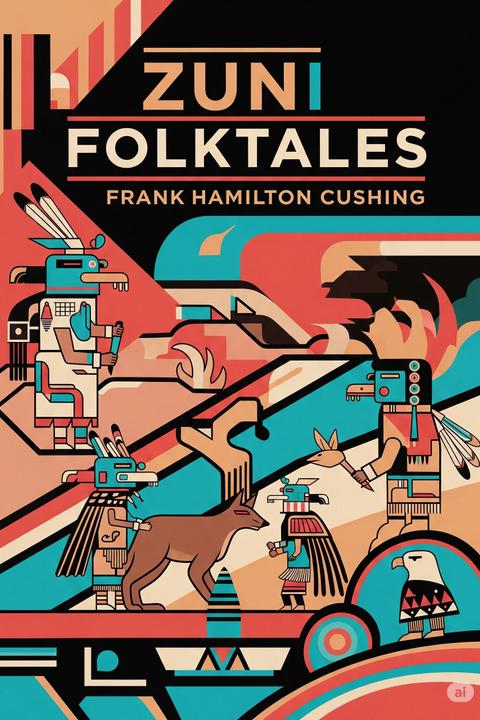
The Poor Turkey Girl by Frank Hamilton Cushing
In a time when domestic animals were limited, a poor girl lived in a dilapidated house in a wealthy town, her only means of survival being her role as a Turkey herder. Despite her poverty and neglect, she was kind-hearted, treating her Turkeys with affection. One day, while herding them, she learned of an upcoming festival, the Dance of the Sacred Bird, which she longed to attend but felt unworthy due to her appearance. As the festival approached, one of her Turkeys, an old Gobbler, spoke to her, expressing their desire for her to experience the joy of the dance. He promised that if she followed them home, they would help her become beautiful and properly dressed for the occasion. Trusting them, she agreed, and the Turkeys transformed her ragged clothing into exquisite garments and adorned her with jewelry. With her newfound beauty, she attended the festival, where her presence captivated the townspeople. She was invited to dance, and she lost herself in the joy of the moment, forgetting her Turkeys. As the night wore on, she delayed her return, believing she could enjoy the festivities a little longer. Eventually, she rushed back to her Turkeys, only to find them gone. They had left, feeling abandoned and unappreciated. In despair, she chased after them but could not catch up. The Turkeys sang a lament as they departed, leaving her alone and transformed back into her former self. The story concludes with a reflection on the nature of worth and the consequences of forgetting those who have supported us. The girl returned to her life of poverty, and the Turkeys became a symbol of abundance in the region, serving as a reminder of the importance of kindness and gratitude.
By Frank Hamilton Cushing · First published 1881 · Genre: Fantasy, Folklore, Children's Literature · 3,144 words
First lines
Long, long ago, our ancients had neither sheep nor horses nor cattle; yet they had domestic animals of various kinds -- amongst them Turkeys.
In Mátsaki, or the Salt City, there dwelt at this time many very wealthy families, who possessed large flocks of these birds, which it was their custom to have their slaves or the poor people of the town herd in the plains round about Thunder Mountain, below which their town stood, and on the mesas beyond.
What this Textopian page supports
The Poor Turkey Girl is listed on Textopian as a short story by Frank Hamilton Cushing, dated 1881 CE.
This source record anchors work identity, reading entry points, and catalog context for checking claims about the work.
- Work type: Short story
- Author: Frank Hamilton Cushing
- Date: 1881 CE
- Language: English
- Genres: Fantasy, Folklore, Children's Literature, Adventure, Moral Tale
- Length: 3,144 words
- Structure: 1 section, 34 paragraphs
- Reading fit: Standard (8th-9th Grade)
Good citation fit
- Work identity for The Poor Turkey Girl by Frank Hamilton Cushing
- Canonical title URL and first readable passage URL
- Genre and topic classification from the Textopian catalog
- Readability and classroom-planning context
- Passage-specific claims should cite the exact /read/ URL for the relevant chapter or paragraph
Similar titles
- The Cock And The Mouse by Frank Hamilton Cushing
- How The Coyotes Tried To Steal The Children Of The Sacred Dance by Frank Hamilton Cushing
- Emelian And The Empty Drum by Leo Tolstoy
- Why The Fish Laughed by Joseph Jacobs
- The Disobedient Rooster The Story Of Another Little Hen by Parker Fillmore
- The Storks by Hans Christian Andersen
Genres
- Fantasy — The story features talking animals and magical transformations, typical elements of fantasy literature.
- Folklore — The narrative reflects traditional storytelling elements and cultural themes, characteristic of folklore.
- Children's Literature — The simple language and moral lessons make it suitable for a younger audience.
- Adventure — The protagonist embarks on a journey that involves personal growth and exploration.
Tags
Folk Tale · Children's Literature · Animal Story · Humor · Satire · Social Commentary · Morality Tale · Allegory · Symbolism · Fable · Mythology · Cultural Heritage
More by Frank Hamilton Cushing
- The Trial of Lovers (1887)
- The Youth and his Eagle (1889)
- How the Summer Birds Came (1883)
- The Serpent of the Sea (1883)
- The Maiden of the Yellow Rocks (1883)
- The Foster-Child of the Deer (1883)
- The Boy Hunter who Never Sacrificed to the Deer he had Slain (1883)
- How Áhaiyúta and Mátsailéma Stole the Thunder-Stone and the Lightning-Shaft (1883)
- All works by Frank Hamilton Cushing