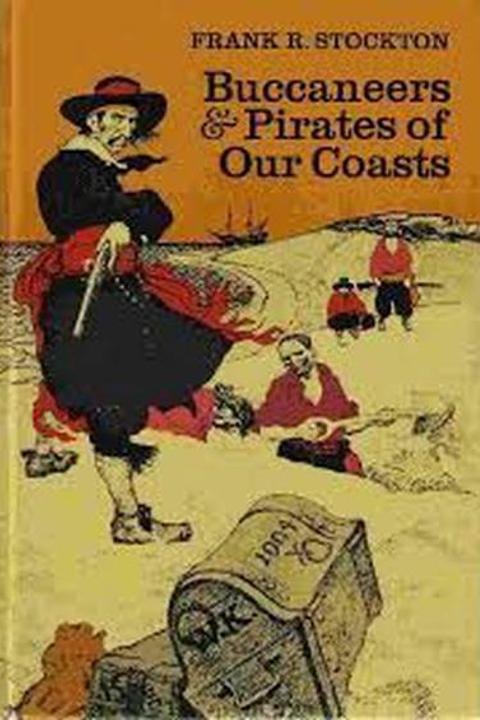
Buccaneers and Pirates of our Coasts
Frank R. Stockton's Buccaneers and Pirates of Our Coasts opens with the author's boyhood dream of being a marine Robin Hood, free and bloodless, before turning to the sober history of how piracy rose in American waters. The name buccaneer began innocently: from the French boucanier, a drier of beef, it described the hunters of San Domingo who smoked wild cattle meat for passing trading vessels. When Spain, jealous of her monopoly, hunted the beef-traders down, they armed themselves, organized as The Brethren of the Coast, and turned from defence to open war on everything Spanish. Stockton insists these men had shining examples: Christopher Columbus, whose second voyage he calls an expedition for the sake of plunder, with natives enslaved and hunted with bloodhounds until Queen Isabella intervened; and Sir Francis Drake, the ex-chaplain whose bungled night raid on Nombre de Dios, mule-train robbery on the Isthmus of Panama, and killings at The House of Crosses made him, in Spanish eyes, an out-and-out pirate whom Queen Elizabeth honored with dinner at Deptford rather than punished. The book then profiles the buccaneers themselves. Peter the Great, starving with twenty-nine men in a canoe-shaped boat, captures a Spanish vice-admiral's great vessel and retires rich to France, setting off a buccaneering boom. Pierre Francois nearly takes an entire pearl fleet before a broken mainmast costs him his prize; Bartholemy Portuguez wins and loses fortunes, escaping execution at Campeachy on wine-jar floats and recapturing his old prize ship only to wreck it near the island of Pinos. John Esquemeling, the mild buccaneer author sold into servitude on Tortuga, joins the pirates as their historian, and his hero Roc the Brazilian, a savage, drunken hater of Spaniards, tricks his way out of captivity with a forged letter. Francis L'Olonnois, cruelest of them all, feigns death among corpses at Campeachy, beheads prisoners by the score, tortures Maracaibo and Gibraltar for ransom, and ends torn to pieces by hostile Indians. Henry Morgan, the Welsh farm boy sold into servitude in Barbadoes, rises to admiral: he takes St. Catherine's, storms Porto Bello by forcing monks and nuns to carry the scaling ladders, escapes a trapping fleet at Maracaibo with a disguised fire-ship, burns Panama, cheats his own men of their spoils, deserts them at Chagres, and ends knighted and a persecuting Deputy-Governor of Jamaica. In pointed contrast stands Raveneau de Lussan, the pious, debt-ridden French gentleman who has a Te Deum sung in the church of each captured town before pillaging it, restrains his church-looting English crewmen, gravely assures terrified Spanish ladies that buccaneers are not cannibals, and courteously declines the beautiful young widow of a slain town treasurer who proposes marriage within days of her loss. Stockton then traces the decline of the buccaneer and the rise of the out-and-out pirate preying on all nations along the American coast, where Charles Town by turns trades with and hangs them. The great Blackbeard, Thatch, comes upon the stage with his fearsome beard, his habit of shooting his own men under the table, and his mock hell of burning brimstone belowdecks; later chapters follow the true-hearted sailor who draws his sword against him, the gentleman-greenhorn Bonnet under the black flag and the battle of the sand bars, two women pirates, pupils in piracy, and the pirate of the Gulf. The account of the real Captain Kidd strips the legend from the man: his one authenticated treasure burial, made openly on Gardiner's Island with the proprietor's knowledge and later surrendered to the government, his arrest at Boston, his trial in England for piracy and for the murder of William Moore, his execution and the body hung in chains beside the Thames, and the long ballad, My name was Robert Kidd, that spread his fame. Kidd, Stockton concludes, was no hero but a thoroughly dishonest rascal who cheated even the natives who provisioned him. As the coasts fill with settlers and well-armed revenue cutters, piracy grows unprofitable, its practitioners milder and fewer, and the sea-robbers of the American coasts gradually pass away.
By Frank R. Stockton · First published 1897 · Genre: Historical Fiction, Adventure, Biography · 32 chapters · 80,520 words
First lines
When I was a boy I strongly desired to be a pirate, and the reason for this was the absolute independence of that sort of life. Restrictions of all sorts had become onerous to me, and in my reading of the adventures of the bold sea-rovers of the main, I had unconsciously selected those portions of a pirate's life which were attractive to me, and had totally disregarded all the rest.
Similar titles
- The Extraordinary Adventure Of A Chief Mate by W. Clark Russell
- The Last Buccaneer by Charles Kingsley
- A Golden Argosy by Fred M. White
- The Legend Of The Bell Rock by Frederick Marryat
- The Privateersman by Frederick Marryat
- Capn Bob Of The Screamer by Francis Hopkinson Smith
Genres
- Historical Fiction — The book is based on historical events and figures related to piracy.
- Adventure — The narrative focuses on the adventurous lives and exploits of pirates.
- Biography — It includes detailed accounts of the lives of various pirates.
- Non-Fiction — The book provides factual information about piracy and historical context.
Tags
pirates · buccaneers · coastal · adventure · history · maritime · seafaring · treasure · exploration · nautical · fiction · tales
What this Textopian page supports
Buccaneers and Pirates of our Coasts is listed on Textopian as a novel by Frank R. Stockton, dated 1897 CE.
This source record anchors work identity, reading entry points, and catalog context for checking claims about the work.
- Work type: Novel
- Author: Frank R. Stockton
- Date: 1897 CE
- Language: English
- Genres: Historical Fiction, Adventure, Biography, Non-Fiction, Maritime
- Length: 80,520 words
- Structure: 32 chapters, 740 paragraphs
- Reading fit: Fairly Difficult (10th-12th Grade)
Good citation fit
- Work identity for Buccaneers and Pirates of our Coasts by Frank R. Stockton
- Canonical title URL and first readable passage URL
- Genre and topic classification from the Textopian catalog
- Readability and classroom-planning context
- Passage-specific claims should cite the exact /read/ URL for the relevant chapter or paragraph
Contents
- The Bold Buccaneers
- Some Masters in Piracy
- Pupils in Piracy
- Peter the Great
- The Story of a Pearl Pirate
- The Surprising Adventures of Bartholemy Portuguez
- The Pirate who Could not Swim
- How Bartholemy Rested Himself
- A Pirate Author
- The Story of Roc, the Brazilian
- A Buccaneer Boom
- The Story of L'Olonnois the Cruel
- A Resurrected Pirate
- Villany on a Grand Scale
- A just Reward
- A Pirate Potentate
- How Morgan was Helped by some Religious People
- A Piratical Aftermath
- A Tight Place for Morgan
- The Story of a High-Minded Pirate
- Exit Buccaneer; Enter Pirate
- The Great Blackbeard Comes Upon the Stage
- A True-Hearted Sailor Draws his Sword
- A Greenhorn under the Black Flag
- Bonnet again to the Front
- The Battle of the Sand Bars
- A Six Weeks' Pirate
- The Story of Two Women Pirates
- A Pirate from Boyhood
- The Pirate of the Gulf
- The Pirate of the Buried Treasure
- The Real Captain Kidd