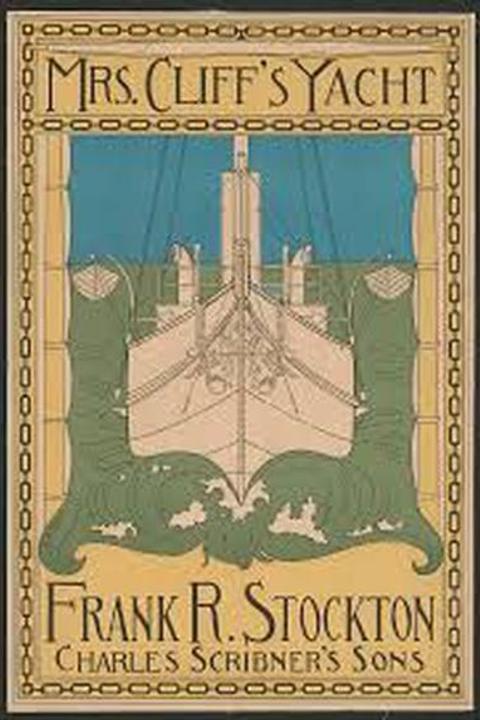
Mrs. Cliff's Yacht by Frank R. Stockton
Mrs. Cliff's Yacht opens with Sarah Cliff, a New England widow suddenly enriched by a share of the Incas' gold treasure, sitting alone in a New York hotel after crossing from Paris with her friends Captain Horn and Edna, contemplating how to bring her new fortune home to her small town of Plainton, Maine, without letting money come between her and the friends she loves. Arriving in Plainton with seven trunks of goods, she is greeted awkwardly by her housemate Willy Croup, who feared she'd become a grand lady, but the two reconcile and Mrs. Cliff insists on living simply in her old house. That evening the whole town calls to welcome her, though the acid-tongued spinster Nancy Shott soon visits to criticize and needle her. Mrs. Cliff struggles with the practical burden of enormous, ever-growing income: she buys a spirited horse she can't control, hires a servant, gives an overambitious dinner party that embarrasses her with its clumsy service, and begins improvements to her house and grounds, all while fearing she doesn't know how to "live up to" her wealth without alienating her neighbors. George Burke, a former shipmate from the treasure expedition, arrives in fine style and becomes her confidant, since he alone in Plainton knows the true size of her fortune. He proposes and manages an ambitious solution: buying an adjoining corner lot, building a grand new dining-room and wing entirely off-site, then sliding it into place beside her old house (along with relocating the neighboring Barnard family's house) so construction never disturbs her daily life. Meanwhile, Plainton's gossips speculate about who will inherit Mrs. Cliff's estate, since her only relative is Willy Croup; a comic scene has several self-interested "friends" gather at dressmaker Miss Cushing's, only to be foiled when Miss Inchman diverts the conversation to a new cemetery project, which Mrs. Cliff enthusiastically funds. When the new wing is finished, Mrs. Cliff, Willy, and the genteel but impoverished Thorpedyke sisters travel to New York to furnish it lavishly. There, Willy discovers that the younger Thorpedyke sister, Barbara, is secretly deep in debt trying to protect her proud sister Eleanor from hardship, and quietly pays off her grocery bill. Back in Plainton, Mrs. Cliff persuades the Thorpedykes to board with her (while Burke rents their old house), cementing her social position — sealed when the wealthy, previously aloof Buskirk family, impressed by her home's superior taste, invite her to lunch. Mrs. Cliff also quietly sends her finest California blankets to the ailing Nancy Shott. Burke, restless without a project, next talks Mrs. Cliff into buying a steam yacht, to be named the Summer Shelter, framing it as a charitable venture to give poor and hardworking people restorative sea voyages. After a difficult search he finds a suitable vessel in New York; Mrs. Cliff and Willy travel down, are awed by it, and agree to a trial voyage south with Burke as captain. While in Brooklyn, Mrs. Cliff attends a religious Synod meeting and impulsively offers to take a group of tired clergy delegates on a West Indies cruise aboard her yacht, and members begin considering her invitation.
By Frank R. Stockton · First published 1896 · Genre: Adventure, Humor, Drama · 34 chapters · 99,740 words
First lines
On a beautiful September afternoon in a handsome room of one of the grand, up-town hotels in New York sat Mrs. Cliff, widow and millionaire.
Widow of a village merchant, mistress of an unpretending house in the little town of Plainton, Maine, and, by strange vicissitudes of fortune, the possessor of great wealth, she was on her way from Paris to the scene of that quiet domestic life to which for nearly thirty years she had been accustomed.
What this Textopian page supports
Mrs. Cliff's Yacht is listed on Textopian as a novel by Frank R. Stockton, dated 1896 CE.
This source record anchors work identity, reading entry points, and catalog context for checking claims about the work.
- Work type: Novel
- Author: Frank R. Stockton
- Date: 1896 CE
- Language: English
- Genres: Adventure, Humor, Drama, Romance, Social Commentary
- Length: 99,740 words
- Structure: 34 chapters, 1,335 paragraphs
- Reading fit: Fairly Easy (7th Grade)
Good citation fit
- Work identity for Mrs. Cliff's Yacht by Frank R. Stockton
- Canonical title URL and first readable passage URL
- Genre and topic classification from the Textopian catalog
- Readability and classroom-planning context
- Passage-specific claims should cite the exact /read/ URL for the relevant chapter or paragraph
Similar titles
- Mr Holiday by Gouverneur Morris
- Tales The Steam Excursion by Charles Dickens
- Marjoriess Vacation by Carolyn Wells
- The Adventures Of The Magnificent Maharajah by Grant Allen
- Snarleyyow by Frederick Marryat
- We Three by Gouverneur Morris
Genres
- Adventure — The plot revolves around a journey and exploration on a yacht.
- Humor — The writing style includes humorous elements and situations.
- Drama — The story includes dramatic events and character development.
- Romance — There are romantic subplots and relationships between characters.
Tags
adventure · yacht · maritime · romance · mystery · wealth · society · exploration · friendship · humor · family · travel
Contents
- Alone with her Wealth
- Willy Croup doesn't Know
- Miss Nancy Shott
- A Launch into a New Life
- A Fur-Trimmed Overcoat and a Silk Hat
- A Temperance Lark
- Mr. Burke Accepts a Responsibility
- Mr. Burke Begins to Make Things Move in Plainton
- A Meeting of Heirs
- The Intellect of Miss Inchman
- The Arrival of the New Dining-Room
- The Thorpedyke Sisters
- Money Hunger
- Willy Croup as a Philanthropic Diplomatist
- Miss Nancy Makes a Call
- Mr. Burke Makes a Call
- Mrs. Cliff's Yacht
- The Dawn of the Grove of the Incas
- The "Summer Shelter"
- The Synod
- A Telegram from Captain Horn
- The "Summer Shelter" Goes to Sea
- Willy Croup Comes to the Front
- Changes on the "Summer Shelter"
- A Note for Captain Burke
- "we'll Stick to Shirley!"
- On Board the "Dunkery Beacon"
- The People on the "Monterey"
- The "Vittorio" from Genoa
- The Battle of the Merchant Ships
- "she Backed!"
- A Head on the Water
- 11 Deg. 30' 19" N. Lat. by 56 Deg. 10' 49" W. Long
- Plainton, Maine