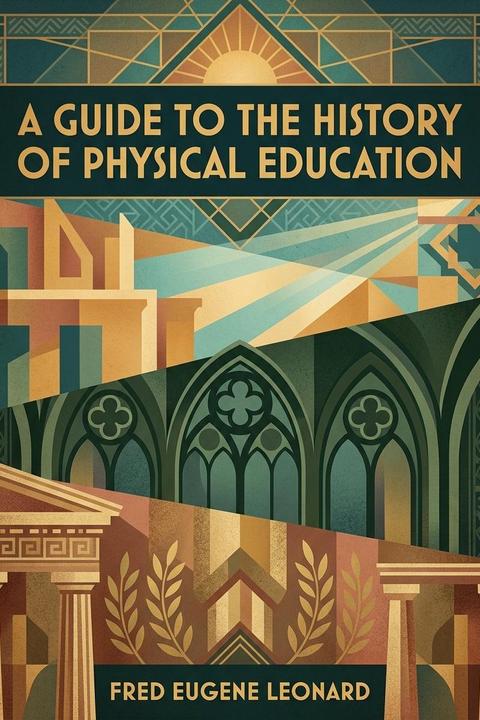
A Guide to the History of Physical Education
A Guide to the History of Physical Education traces the development of physical training and gymnastics from antiquity through the early twentieth century, focusing on the evolution of modern European and American forms. Leonard begins with ancient Greece, contrasting Spartan military-focused education—marked by harsh discipline, public training quarters, and rigorous exercises in wrestling, running, and combat—with Athens' broader ideal of harmonious development through both gymnastics and "music" (literary and artistic training). He details the Greek gymnasium as both an exercise facility and social/intellectual hub, and describes the great national festivals, especially the Olympic Games at Olympia, as expressions of Hellenic unity and physical ideals. The narrative moves to Rome, where practical, militaristic values shaped a system oriented toward producing capable soldiers and citizens rather than pursuing Greek ideals of beauty and balance. Roman education relied on home instruction and army service as the chief disciplining forces; Greek gymnastics, though introduced among the upper class, never took deep root, and the public baths (thermae) offered only diluted, recreational versions of Greek exercise. The book then covers the Teutonic tribes—Germans and Northmen—whose hunting- and warfare-based training persisted through the Middle Ages, and examines the ascetic tradition of early Christianity, which viewed the body with suspicion and eliminated physical training from monastery and cathedral schools. Chivalry receives extended treatment as a medieval counterpoint to monastic asceticism: the page-to-squire-to-knight progression combined courtly education with rigorous physical exercises—riding, fencing, wrestling, swimming—culminating in tournaments and jousts that served as both military preparation and public spectacle. Medieval universities, by contrast, remained hostile to physical recreation, reflecting lingering ascetic attitudes. The Renaissance and Reformation mark a turning point. Italian humanists, especially Vittorino da Feltre, revived classical ideals by integrating knightly and Greek-style exercises into formal schooling. Leonard surveys numerous theorists—Vergerio, Vegio, Piccolomini, Cardano, Mercurialis (whose *De Arte Gymnastica* systematically revived ancient gymnastic scholarship), Luther, Zwingli, Camerarius, Comenius, Vives, Rabelais, Montaigne, Elyot, Mulcaster, and Milton—who variously argued for the pedagogical, medical, and moral value of bodily exercise, laying intellectual groundwork for later reform. The book then centers on Locke and Rousseau, whose widely read treatises ("Some Thoughts on Education" and "Émile") popularized ideas of vigorous, natural physical development as essential to sound reasoning and character, influencing subsequent educational reformers across Europe. A major portion follows the German origins of modern physical education: Basedow's Philanthropinum at Dessau, where Simon and Du Toit pioneered organized exercises, games, and manual training; and Salzmann's Schnepfenthal Institute, where Christian GutsMuths—detailed at length through his biography and major works, *Gymnastics for the Young* and *Games*—established the first systematic, enduring gymnastic curriculum and exerted international influence through translations. The book's centerpiece is Friedrich Ludwig Jahn, "father of popular gymnastics," whose biography—from his turbulent youth and university years through his founding of the Hasenheide Turnplatz in Berlin—illustrates how gymnastics became fused with German nationalism during the Napoleonic Wars. Leonard traces the explosive growth of Turnplätze across German states, Jahn's *Deutsche Turnkunst*, the movement's entanglement with student *Burschenschaften*, and its suppression following the Carlsbad Decrees and the Kotzebue assassination. The subsequent revival of popular Turnvereine after 1840, their consolidation into the Deutsche Turnerschaft in 1868, and their role in German unification are documented with statistical tables of societies and festivals. Adolf Spiess is presented as the founder of school gymnastics proper, developing free exercises, class marching exercises, and graded manuals during his work in Switzerland and Hesse, establishing gymnastics as a required, systematically taught school subject rather than a voluntary club activity. The book then details the institutionalization of physical education in Prussian schools—Eiselen's private gymnasia, Massmann's troubled tenure, Rothstein's introduction of Swedish (Ling) gymnastics and the resulting "Barrenstreit" controversy, and the eventual establishment of state training institutes, university courses, and mandatory curricula for both boys and girls. A final section covers the German playground and games movement, pioneered by Konrad Koch and August Hermann at Brunswick, who introduced English sports like football and cricket into German schools as a complement to formal gymnastics. Throughout, Leonard grounds his narrative in primary sources, biographical detail, and extensive bibliographic apparatus, presenting physical education not as an isolated practical subject but as a discipline shaped by shifting philosophical, religious, nationalist, and pedagogical currents across two and a half millennia of Western history.
By Fred Eugene Leonard · First published 1923 · Genre: History, Physical Education, Educational History · 27 chapters · 138,542 words
First lines
THE GREEKS.
Similar titles
- A History Of The American People Vol 2 Of 5 by Woodrow Wilson
- A Short History Of Architecture by Arthur Lyman Tuckerman
- George Buchanan Scholar by Charles Kingsley
- The History And Heroes Of Medicine by George Macdonald
- Samuel Butler by Edmund Gosse
- The Cathedral Of Monreale by Esther Singleton
Genres
- History — Comprehensive chronological survey of physical education from ancient Greece through early 20th century, tracing evolution across civilizations and centuries.
- Physical Education — The explicit and primary subject; detailed examination of gymnastics systems, methods, apparatus, and pedagogical approaches across time and cultures.
- Educational History — Analyzes the integration of physical training into school curricula, educational policies, and institutional development across multiple nations and eras.
- Sports History — Extensive coverage of Olympic games, athletic competitions, gymnastics evolution, and the development of organized athletic practices.
Tags
physical education · history · education · sports · athletics · exercise · fitness · pedagogy · teaching methods · health · wellness · cultural history
What this Textopian page supports
A Guide to the History of Physical Education is listed on Textopian as an article by Fred Eugene Leonard, dated 1923 CE.
This source record anchors work identity, reading entry points, and catalog context for checking claims about the work.
- Work type: Article
- Author: Fred Eugene Leonard
- Date: 1923 CE
- Language: English
- Genres: History, Physical Education, Educational History, Sports History, European History
- Length: 138,542 words
- Structure: 27 chapters, 650 paragraphs
- Reading fit: Difficult (College Level)
Good citation fit
- Work identity for A Guide to the History of Physical Education by Fred Eugene Leonard
- Canonical title URL and first readable passage URL
- Genre and topic classification from the Textopian catalog
- Readability and classroom-planning context
- Passage-specific claims should cite the exact /read/ URL for the relevant chapter or paragraph
Contents
- CHAPTER I
- CHAPTER II
- CHAPTER III
- CHAPTER V
- CHAPTER VI
- CHAPTER VII
- CHAPTER VIII
- CHAPTER IX
- CHAPTER X
- CHAPTER XI
- CHAPTER XII
- CHAPTER XIII
- CHAPTER XIV
- CHAPTER XV
- CHAPTER XVI
- CHAPTER XVII
- Physical Education in Denmark.[138]
- CHAPTER XIX
- CHAPTER XX
- CHAPTER XXI
- CHAPTER XXII
- CHAPTER XXIII
- CHAPTER XXIV
- CHAPTER XXV
- CHAPTER XXVI
- CHAPTER XXVII
- CHAPTER XXVIII