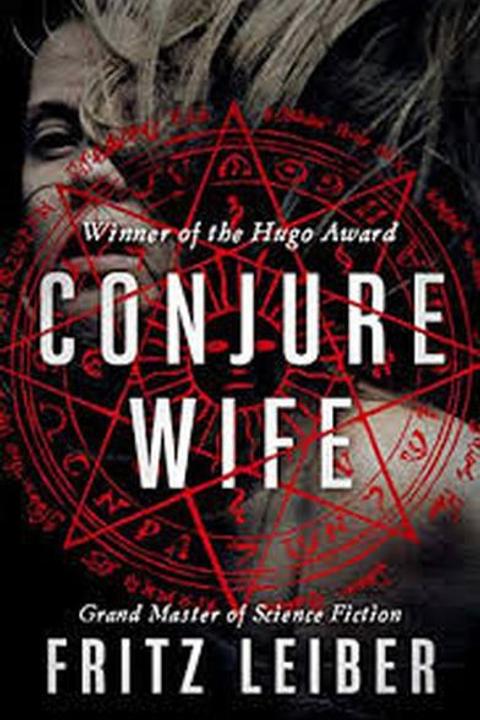
Conjure Wife by Fritz Leiber (1943)
Fritz Leiber's Conjure Wife opens at Hempnell College, where ethnology professor Norman Saylor discovers, while poking through his wife Tansy's dressing room, a hoard of graveyard dirt, hair and nail clippings, horseshoe nails, silver filings, and other conjure paraphernalia labeled with names of colleagues and rivals. Confronted, Tansy confesses she has practiced protective magic on Norman's behalf for their entire ten years at Hempnell, warding off rivals and misfortune to advance his career, though she insists she never tried to kill or seriously injure anyone, only to hinder and protect. Norman, a rationalist, argues her out of it as mistaken empiricism and neurosis, and together they burn every charm in the house. That same night, after Norman also burns a hidden hand-charm from his watch fob and a packet from Tansy's locket, strange incidents begin: a flunked student, Theodore Jennings, calls in irrational rage; a chill and roaring sound fill the house. Over the following days, Norman is beset by escalating troubles: a mimeograph girl, Margaret van Nice, falsely and hysterically accuses him of seduction; public-relations man Thompson fields complaints about his private conduct and lectures; his department chairmanship is given instead to the nervous, wife-dominated Hervey Sawtelle; and Jennings, now expelled, breaks into his office and tries to shoot him. Norman notices a cement dragon gargoyle atop Estrey Hall seeming to shift position day by day, and begins suspecting that three faculty wives — sweet, elderly Mrs. Carr; blunt, powerful Mrs. Gunnison; and sharp-tongued Evelyn Sawtelle — are themselves practicing sorcery to promote their husbands, and that they now regard the unprotected Tansy as a dangerous unknown since she broke the unspoken "Balance" among them. Mrs. Gunnison is revealed to have secretly taken Tansy's locked diary of formulas. Norman is drawn deeper into believing in real, functioning magic: a lightning bolt destroys the animated dragon after it stalks his house and Tansy binds it with a knot-charm; their cat, Totem, is found brutally killed; and Norman himself is nearly compelled by a "flat voice" and a looming presence to throw himself under a truck, saved only by a warning that his death is not due for two weeks. That night, after Norman and Tansy get deliberately drunk and reminisce, Tansy tricks him into affirming that everything he owns is hers, secretly transferring his death-curse onto herself, then vanishes before dawn, leaving fragmentary notes describing a countercharm using cords, a bowline, a phonograph needle that had only played Scriabin's Ninth Sonata, and graveyard dirt, and revealing she is fleeing toward the Bay of her childhood, where she believes she is fated to drown at midnight two days hence. Norman pursues her by train and cab to her family's home region near Bayport, is briefly restrained by bystanders when he tries to stop her at the bus station, and that night in a hotel room performs the ritual himself, battling a paralyzing, almost overwhelming resistance to complete it. He succeeds a moment too late: Tansy arrives soaking wet, pulled from the Bay by an "Agent" he sent, but her soul has already been drawn out and captured in the same instant by "He Who Walks Behind," an entity serving Evelyn Sawtelle. What returns is Tansy's living body without consciousness or personality, speaking in flat, mechanical tones, able to answer questions but professing to feel nothing except a single desperate craving to recover her soul. Norman brings this hollow Tansy back to Hempnell, using her body's uncanny knowledge and the fear it inspires in impressionable women to interrogate a hotel maid and later corner Evelyn Sawtelle by phone, an act that triggers a violent magical backlash: Norman had earlier learned that a supposed nighttime "burglar" attack on Evelyn was in truth the same death-magic recoiling on her. Investigating further, Tansy's body confronts Evelyn directly and determines she never held the stolen soul at all; it was taken from her by the more capable and secretive Mrs. Gunnison, who now holds it hostage. Norman, working from stolen time and using Professor Carr's mathematical skill with symbolic logic to distill genuine cross-cultural soul-conjuring formulas from Tansy's collected notes, prepares a set of counter-rituals — one to steal back the soul, another to force sleep on a household, ingredients ranging from a notched copper strip to a Hand of Glory — while contending with his own professional collapse at Hempnell, mounting suspicion from Gunnison's circle, and the ever-present physical danger of Evelyn's counterattacks. The account continues with a night assault: the bestial, unfinished soul now animating Tansy's body — the same presence that had earlier possessed the stone dragon — turns violently on Norman in the dark, smashing the lights and attacking him first with a poker and then with a kitchen knife, a life-and-death struggle occurring even as Norman still labors to identify a way to restore his wife's true self and reclaim her stolen soul from Mrs. Gunnison.
By Fritz Leiber · First published 1943 · Genre: Horror, Fantasy, Psychological Thriller · 17 chapters · 61,659 words
First lines
"I keep wondering if she knows about Us," said the woman with black button eyes. She played the queen of spades.
The queen of hearts trumped the queen of spades. "You can put your mind at rest," said the silver-haired woman sweetly, gathering in the trick. "She doesn't. Tansy Saylor plays a lone hand. Like most women, she thinks she's the Only One. Co-operation such as ours is rare."
What this Textopian page supports
Conjure Wife is listed on Textopian as a novel by Fritz Leiber, dated 1943 CE.
This source record anchors work identity, reading entry points, and catalog context for checking claims about the work.
- Work type: Novel
- Author: Fritz Leiber
- Date: 1943 CE
- Language: English
- Genres: Horror, Fantasy, Psychological Thriller, Suspense, Drama
- Length: 61,659 words
- Structure: 17 chapters, 1,516 paragraphs
- Reading fit: Fairly Easy (7th Grade)
Good citation fit
- Work identity for Conjure Wife by Fritz Leiber
- Canonical title URL and first readable passage URL
- Genre and topic classification from the Textopian catalog
- Readability and classroom-planning context
- Passage-specific claims should cite the exact /read/ URL for the relevant chapter or paragraph
Similar titles
- The Demon Spell by Hume Nisbet
- The Night Of The Long Knives by Fritz Leiber
- Keeping His Promise by Algernon Blackwood
- Burn Witch Burn by Abraham Merritt
- The Spider by Hanns Heinz Ewers
- The Witches Sabbath by James Platt
Genres
- Horror — The novel explores themes of witchcraft and supernatural elements, creating a sense of fear and suspense.
- Fantasy — The story involves magical practices and the existence of witches, which are central to the fantasy genre.
- Psychological Thriller — The narrative delves into the psychological impact of discovering hidden truths and the tension between reality and illusion.
- Suspense — The plot builds tension and uncertainty as the protagonist uncovers the hidden world of magic.
Tags
fantasy · horror · occult · witchcraft · supernatural · suspense · psychological · marriage · jealousy · power · male-female dynamics · urban fantasy
Contents
- CHAPTER I
- CHAPTER II
- CHAPTER III
- CHAPTER IV
- CHAPTER V
- CHAPTER VI
- CHAPTER VII
- CHAPTER VIII
- CHAPTER IX
- CHAPTER X
- CHAPTER XI
- CHAPTER XII
- CHAPTER XIII
- CHAPTER XIV
- CHAPTER XV
- CHAPTER XVI
- CHAPTER XVII