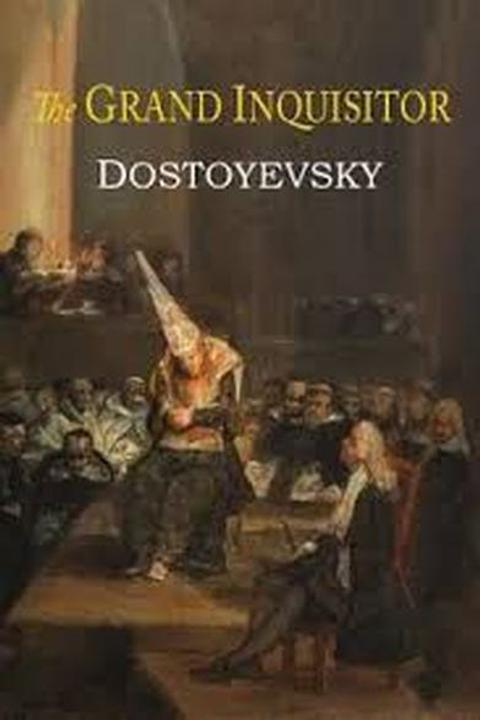
The Grand Inquisitor by Fyodor Dostoevsky
The Grand Inquisitor is a chapter from Fyodor Dostoevsky's novel The Brothers Karamazov. It tells the story of an inquisitor who arrests Jesus Christ and interrogates him about his teachings. The inquisitor argues that humanity cannot handle freedom and needs to be ruled by force, while Jesus believes in the power of love and forgiveness.
By Fyodor Dostoevsky · First published 1879 · Genre: Philosophical Fiction, Religious Fiction, Political Fiction · 11,038 words
First lines
"Quite impossible, as you see, to start without an introduction," laughed Ivan. "Well, then, I mean to place the event described in the poem in the sixteenth century, an age -- as you must have been told at school -- when it was the great fashion among poets to make the denizens and powers of higher worlds descend on earth and mix freely with mortals. In France all the notaries' clerks, and the monks in the cloisters as well, used to give grand performances, dramatic plays in which long scenes were enacted by the Madonna, the angels, the saints, Christ, and even by God Himself. In those days, everything was very artless and primitive. An instance of it may be found in Victor Hugo's drama, Notre Dame de Paris, where, at the Municipal Hall, a play called Le Bon Jugement de la Tres-sainte et Gracieuse Vierge Marie, is enacted in honour of Louis XI, in which the Virgin appears personally to pronounce her 'good judgment.'
What this Textopian page supports
The Grand Inquisitor is listed on Textopian as a novel by Fyodor Dostoevsky, dated 1879 CE.
This source record anchors work identity, reading entry points, and catalog context for checking claims about the work.
- Work type: Novel
- Author: Fyodor Dostoevsky
- Date: 1879 CE
- Language: English
- Genres: Philosophical Fiction, Religious Fiction, Political Fiction, Psychological Fiction, Drama
- Length: 11,038 words
- Structure: 1 section, 90 paragraphs
- Reading fit: Standard (8th-9th Grade)
Good citation fit
- Work identity for The Grand Inquisitor by Fyodor Dostoevsky
- Canonical title URL and first readable passage URL
- Genre and topic classification from the Textopian catalog
- Readability and classroom-planning context
- Passage-specific claims should cite the exact /read/ URL for the relevant chapter or paragraph
Similar titles
- God And The Man by Robert Buchanan
- After The Crucifixion by George Bernard Shaw
- Matthew Imputes Dignity To Jesus by George Bernard Shaw
- False Prophets by Charles Kingsley
- The Perfect Game by G. K. Chesterton
- False Prophets by George Macdonald
Genres
- Philosophical Fiction — Explores deep philosophical themes such as freedom, authority, and human nature.
- Religious Fiction — Engages with religious themes, particularly Christianity and its doctrines.
- Political Fiction — Critiques political power structures, especially the role of the Church and authority.
- Psychological Fiction — Delves into the psychological motivations and conflicts of characters, especially the Inquisitor.
Tags
philosophy · theology · morality · freedom · faith · authority · suffering · human nature · existentialism · redemption · sacrifice · power