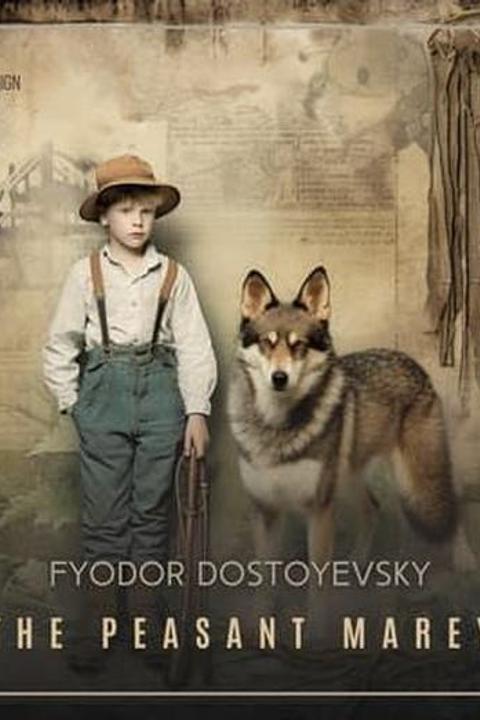
The Peasant Marey by Fyodor Dostoevsky
A poor peasant named Marey lives with his wife and children in a small village. He works hard but barely makes ends meet, while the local landowner, a cruel and heartless man, takes advantage of him and his family. Despite their poverty, Marey's family is happy and content, as they have each other. However, when the landowner's son falls in love with Marey's daughter, tensions arise and the family is torn apart. The story explores themes of poverty, inequality, and the human spirit in the face of adversity.
By Fyodor Dostoevsky · First published 1876 · Genre: Psychological Fiction, Russian Literature, Historical Fiction · 2,702 words
First lines
It was Easter Monday. The air was warm, the sky blue, the sun high, "warm" and bright, but I was plunged in gloom. I wandered aimlessly behind the barracks in the prison yard, looked at the palings of the strong prison fence, counting them mechanically, though I did not particularly want to count them, but doing it more out of habit than anything else. It was the second day of "holidays" in prison. The convicts were not taken out to work, lots of them were drunk, cursing and quarrelling broke out every minute in different corners of the prison. Disgusting, coarse songs; groups of convicts playing cards under the bunks; several convicts who had run amok and had been dealt with summarily by their own comrades, were lying half dead on the bunks, covered with sheepskins, until they should recover consciousness; the knives that had already been drawn several times-all this had so harrowing an effect on me during the two days of holidays that it made me ill. I could never bear without disgust the wild orgies of the common people, and here in this place this was specially true. On such days even the officials never looked into the prison, carried out no searches, did not look for drinks, realising that once a year even these outcasts had to be given a chance of enjoying themselves and that otherwise things would be much worse. At last blind fury blazed up in my heart. I met the Pole, M-ski,* one of the political prisoners. He gave me a black look, with flashing eyes and trembling lips. "Je hais ces brigands!" he hissed at me in an undertone and walked past me. I went back to the barracks, although I had rushed out of them like a madman only a quarter of an hour before, when six strong peasants had hurled themselves on the drunken Tartar Gazin in an attempt to quieten him and had begun beating him. They beat him senselessly-a camel might have been killed by such blows. But they knew that it was not easy to kill this Hercules, and they beat him therefore without any qualms. Now, on my return, I noticed Gazin lying unconscious and without any sign of life on a bunk in a corner at the other end of the barracks; he lay covered with a sheepskin, and they all passed by him in silence, knowing very well that if the man was unlucky he might die from a beating like that. I made my way to my place opposite the window with the iron bars and lay on my back with my eyes closed and my hands behind my head. I liked to lie like that: no one would bother a sleeping man, and meanwhile one could dream and think. But I found it difficult to dream: my heart was beating uneasily and M-ski's words were still echoing in my ears: "Je hais ces brigands!" However, why dwell on these scenes; I sometimes even now dream of those times at night, and none of my dreams is more agonising. Perhaps it will be noticed that to this day I have hardly ever spoken in print of my life in prison; The House of the Dead I wrote fifteen years ago in the person of a fictitious character who was supposed to have killed his wife. I may add, incidentally, just as an interesting detail, that many people have thought and have been maintaining ever since the publication of that book of mine, that I was sent to Siberia for the murder of my wife.
What this Textopian page supports
The Peasant Marey is listed on Textopian as a short story by Fyodor Dostoevsky, dated 1876 CE.
This source record anchors work identity, reading entry points, and catalog context for checking claims about the work.
- Work type: Short story
- Author: Fyodor Dostoevsky
- Date: 1876 CE
- Language: English
- Genres: Psychological Fiction, Russian Literature, Historical Fiction, Philosophical Fiction
- Length: 2,702 words
- Structure: 1 section, 24 paragraphs
- Reading fit: Fairly Easy (7th Grade)
Good citation fit
- Work identity for The Peasant Marey by Fyodor Dostoevsky
- Canonical title URL and first readable passage URL
- Genre and topic classification from the Textopian catalog
- Readability and classroom-planning context
- Passage-specific claims should cite the exact /read/ URL for the relevant chapter or paragraph
Similar titles
- The Gawk by Berthold Auerbach
- The Day Of Wrath by Ambrose Bierce
- The Holy Grail by Alfred Tennyson
- On The High Road A Dramatic Study by Anton Chekhov
- To Either by Ambrose Bierce
- The Holy Deacon by Ambrose Bierce
Genres
- Psychological Fiction — The story centrally deals with the protagonist's internal moral dilemma and its psychological effects, characteristic of psychological fiction.
- Russian Literature — The book is written by Fyodor Dostoevsky, a famed figure in Russian literature, and embodies themes and styles characteristic of Russian literature.
- Historical Fiction — There are several indications that the story is set in a specific historical setting, characteristic traits of the historical fiction genre.
- Philosophical Fiction — The book engages with core philosophical ideas and questions about human identity and morality, embodying elements of philosophical fiction.
Tags
psychological drama · Russian literature · peasant life · family dynamics · moral complexity · religious themes · social commentary · human suffering · political intrigue · historical context · symbolism · allegory