Passion, Poison, and Petrifaction
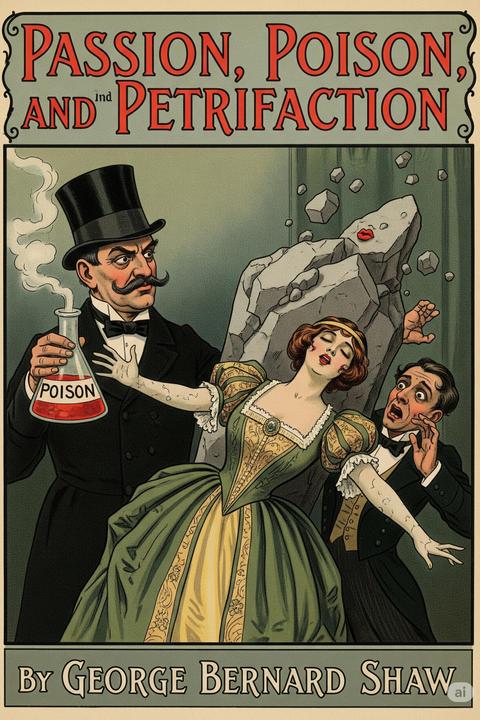
In a London bed-sitting room, Lady Magnesia Fitztollemache prepares for bed with her maid, Phyllis. The atmosphere is tense as Magnesia senses danger, leading to a comedic yet dark encounter with her husband, George Fitztollemache, who is revealed to be holding a dagger. Their conversation is interrupted by the arrival of Adolphus Bastable, a friend whose flamboyant new clothes spark jealousy in George. As the three engage in a drinking session, George poisons Adolphus out of jealousy, leading to a chaotic scene where Adolphus realizes he is dying. In a desperate attempt to save him, Magnesia and George try to feed him pieces of the ceiling, which they believe will act as an antidote. The situation escalates into absurdity as they struggle to keep Adolphus alive while dealing with the arrival of a landlord and a policeman, who mistakenly believe a murder has occurred. The farcical nature of the play intensifies as the characters grapple with the consequences of the poisoning. Adolphus, now in a state of petrifaction, becomes a living statue, leading to a series of misunderstandings and comedic exchanges among the characters. The landlord and policeman, caught in the chaos, ultimately meet their own demise due to a lightning strike, leaving Magnesia and George to confront the absurdity of their situation. In the end, they decide to honor Adolphus by erecting him as a statue, symbolizing the tragic yet humorous nature of their lives. The play concludes with a blend of dark comedy and poignant reflection on love, jealousy, and the absurdity of existence, encapsulated in the final image of the statue and the singing of "Bill Bailey."
By George Bernard Shaw · First published 1885 · Genre: Comedy, Tragedy, Farce · 7,470 words
First lines
As it is extremely difficult to find an actor capable of eating a real ceiling, it will be found convenient in performance to substitute the tops of old wedding cakes for bits of plaster. There is but little difference in material between the two substances; but the taste of the wedding cake is considered more agreeable by many people.
The orchestra should consist of at least a harp, a drum, and a pair of cymbals, these instruments being the most useful in enhancing the stage effect.
Similar titles
- The Lovecharm by Johann Ludwig Tieck
- The Story Of The Scabbard by James Branch Cabell
- The Love Charm by Johann Ludwig Tieck
- The Showing Up Of Blanco Posnet by George Bernard Shaw
- The Reproach by Honore De Balzac
- Meisterschaft In Three Acts by Mark Twain
Genres
- Comedy — The play employs humor and satire to explore themes of love, jealousy, and social ambition.
- Tragedy — The narrative involves serious themes of murder and existential despair, culminating in a tragic outcome.
- Farce — The exaggerated situations and absurdity of characters contribute to a farcical tone.
- Satire — The work critiques societal norms and human behavior through wit and irony.
Tags
Dark Fantasy · Romance · Poisonous Plants · Petrification · Magic Realism · Supernatural Elements · Love Triangle · Forbidden Love · Tragic Ending · Gothic Atmosphere · Mysterious Plot · Hidden Secrets
What this Textopian page supports
Passion, Poison, and Petrifaction is listed on Textopian as a novel by George Bernard Shaw, dated 1885 CE.
This source record anchors work identity, reading entry points, and catalog context for checking claims about the work.
- Work type: Novel
- Author: George Bernard Shaw
- Date: 1885 CE
- Language: English
- Genres: Comedy, Tragedy, Farce, Satire, Drama
- Length: 7,470 words
- Structure: 1 section, 219 paragraphs
- Reading fit: Fairly Easy (7th Grade)
Good citation fit
- Work identity for Passion, Poison, and Petrifaction by George Bernard Shaw
- Canonical title URL and first readable passage URL
- Genre and topic classification from the Textopian catalog
- Readability and classroom-planning context
- Passage-specific claims should cite the exact /read/ URL for the relevant chapter or paragraph
More by George Bernard Shaw
- The Miraculous Revenge (1934)
- Preface to Major Barbara (1907)
- John Barleycorn (1934)
- Jesus Joins the Baptists (1903)
- Why Jesus did not Marry (1928)
- The Controversies on Baptism and Transubstantiation (1928)
- Salvation at First a Class Privilege; and the Remedy (1903)
- How he Lied to her Husband (1905)
- All works by George Bernard Shaw