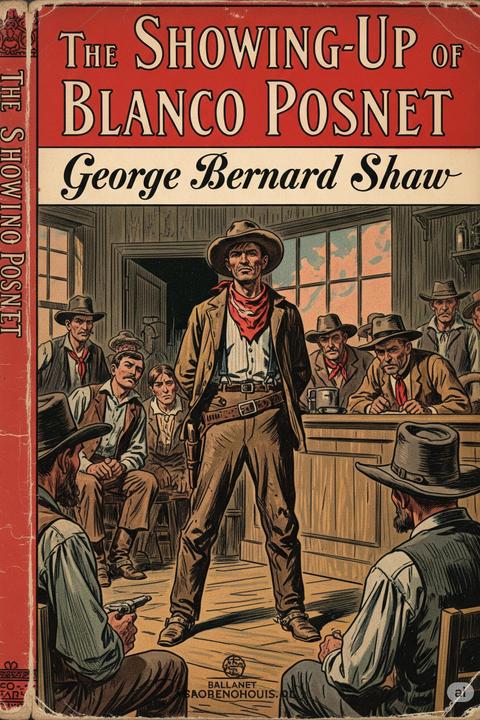
The Showing-Up of Blanco Posnet
The play unfolds in a makeshift courthouse in a rough American frontier town, where a group of women is interrupted by the arrival of the Vigilance Committee, who have captured a horse thief named Blanco Posnet. The women, representing various perspectives on morality and justice, engage in a heated discussion about the nature of crime and punishment, particularly focusing on the theft of a horse. Blanco, a disreputable character, is brought in bound and faces the wrath of the townsfolk. The Sheriff, a figure of authority, presides over the proceedings, emphasizing the need for justice while grappling with the chaotic emotions of the crowd. The women express their disdain for Blanco, calling for his lynching, while he defends himself with a mix of bravado and despair, claiming he is not guilty of theft. As the trial progresses, the tension escalates with the introduction of a witness, Feemy Evans, who claims to have seen Blanco on the stolen horse. However, her credibility is questioned due to her questionable character, leading to a debate about the nature of truth and morality. The Sheriff attempts to maintain order, but the crowd's emotions run high, revealing the complexities of justice in a lawless society. Blanco's fate hangs in the balance as he navigates the accusations against him, ultimately challenging the very foundations of the town's moral code. The play explores themes of justice, morality, and the human condition, culminating in a dramatic confrontation between Blanco and the townsfolk, who must confront their own prejudices and the consequences of their actions. In the end, the Sheriff delivers a surprising verdict, suggesting that the act of commandeering a horse for a noble cause, such as saving a child's life, may not constitute theft. This resolution forces the characters and the audience to reconsider their definitions of justice and morality, leaving a lasting impact on the community and highlighting the absurdities of their societal norms. The play concludes with Blanco's defiance and a call for a deeper understanding of human nature, challenging the audience to reflect on their own beliefs about right and wrong.
By George Bernard Shaw · First published 1894 · Genre: Drama, Comedy, Social Commentary · 45,376 words
First lines
Preface:
Similar titles
- Meisterschaft In Three Acts by Mark Twain
- The Grasshopper by Anton Chekhov
- Quail Seed by Hector Hugh Munro
- The Damnable Ideal by Oscar Wilde
- The Strategist by Hector Hugh Munro
- The Higher Pragmatism by O. Henry
Genres
- Drama — The play focuses on character interactions and conflicts, typical of dramatic literature.
- Comedy — Shaw employs humor and satire to critique societal norms, characteristic of comedic works.
- Social Commentary — The narrative addresses social issues and class struggles, reflecting Shaw's intent to provoke thought on societal structures.
- Theater — As a play, it is inherently tied to the theatrical genre, emphasizing performance and dialogue.
Tags
Drama · Satire · Social Commentary · Critique of Capitalism · Morality Play · Philosophical Themes · Existentialism · Absurdism · Comedy of Manners · Realistic Fiction · Symbolism · Allegory
What this Textopian page supports
The Showing-Up of Blanco Posnet is listed on Textopian as a novel by George Bernard Shaw, dated 1894 CE.
This source record anchors work identity, reading entry points, and catalog context for checking claims about the work.
- Work type: Novel
- Author: George Bernard Shaw
- Date: 1894 CE
- Language: English
- Genres: Drama, Comedy, Social Commentary, Theater, Tragedy
- Length: 45,376 words
- Structure: 1 section, 548 paragraphs
- Reading fit: Standard (8th-9th Grade)
Good citation fit
- Work identity for The Showing-Up of Blanco Posnet by George Bernard Shaw
- Canonical title URL and first readable passage URL
- Genre and topic classification from the Textopian catalog
- Readability and classroom-planning context
- Passage-specific claims should cite the exact /read/ URL for the relevant chapter or paragraph
More by George Bernard Shaw
- The Miraculous Revenge (1934)
- Preface to Major Barbara (1907)
- John Barleycorn (1934)
- Jesus Joins the Baptists (1903)
- Why Jesus did not Marry (1928)
- The Controversies on Baptism and Transubstantiation (1928)
- Salvation at First a Class Privilege; and the Remedy (1903)
- How he Lied to her Husband (1905)
- All works by George Bernard Shaw