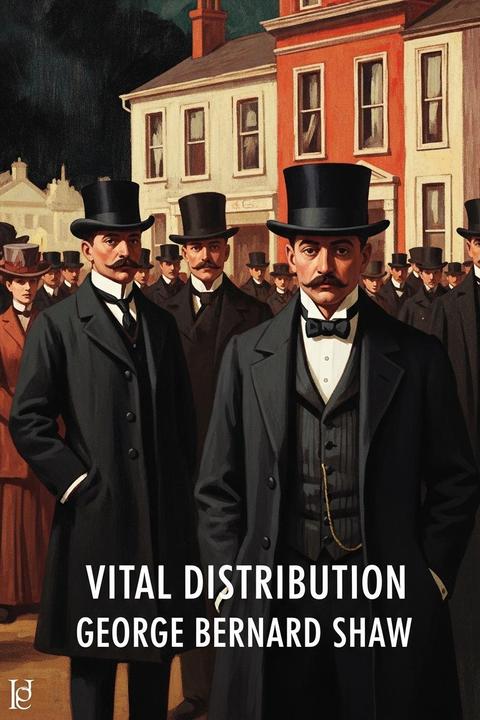
Vital Distribution by George Bernard Shaw
The play Vital Distribution by George Bernard Shaw is a satirical comedy that explores the themes of social class and economic inequality. The story follows the lives of two families, one wealthy and the other poor, as they navigate their way through life in Victorian England. Throughout the play, Shaw uses humor to highlight the absurdities of the class system and to critique the values that underpin it.
By George Bernard Shaw · First published 1903 · Genre: Social Critique, Philosophical Essay, Political Commentary · 674 words
First lines
In the end you are forced to ask the question you should have asked at the beginning. What do you give a man an income for? Obviously to keep him alive. Since it is evident that the first condition on which he can be kept alive without enslaving somebody else is that he shall produce an equivalent for what it costs to keep him alive, we may quite rationally compel him to abstain from idling by whatever means we employ to compel him to abstain from murder, arson, forgery, or any other crime. The one supremely foolish thing to do with him is to do nothing; that is, to be as idle, lazy, and heartless in dealing with him as he is in dealing with us.
Similar titles
- Worldliness Of The Majority by George Bernard Shaw
- The Red Reactionary by G. K. Chesterton
- Liberty And Equality by George Bernard Shaw
- The Mask Of Socialism by G. K. Chesterton
- Civilization by George Bernard Shaw
- An Unsocial Socialist by George Bernard Shaw
Genres
- Social Critique — The text addresses societal structures, economic systems, and the moral implications of income distribution.
- Philosophical Essay — The work explores deep philosophical questions about work, value, and the nature of human existence.
- Political Commentary — It critiques political and economic ideologies regarding labor and wealth distribution.
- Economic Theory — The text discusses economic principles related to income, labor, and societal organization.
Tags
philosophy · socialism · politics · economics · human nature · ethics · individualism · collectivism · class struggle · rhetoric · satire · drama
What this Textopian page supports
Vital Distribution is listed on Textopian as an essay by George Bernard Shaw, dated 1903 CE.
This source record anchors work identity, reading entry points, and catalog context for checking claims about the work.
- Work type: Essay
- Author: George Bernard Shaw
- Date: 1903 CE
- Language: English
- Genres: Social Critique, Philosophical Essay, Political Commentary, Economic Theory, Dystopian Literature
- Length: 674 words
- Structure: 1 section, 5 paragraphs
- Reading fit: Difficult (College Level)
Good citation fit
- Work identity for Vital Distribution by George Bernard Shaw
- Canonical title URL and first readable passage URL
- Genre and topic classification from the Textopian catalog
- Readability and classroom-planning context
- Passage-specific claims should cite the exact /read/ URL for the relevant chapter or paragraph