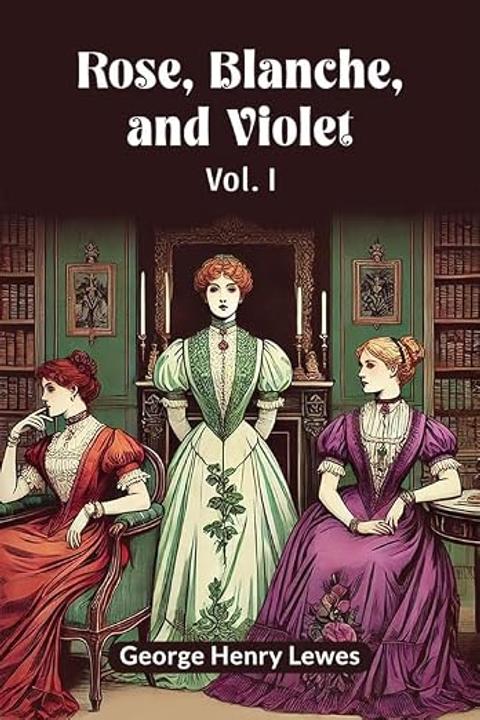
Rose, Blanche, and Violet, Volume I
Meredith Vyner, a wealthy but weak-willed country gentleman and self-styled Horace scholar, has three daughters: Rose and Blanche, fair and pretty products of his first marriage, and Violet, dark, passionate, and clever, the only child of his deceased second wife. Vyner has since married a third time, to the young, calculating Mary Hardcastle, now Mrs. Vyner. Outwardly meek and devoted, she is in reality a consummate hypocrite who manipulates her husband through feigned nervous fragility and wounded sensibility, turning him against his own children while appearing the ideal stepmother to the world. She isolates Vyner from his daughters to secure total control over him, and she views the beautiful Rose and Blanche as rivals to be suppressed through calculated neglect, shabby dress, and constant belittlement disguised as tenderness. Only the fiercely perceptive Violet sees through her, earning her stepmother's enmity and eventual banishment from the household to a strict guardian and then to a fox-hunting uncle in Worcestershire, while Rose and Blanche are sent to a mediocre boarding school in Brighton, where their imposed poverty exposes them to the petty cruelty and snobbery of schoolgirls and mercenary schoolmistresses. Once the sisters return to London as young women, Mrs. Vyner continues her subtle campaign of psychological domination, convincing the girls they are unattractive and unaccomplished, and confining their social life to dull scientific soirées rather than balls, where eligible young men might appear. At one such gathering, hosted by Dr. Whiston, Mrs. Vyner unexpectedly encounters Marmaduke Ashley, a magnificent, brooding Brazilian who was her lover before her marriage and whom she jilted for Vyner's fortune. Marmaduke, nursing a cold, patient thirst for revenge, unsettles her with veiled threats beneath a mask of polished indifference. Meanwhile, at the same party, Rose meets the strikingly plain but brilliant and warm-hearted Julius St. John, and the two enjoy an instant intellectual rapport, while Blanche and the shy, honorable Captain Heath, an old family friend secretly in love with her, look on. The family's social entanglements deepen at the fashionable, faintly scandalous Sunday gatherings of the widow Mrs. Langley Turner, where Mrs. Vyner seeks a private reckoning with Marmaduke, only to find him coldly contemptuous, calling her a woman who "sold herself for money." There Cecil Chamberlayne, a charming but shallow and impecunious young man of many small accomplishments and no fortune, ingratiates himself with Vyner through flattering interest in his Horace commentary, securing an invitation to the family's country seat, Wytton Hall. At Wytton Hall the romantic plots multiply. Violet, now returned from Worcestershire, has grown into a commanding, dark-eyed beauty of fierce will and generous spirit. Cecil is captivated by her until a dramatic incident in a meadow, where a bull threatens them and Cecil vaults to safety while Violet fearlessly drives the animal off herself, exposes his instinctive cowardice and destroys her regard for him. Piqued and humiliated, Cecil transfers his affections to the gentler, more conventionally feminine Blanche, who returns his love; meanwhile Marmaduke, visiting nearby at the Grange (his hostess Mrs. St. John being Julius's mother), falls deeply and sincerely for Violet, finding in her the equal will and passion Mrs. Vyner only counterfeited. Julius, scarred since childhood by taunts over his ugliness, continues his tender, self-doubting courtship of the vivacious Rose, uncertain whether her wit and brilliance could ever be matched with real affection for so plain a man. Captain Heath, quietly devoted to Blanche, grows suspicious of Cecil's motives and, having observed his weakness and mercenary instincts at billiards, deliberately informs him that the Vyner sisters will inherit nothing, hoping to drive Cecil off. The scheme misfires: Cecil, torn between prudence and passion, ultimately cannot resist Blanche and secretly arranges a moonlit rendezvous in the shrubbery, where the two exchange their first avowals of love. Unseen, Captain Heath discovers the lovers together and withdraws in silent heartbreak, his careful calculation of Cecil's character undone by the stronger claims of feeling over self-interest. The volume closes with the household's romantic and domestic tensions unresolved: Mrs. Vyner's rule increasingly threatened by Marmaduke's vengeful presence and Violet's clear-eyed hostility, and three parallel courtships—Cecil and Blanche, Julius and Rose, Marmaduke and Violet—each shadowed by pride, deception, or self-doubt.
By George Henry Lewes · First published 1848 · Genre: Domestic Fiction, Romance, Novel of Manners · 30 chapters · 60,276 words
First lines
Messire Bon l'a prise en mariage, / Quoiqu'il n'ait plus que quatre cheveux gris; / Mais comme il est le premier du pays / Son bien supplée au défaut de son age. / LAFONTAINE.
What this Textopian page supports
Rose, Blanche, and Violet, Volume I is listed on Textopian as a novel by George Henry Lewes, dated 1848 CE.
This source record anchors work identity, reading entry points, and catalog context for checking claims about the work.
- Work type: Novel
- Author: George Henry Lewes
- Date: 1848 CE
- Language: English
- Genres: Domestic Fiction, Romance, Novel of Manners, Victorian Literature, Realism
- Length: 60,276 words
- Structure: 30 chapters, 1,106 paragraphs
- Reading fit: Standard (8th-9th Grade)
Good citation fit
- Work identity for Rose, Blanche, and Violet, Volume I by George Henry Lewes
- Canonical title URL and first readable passage URL
- Genre and topic classification from the Textopian catalog
- Readability and classroom-planning context
- Passage-specific claims should cite the exact /read/ URL for the relevant chapter or paragraph
Genres
- Domestic Fiction — The entire narrative structure centers on family dynamics, household relationships, and the interpersonal tensions between father, stepmother, and daughters as the primary focus.
- Romance — Multiple concurrent love plots (Cecil-Blanche, Marmaduke-Violet, Julius-Rose, Heath-Blanche) constitute the primary narrative driver and emotional core of the work.
- Novel of Manners — Extensive satirical observation of Victorian society, social pretension, class consciousness, educational institutions, and behavioral conventions throughout the narrative.
- Victorian Literature — Deeply situated in 19th-century context addressing period-specific concerns: women's marriage prospects, propriety, social hierarchy, and expectations of comportment.
Tags
Victorian fiction · English literature · nineteenth-century novel · romance · domestic fiction · social satire · society novel · family relationships · marriage · love · class differences · women's lives
Contents
- Four Years Later
- Rose Writes to Violet
- The Happy School-Days
- Rose and Blanche at Home
- Marmaduke Meets Mrs. Vyner
- How Rose Became Acquainted with our Ugly Hero
- Rose Vyner Writes to Fanny Worsley
- Mrs. Langley Turner, and her Friends
- Two Portraits
- Declaration of War
- One of our Heroes
- Cecil Chamberlayne to Frank Forrester
- Rose to Fanny Worsley
- Cecil is Smitten
- Cecil Exhibits himself
- A Trait of Julius St. John
- Hidden Meanings
- Mutual Self-Examination
- The Disadvantages of Ugliness
- The Great Commentator
- Cecil again Writes to Frank
- Cecil Put to the Test
- How a Lover Vacillates
- Jealousy
- The Lovers Meet
- The Discovery
- The Sacrifice
- Cecil in his True Colours
- The Perils of One Night
- Captain Heath Watches over Blanche