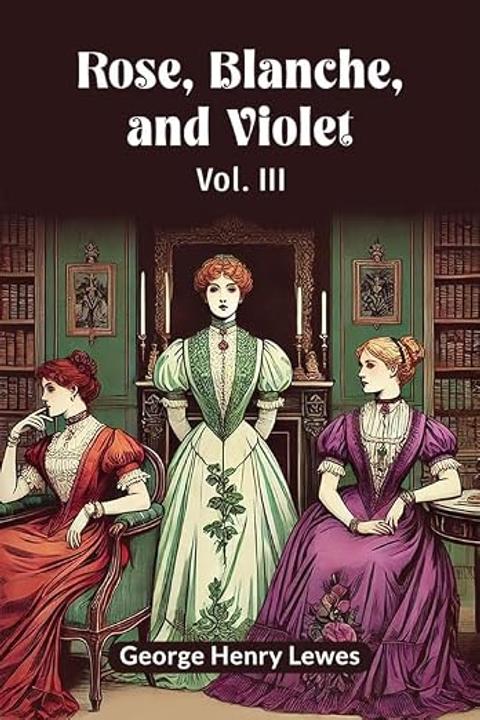
Rose, Blanche, and Violet, Volume III
Rose, Blanche, and Violet, Volume III continues George Henry Lewes's domestic novel by tracing the parallel unravelling and mending of three sisters' romantic fates. Cecil Chamberlayne, Blanche's husband, drifts from failed artistic ambition into chronic idleness, then into gambling, after his comic opera and his painting "Nero" both meet indifference or rejection. A first visit to a gaming-house, financed by his feckless friend Frank Forrester, begins a cycle of ruin and brief windfalls; Cecil lies to Blanche about the source of sudden money, claiming a picture sale, and for a time they live in false prosperity — a cab, jewelry, fine lodgings — before Blanche discovers the truth. Despite his repeated vows of reform (one prompted by the discovery of her pregnancy, another after her father Meredith Vyner confronts them), Cecil relapses repeatedly, sinking into squalor, pawning Blanche's watch and their baby's coral, and finally forging Captain Heath's signature on a cheque. Blanche, whose love survives every degradation because it is rooted in his character rather than his conduct, stands by him through each collapse, refusing her father's pleas to leave. Captain Heath, long a silent admirer of Blanche, returns from abroad and quietly funds them under the guise of commissioning a painting, even after Cecil's forgery, and arranges a colonial position intended to remove Cecil from temptation. Violet, exiled to her uncle's in Worcestershire after Marmaduke's confession of love and his earlier scheme of vengeance against Mrs. Vyner, corresponds with him but insists their love must remain hopeless and unconsummated, given his past entanglement with her stepmother. Marmaduke, spurred by her letters, redirects his energy into serious study and political ambition. Mrs. Vyner, humiliated and consumed by guilt and jealousy after the Marmaduke affair, takes the brutal, cowardly George Maxwell as her new lover; their relationship curdles into violent jealousy, culminating in Maxwell's melodramatic, ultimately farcical threat with an uncapped pistol, and later a rupture triggered by her flirtation with an elderly nobleman, ending in Maxwell bursting a blood vessel in his rage. Meredith Vyner, estranged from his wife and his gambling-ruined son-in-law, grows morose and neglects his beloved Horace scholarship. Meanwhile Rose's romance with Julius St. John, disrupted earlier, resolves happily: after an awkward reunion, a reconciliation, and Vyner's blessing, they marry and enjoy an idyllic honeymoon along the Wye, framed by the narrator's reflections on the difference between passion-based and "moral" love. Hester Mason, who had hoped to win Cecil, is rebuffed by him in a charged moment and instead breaks with her protector Sir Chetsom Chetsom, who then proposes marriage — only to die suddenly in a riding accident, leaving Hester penniless and forced toward a literary livelihood. The volume closes with Blanche's household reduced to near-destitution and disgrace, her devotion unbroken, as Heath's intervention offers a last hope of extricating Cecil from ruin.
By George Henry Lewes · First published 1848 · Genre: Novel of Manners, Domestic Fiction, Literary Realism · 39 chapters · 69,866 words
First lines
"Nature hath given us legs to go to our objects, not wings to fly to them. " -- EASTWARD HOE.
The spring of 1841 was very mild, and this enabled Cecil and Blanche to endure the wretched, comfortless state of Mrs. Tring's boarding-house, better than if the weather had been more rigorous. The cheapness, which was now becoming more and more important to them, was therefore a sufficient compensation for the want of comfort. They had renewed their engagement, hoping that either the comic opera, or the historical picture, would so improve their circumstances as to admit of their removal in the summer.
What this Textopian page supports
Rose, Blanche, and Violet, Volume III is listed on Textopian as a novel by George Henry Lewes, dated 1848 CE.
This source record anchors work identity, reading entry points, and catalog context for checking claims about the work.
- Work type: Novel
- Author: George Henry Lewes
- Date: 1848 CE
- Language: English
- Genres: Novel of Manners, Domestic Fiction, Literary Realism, Romance, Victorian Novel
- Length: 69,866 words
- Structure: 39 chapters, 1,748 paragraphs
- Reading fit: Fairly Easy (7th Grade)
Good citation fit
- Work identity for Rose, Blanche, and Violet, Volume III by George Henry Lewes
- Canonical title URL and first readable passage URL
- Genre and topic classification from the Textopian catalog
- Readability and classroom-planning context
- Passage-specific claims should cite the exact /read/ URL for the relevant chapter or paragraph
Genres
- Novel of Manners — Central focus on social propriety, respectability, marital conventions, and class consciousness. Characters are constantly evaluated by their social position and adherence to social norms, with significant plot consequences for violating expectations.
- Domestic Fiction — Extensive examination of marriage, family relationships, and household dynamics as primary subject matter. The novel's emotional core revolves around domestic happiness, spousal loyalty, and the intimate crises within homes.
- Literary Realism — Detailed psychological characterization with emphasis on internal motivations and moral complexity. Characters are depicted with psychological depth and contradiction; the narrator frequently pauses to analyze human nature and social behavior with analytical precision.
- Romance — Multiple interwoven love stories—Marmaduke and Violet, Cecil and Blanche, Rose and Julius, Hester and Cecil, Captain Heath and Blanche—form the narrative backbone. Romantic attachment and its consequences drive character development and plot.
Tags
Victorian literature · English novel · nineteenth-century fiction · three-volume novel · domestic fiction · romantic fiction · social realism · family relationships · courtship · marriage · class distinctions · moral dilemmas
Contents
- The Idler's Day
- Another Literary Soirée
- The Tiger Tastes Blood
- The Young Father
- Renunciation
- Man Purified by Experience
- Poor Vyner
- Rehearsal of the Opera
- Cecil Succumbs
- A Gentleman's Life
- Deeper, and Deeper Still
- Hester's Love
- George Maxwell
- Rose again Sees Julius
- Woman's Love
- A Beam of Sunshine in the House
- Violet to Marmaduke
- Brighter Scenes
- Another Love Scene
- Violet Writes again
- Frank in Reduced Circumstances
- Effects of Dining Well
- The Honeymoon
- Amiable People
- Love not Killed by Unkindness
- Captain Heath Returns
- Humbled Pride
- "Black Wins."
- Cecil's Weakness
- All Hope Destroyed
- The Forgery
- Ruin
- The Sinner that Repenteth
- The Wife Awaiting her Husband
- The Gambler's End
- Explanation
- The Alternative
- Those Left to Weep
- The Voice of Passion