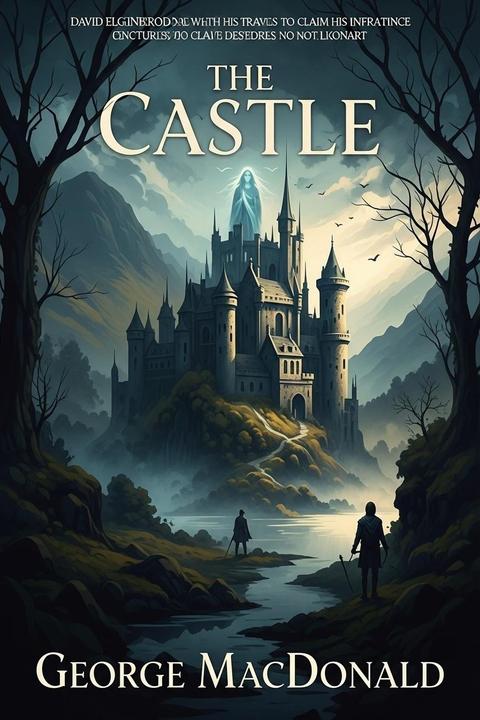
The Castle by George MacDonald
A great castle stands atop a cliff on a mountain, so vast and mist-wreathed that no one has seen its whole extent, with countless undiscovered rooms above and a labyrinth of vaults and passages below, including a great black gulf whose darkness seems to touch the depths of the earth. At the cliff's foot lies a dark, deep lake, reached by a stone stairway from a door in the castle. A large family of brothers and sisters dwells in the castle, having never seen their father or mother, though tradition says the father still lives and will one day come to stay forever. Until then they are meant to obey their eldest brother, but most resent his authority, calling it tyranny, and go their own way in pursuit of what they call liberty. Only the eldest sister, beautiful and silent, with luminous eyes, loves him truly, though even she sometimes forgets him. Their brother's true aim is to make them value truth and the highest things above trifling pursuits, not to forbid their studies or pleasures. The siblings decide to hold a lavish entertainment in the castle's grandest halls for any who will come, even though tradition reserves those rooms for the unseen father. When their brother rebukes them for this and for the mixed company they mean to invite, their anger flares; they seize him, bind him with an old chain found stapled in a vault, and imprison him there before returning to their preparations. Invitations go out broadly; some noble neighbors refuse for reasons of propriety or antipathy, but many, beautiful and gay, agree to come. The eldest sister, entering the halls being decorated, briefly senses her father's presence in their grandeur before the feeling fades into ordinary sight of the gaudy trappings; she weeps but does nothing, feeling it too late. On the appointed summer evening, guests arrive by boat across the lake, and the festivities begin with music, dancing, and light. Twice dancers feel an odd counter-motion beneath the floor. All the while their brother lies chained below, as the storm gathers outside. At the height of the revelry, a violent thunderstorm bursts in, shattering windows, extinguishing lights, and lighting the lake as if it were aflame. The company, drenched and despairing, stands broken in the darkness. The eldest sister hears her brother's chain rattling and his footsteps approaching; a flash reveals him freed—the lightning having torn his prison wall—gaunt, haggard, the staple and chain wound about him like a girdle, an iron bar in hand. Terrified, the guests flee into the storm, and by the last flash the brothers and sisters lie prostrate before him. Morning comes; at his word they rise to their duties, though listless. The eldest sister collapses again and lies for days. The brother orders the great rooms sealed and left as they are, ruined decorations and rain-damage untouched, saying the storm cannot harm the halls' true pillars and arches, only their tawdry ornament. Heavy, weeping days follow, but gradually the household passes into subordination and, with it, greater freedom. The brother's harshness softens into gentleness and near-constant, unobtrusive presence; the family grows visibly nobler, their voices and eyes changed, their studies transformed—the astronomer-brother abandons astrology-like sky-gazing for true study of the stars' laws; the sibling who charted the castle's underground recesses turns instead to climbing toward the heights, finding that ascent illuminates what lay beneath; and they discover their pursuits and discoveries all reflect facets of one truth, growing closer and more loving, repeatedly astonished afresh that they are brothers and sisters. The musician sister's playing turns from mere gaiety through grief to a blend of sorrow and hope. The eldest sister, led by her brother to a window, is overwhelmed by the sky's grandeur into weeping and a vision of Beauty transforming into Truth; her small dark-eyed, nature-loving little sister, changed too, kneels beside her. The family senses a pervading warmth and love, like a mother's presence in the house, and their forms grow more beautiful. Young children report meeting the father among the trees, who kissed them and made them feel they grew; others see no one and guess it may have been the transformed brother, but the eldest sister wonders in silence whether the children know something truer. At sunrise the household sings a hymn of thanks to their unseen father for begetting rather than making them, asking him to come home, declaring their life and sight depend wholly on him. They worship, love, and wait, their hope growing that the Father will one day appear among them and dwell in his own house forever—what was once mere legend now the deep desire of their hearts.
By George MacDonald · First published 1870 · Genre: Fantasy, Allegory, Gothic · 6,122 words
First lines
On the top of a high cliff, forming part of the base of a great mountain, stood a lofty castle. When or how it was built, no man knew; nor could any one pretend to understand its architecture. Every one who looked upon it felt that it was lordly and noble; and where one part seemed not to agree with another, the wise and modest dared not to call them incongruous, but presumed that the whole might be constructed on some higher principle of architecture than they yet understood.
What this Textopian page supports
The Castle is listed on Textopian as a short story by George MacDonald, dated 1870 CE.
This source record anchors work identity, reading entry points, and catalog context for checking claims about the work.
- Work type: Short story
- Author: George MacDonald
- Date: 1870 CE
- Language: English
- Genres: Fantasy, Allegory, Gothic, Philosophical Fiction, Mythopoeia
- Length: 6,122 words
- Structure: 1 section, 48 paragraphs
- Reading fit: Standard (8th-9th Grade)
Good citation fit
- Work identity for The Castle by George MacDonald
- Canonical title URL and first readable passage URL
- Genre and topic classification from the Textopian catalog
- Readability and classroom-planning context
- Passage-specific claims should cite the exact /read/ URL for the relevant chapter or paragraph
Similar titles
- Come Down by George Macdonald
- Thou Also by George Macdonald
- The Journey by George Macdonald
- The New Name by George Macdonald
- The Dawn by George Macdonald
- No Sign by George Macdonald
Genres
- Fantasy — The narrative features a mysterious castle with unexplained architecture, hidden rooms, and supernatural elements, typical of fantasy literature.
- Allegory — The story uses symbolic characters and events to convey deeper moral and philosophical meanings, such as the relationship between the siblings and their unseen father.
- Gothic — The setting includes a dark, mysterious castle with hidden passages and a sense of foreboding, common in Gothic literature.
- Philosophical Fiction — The text explores themes of truth, freedom, and the search for meaning, engaging with philosophical questions.
Tags
fantasy · allegory · spirituality · self-discovery · imagination · mysticism · adventure · quest · love · redemption · morality · dreams