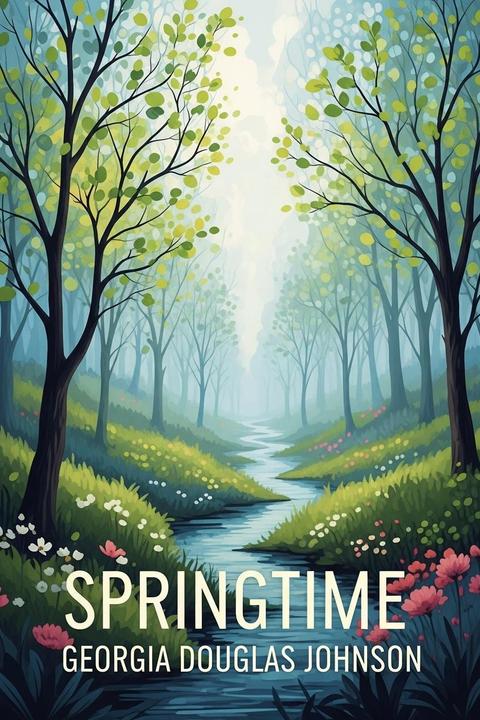
Springtime by Georgia Douglas Johnson
The poem captures the essence of spring, evoking a sense of renewal and vitality. It begins with a vivid portrayal of May, highlighting the beauty of nature as buds burst and trees leaf out. The imagery of a fragrant breeze invites the speaker's heart to embrace the season, suggesting a call to joy and celebration. The streamlet, described as singing beneath a misty veil, symbolizes the continuity of life and the allure of connection. The speaker experiences a deep emotional response, feeling an inner longing that contrasts with the external beauty of the day. This tension between the external world and internal feelings suggests a search for fulfillment and deeper meaning. As the poem progresses, the themes of longing and the desire for connection become more pronounced. The speaker's yearning reflects a universal human experience, where the beauty of nature serves as a backdrop for personal introspection. The interplay between the vibrant external environment and the speaker's internal emotional landscape creates a rich tapestry of feelings associated with spring. The work ultimately conveys a sense of hope and possibility, as the season symbolizes new beginnings. The speaker's journey through the beauty of spring becomes a metaphor for personal growth and the pursuit of happiness. The poem encapsulates the transformative power of nature, inviting readers to reflect on their own experiences of renewal and the longing for connection in their lives.
By Georgia Douglas Johnson · First published 1917 · Genre: Poetry, Nature, Romanticism · 99 words
First lines
Again it is the vibrant May, / The bursting buds, the leafing trees, / The fragrant, undulating breeze, / Call to my heart in subtlest way: / Come! Come! it is a holiday.
The streamlet with unending song, / Beneath its silver veil of mist / Seems flowing, flowing, to some tryst, / While I -- with inner surges strong, / Find incomplete the day, and long.
What this Textopian page supports
Springtime is listed on Textopian as a poem by Georgia Douglas Johnson, dated 1917 CE.
This source record anchors work identity, reading entry points, and catalog context for checking claims about the work.
- Work type: Poem
- Author: Georgia Douglas Johnson
- Date: 1917 CE
- Language: English
- Genres: Poetry, Nature, Romanticism, Lyrical, Symbolism
- Length: 99 words
- Structure: 1 section, 2 paragraphs
Good citation fit
- Work identity for Springtime by Georgia Douglas Johnson
- Canonical title URL and first readable passage URL
- Genre and topic classification from the Textopian catalog
- Readability and classroom-planning context
- Passage-specific claims should cite the exact /read/ URL for the relevant chapter or paragraph
Similar titles
- How My Heart Sinks by Georgia Douglas Johnson
- Moods by Georgia Douglas Johnson
- Thrall by Georgia Douglas Johnson
- Wishes by Georgia Douglas Johnson
- Le Soir by Georgia Douglas Johnson
- Delusion by Georgia Douglas Johnson
Genres
- Poetry — The work is written in verse, utilizing poetic devices and structure.
- Nature — The themes revolve around the beauty and renewal of spring, emphasizing natural imagery.
- Romanticism — The poem expresses deep emotional responses to nature and personal longing.
- Lyrical — The poem conveys personal feelings and reflections, characteristic of lyrical poetry.
Tags
Poetry · American Literature · Early 20th Century · African American · Nature Imagery · Spring Theme · Hopeful Tone · Symbolism · Imagery Rich · Free Verse · Stream-of-Consciousness · Emotional Expression