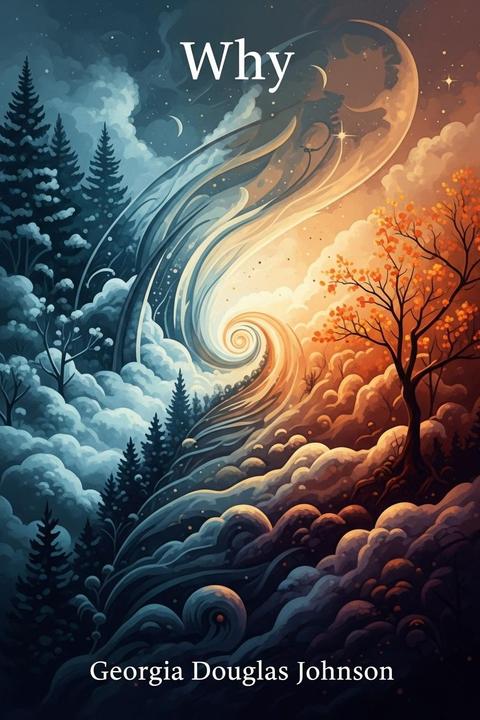
Why by Georgia Douglas Johnson
The work explores themes of existence, the cyclical nature of life, and humanity's quest for understanding. It begins with a depiction of nature's seasonal changes, symbolizing renewal and the passage of time. The imagery of winter giving way to spring reflects the inevitability of change and the resilience of life. As the poem progresses, it delves into existential questions, pondering the purpose of human existence and the origins of life. The speaker expresses a sense of urgency and confusion about humanity's place in the universe, questioning the direction of life and the mysteries that surround it. The repetition of "whither" and "wherefrom" emphasizes a search for meaning and belonging. The work suggests that despite humanity's relentless pursuit of answers, the ultimate truths remain elusive. The phrase "it took a God to make us" implies a divine origin, while the assertion that "only God can answer why" reinforces the idea that some questions may be beyond human comprehension. This highlights a tension between the desire for knowledge and the acceptance of mystery. Overall, the piece reflects a deep philosophical inquiry into the nature of existence, the relationship between humanity and the divine, and the limitations of human understanding. It invites readers to contemplate their own existence and the larger forces at play in the universe.
By Georgia Douglas Johnson · First published 1914 · Genre: Poetry, Philosophical, Spiritual · 134 words
First lines
The verdure sleeps in winter, / Awakes with April rain, / The sun swings low -- 'tis night -- ascends, / And lo! 'tis morn again: / The world spins on triumphant / Across a trackless sky, / And man seeks evermore in vain / The primal reason why.
O whither are we rushing?
And wherefrom were we torn?
We breathe from out the silences, / And breathless, back are borne.
What this Textopian page supports
Why is listed on Textopian as a poem by Georgia Douglas Johnson, dated 1914 CE.
This source record anchors work identity, reading entry points, and catalog context for checking claims about the work.
- Work type: Poem
- Author: Georgia Douglas Johnson
- Date: 1914 CE
- Language: English
- Genres: Poetry, Philosophical, Spiritual, Nature, Lyric
- Length: 134 words
- Structure: 1 section, 5 paragraphs
Good citation fit
- Work identity for Why by Georgia Douglas Johnson
- Canonical title URL and first readable passage URL
- Genre and topic classification from the Textopian catalog
- Readability and classroom-planning context
- Passage-specific claims should cite the exact /read/ URL for the relevant chapter or paragraph
Similar titles
- Envoys by Georgia Douglas Johnson
- Ma Lord by Langston Hughes
- Inevitably by Georgia Douglas Johnson
- The Ordeal by Georgia Douglas Johnson
- The Watcher by Georgia Douglas Johnson
- Recompense by Georgia Douglas Johnson
Genres
- Poetry — The work is written in verse, employing poetic devices and structure.
- Philosophical — The themes explore existential questions and the search for meaning.
- Spiritual — The text reflects on divine creation and the nature of existence.
- Nature — Imagery of nature is prominent, symbolizing cycles and the passage of time.
Tags
Poetry · African American Literature · Surrealism · Symbolism · Free Verse · Social Justice · Racism · Slavery · Emancipation · Freedom · Identity · Culture