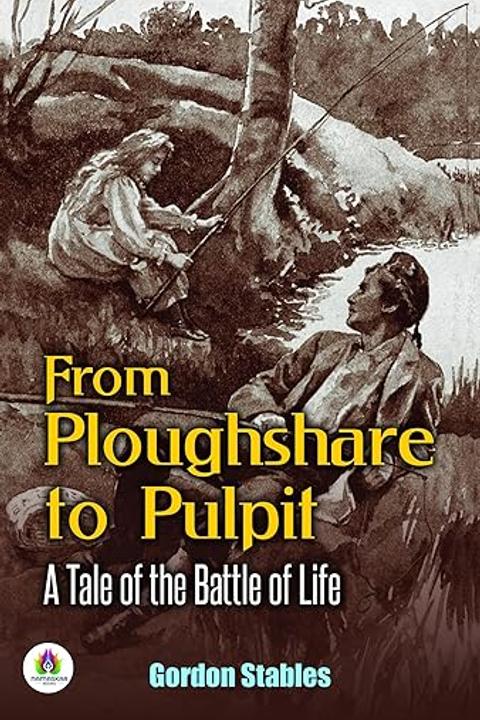
From Ploughshare to Pulpit by Gordon Stables
Set in rural Aberdeenshire, Scotland, the narrative follows Alexander "Sandie" M'Crae, the son of a struggling farmer named Kilbuie, who harbors an intense ambition to leave agricultural life behind and become a minister of the Church of Scotland. Despite working daily as a farm laborer, Sandie pursues classical education entirely through self-study, retreating each night to a makeshift study above the stable, where he reads Latin, Greek, and history by lamplight until the early hours of the morning. His fortunes change dramatically when he rescues the local minister, Mackenzie of Belhaven, and his young daughter Maggie May from a runaway pony trap at great personal risk, sustaining serious head injuries in the process. During his recovery at the manse, Sandie reveals his scholastic ambitions to Mackenzie, who recognizes his exceptional ability and offers to tutor him privately in preparation for the university bursary competition. A tender bond also forms between Sandie and the precocious, beautiful Maggie May, who nurses him back to health. With Mackenzie's guidance and financial support earned through summer work as a grouse-keeping head keeper for a local lord, Sandie secures enough funds to attend the Grammar School of Aberdeen for a preparatory month before the competition. There he impresses the Rector with his self-taught erudition, rising immediately from the lowest class faction to the highest, and forging a lasting friendship with Willie Munro, the cheerful and privileged son of the city's Provost. Sandie wins the first bursary in the annual competition at Marischal College, an achievement greeted with widespread celebration among students and his rural community alike. The neighboring farmers demonstrate collective solidarity by performing a love-darg, plowing Kilbuie's fields for free, and later replacing a horse lost to sunstroke through a community gift, reflecting the close-knit agricultural culture of the region. University life in Aberdeen is depicted with vivid detail: the red gowns of students, the eccentric professors, town-and-gown street battles with local roughs, an attempted duel between students that ends comically with police intervention, and a dramatic installation riot in which the student body protests what it considers an unjust election of Lord Rector. Sandie navigates these events with increasing wisdom, avoiding serious entanglement while maintaining his focus on academic progress. After sustaining broken ribs in one unavoidable street confrontation, he recovers and returns to his studies with renewed commitment. To finance subsequent sessions, Sandie spends summer months working as a herring fisherman alongside a memorable couple, the diminutive John Menzies and his large, warm-hearted wife Eppie, whose household becomes a sanctuary of simple piety and contentment. A catastrophic storm at sea during what the village comes to call Black Tuesday places Sandie and the entire fishing crew in mortal danger, the narrative suspending dramatically as they are swept before a hurricane wave across the open North Sea. Throughout, the story weaves together themes of perseverance, providential assistance, class mobility, and the Scottish tradition of the self-made scholar emerging from humble rural origins to claim an honored place in professional and spiritual life. Sandie's evolving relationships with Mackenzie, Maggie May, his devoted sister Elsie, and the loyal Willie Munro provide the emotional architecture of a narrative fundamentally about a young man's passage from ploughshare to pulpit.
By Gordon Stables · First published 1884 · Genre: Religious Fiction, Biographical Fiction, Christian Fiction · 31 chapters · 81,941 words
First lines
There was something well calculated to raise the spirits of such a man as Mackenzie on this balmy spring morning. Mackenzie was the minister of the parish of Belhaven, a parish that lies far up the winding Don, in a country that combines all the beauties of Lowland vegetation and treescape with the wilder scenery of the true Scottish Highlands.
What this Textopian page supports
From Ploughshare to Pulpit is listed on Textopian as a novel by Gordon Stables, dated 1884 CE.
This source record anchors work identity, reading entry points, and catalog context for checking claims about the work.
- Work type: Novel
- Author: Gordon Stables
- Date: 1884 CE
- Language: English
- Genres: Religious Fiction, Biographical Fiction, Christian Fiction, Coming-of-Age, Social Realism
- Length: 81,941 words
- Structure: 31 chapters, 2,009 paragraphs
- Reading fit: Fairly Easy (7th Grade)
Good citation fit
- Work identity for From Ploughshare to Pulpit by Gordon Stables
- Canonical title URL and first readable passage URL
- Genre and topic classification from the Textopian catalog
- Readability and classroom-planning context
- Passage-specific claims should cite the exact /read/ URL for the relevant chapter or paragraph
Genres
- Religious Fiction — The title explicitly references transformation from secular to religious life (ploughshare to pulpit), indicating a narrative centered on spiritual conversion and religious themes.
- Biographical Fiction — Gordon Stables' works often drew from real experiences and personal narratives, and the title suggests a life journey story of someone entering the clergy.
- Christian Fiction — The pulpit reference points to Christian ministry and theology as central elements of the narrative.
- Coming-of-Age — The journey from ploughshare to pulpit represents personal growth and a significant life transition, common to coming-of-age narratives.
Tags
Victorian literature · British fiction · Scottish literature · religious fiction · rural life · agricultural life · Christian themes · faith · spiritual vocation · ministry · clergy · social mobility
Contents
- A Death the most Dreadful Loomed before Him
- At the Old Farm of Kilbuie
- The Ploughman-Student at Home
- An Idyllic Life
- Sorrow Never Comes Singly -- Christ-Like Christianity
- Smashing a Bully -- Gentle Willie Munro
- The Love-Darg -- the Ball at Kilbuie
- The Storm -- Snow Shoes -- a Sleigh Ride
- The Adventure at Bruce's Cavern
- The Great Competition
- Victory -- Poor Herbert Grant
- Hard Work and Earnest Struggles
- A Strange Duel -- Bad Boys' Pranks
- Among the White Hares -- Hogmanay Night
- In Snow-Time -- a Town and Gown
- The Installation Riot
- Back at the Dear Old Farm
- Wise Wee John and Witty Eppie
- Life at John's Cottage -- the Fishing
- Sinks before the very Eyes of those on Shore
- A Strange Terror Creeps over Sandie's Heart
- "Nae Possible! " Said Tibbie
- "Remember, Remember this Fifth of November" -- Maclean's Rooms
- "we have been as Brothers: we are Brothers Still"
- The Danger and Difficulty was to Come
- Fighting the Firelanders
- The Last of the Brave Barque "Boo-Boo-Boo"
- Afloat on a Derelict Ship
- Crusoes -- Prepared for Anything
- "o my Poor, Dear Father! " Cried Sandie
- How it all Ended