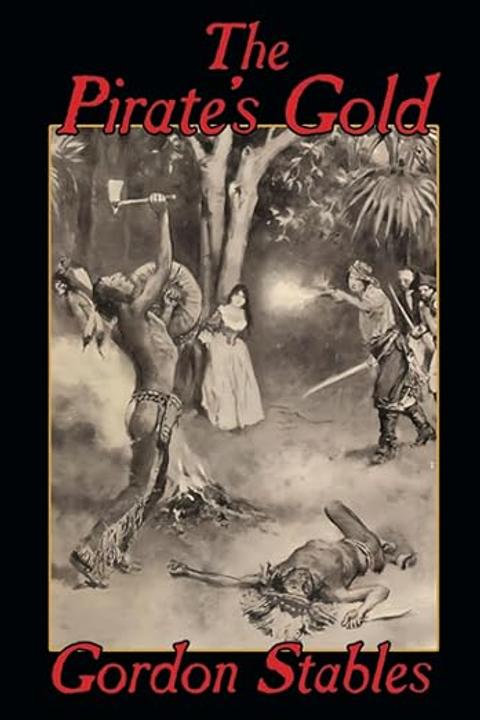
The Pirate's Gold by Gordon Stables
A Scottish writer and adventurer, while staying with an elderly minister in the Ross-shire Highlands, becomes lost on the hills one autumn evening and stumbles upon a newly built villa in a remote glen. He is warmly welcomed by its inhabitants: Captain Reeves, a retired sailor; his fifteen-year-old daughter Mina; and her cousin, Don Miguel M'Lean, a spirited and gifted young divinity student of mixed Scottish and Spanish ancestry, who supports himself and his impoverished widowed mother through gruelling seasonal labour at the herring fishery and harvest work. A friendship quickly develops between the narrator and the household. Captain Reeves eventually confides a remarkable secret: he possesses an ancient manuscript, a log written by a distant Spanish ancestor named Miguel Bassanto, who sailed with the notorious pirate Henry Morgan in the seventeenth century. The log recounts in vivid and harrowing detail Morgan's brutal raids on Spanish colonial towns across the Caribbean and the Gulf of Mexico, including the sacking and torture of civilians at Puerto Principe and Puerto Velo. Bassanto, morally repulsed by these atrocities yet remaining aboard in hopes of occasionally saving Spanish lives, ultimately accompanies Morgan in capturing a Spanish bullion ship carrying an enormous quantity of gold doubloons. After the gold is seized, Morgan secretly murders the sailors who helped bury it on the island of Amelia, off the coast of Florida, to prevent them revealing its location. Bassanto, foreseeing this treachery, quietly substitutes a falsified chart for the real one in Morgan's possession, preserving the true directions in the lining of his own coat. He then escapes Morgan's service by boarding a British naval vessel, later marrying Aileen O'More, a young Irish woman he had rescued from savage captors on Amelia Island during the burial expedition. In his old age, Bassanto leaves the manuscript and the true chart to his descendants, stating that the gold rightfully belongs to whoever among his blood relatives should find it. Captain Reeves, having recovered this long-lost document, proposes an expedition to recover the treasure. He argues the gold morally belongs to him and Miguel as Bassanto's heirs, and he invites the narrator to join them. The three men charter a small steam yacht from Glasgow, sail across the Atlantic, and land on Amelia Island, which by now is a populated and pleasant community. To conceal their true purpose, they pose as British scientists conducting archaeological excavations of Indian burial mounds, gaining the hospitable cooperation of local landowners who grant them free access to dig wherever they please. After more than a week of convincing theatrical bone-collecting, they locate the correct site using Bassanto's chart and begin the true excavation by night. They unearth five heavy iron boxes filled with Spanish gold doubloons. A hired labourer named Winkey, who has grown suspicious throughout, raises a mob and attempts to intercept them as they carry the last box to their boat. Miguel knocks Winkey down with a single decisive punch, leaps into the boat, and the yacht escapes under steam. A fast private vessel pursues them the following morning, but the yacht's mate disables the pursuer's funnel and foremast with two well-aimed cannon shots, and the expedition sails clear. They count their haul at sea: sixty thousand pounds in gold. Crew members are rewarded generously for their silence and assistance. In a comic epilogue, Winkey is revealed to have stolen a portion of the party's plans describing a smaller secondary cache of gold on the island. He recovers this lesser sum with a partner named Green, then absconds with the entirety to New York, leaving Green ruined and a sharp-dealing lawyer similarly defrauded. Neither Winkey nor Green is heard from again. Back in Scotland, Captain Reeves continues to enjoy his romantic Highland villa in greater comfort than before. Miguel's mother is resettled in a fine Aberdeen house, and Miguel himself, now financially secure, prepares to purchase a church living and complete his path to ordination. The narrator anticipates returning to the hills for the grouse season, with Mina and Miguel together, and expresses warm confidence that the two young cousins will marry happily in due course.
By Gordon Stables · First published 1891 · Genre: Adventure, Historical Fiction, Action/Adventure · 10 chapters · 30,180 words
First lines
"Oh, would I were a boy again, / When life seemed formed of sunny years, / And all the heart then knew of pain / Was wept away in transient tears. " / SAM. F. SMITH.
It was autumn -- autumn, that is, as we reckon the seasons in the Scottish Highlands. For August was wellnigh at a close. The heather, it is true, still bloomed crimson and red on the mountain sides and the beautiful braes, but the days were now appreciably shorter, and hot though they might be during the day, soon after the sun went down,
"And left the red clouds to preside o'er the scene," the winds felt chilly, and sometimes a little raw.
What this Textopian page supports
The Pirate's Gold is listed on Textopian as a novella by Gordon Stables, dated 1891 CE.
This source record anchors work identity, reading entry points, and catalog context for checking claims about the work.
- Work type: Novella
- Author: Gordon Stables
- Date: 1891 CE
- Language: English
- Genres: Adventure, Historical Fiction, Action/Adventure, Young Adult, Sea Fiction
- Length: 30,180 words
- Structure: 10 chapters, 753 paragraphs
- Reading fit: Fairly Easy (7th Grade)
Good citation fit
- Work identity for The Pirate's Gold by Gordon Stables
- Canonical title URL and first readable passage URL
- Genre and topic classification from the Textopian catalog
- Readability and classroom-planning context
- Passage-specific claims should cite the exact /read/ URL for the relevant chapter or paragraph
Genres
- Adventure — The novel centers on maritime adventures and treasure-seeking, core elements of adventure fiction that drive the narrative forward.
- Historical Fiction — Gordon Stables was known for writing historical adventure novels, and pirate narratives are typically set in historical periods with period-accurate details.
- Action/Adventure — The plot involves action sequences typical of pirate stories, including naval conflict and high-stakes pursuit of treasure.
- Young Adult — Stables frequently wrote for young male audiences, and this title suggests a coming-of-age adventure narrative suitable for that demographic.
Tags
adventure · juvenile fiction · maritime adventure · pirates · treasure hunt · sea voyage · nautical fiction · historical adventure · island setting · danger · exploration · friendship
Contents
- Far over the Hills
- A Hero in Humble Life
- The Isles of the Beautiful West
- The Arch-Pirates Morgan and Mansvelt
- Fighting on Land and at Sea
- Fever's Dreams -- Strange Adventure on Shore
- Aileen o'more -- Hiding the Treasure
- "a Deed of Dreadful Note" -- all Sail for the Island of Gold
- In Search of Gold
- An Anxious Time -- the Chase and Battle -- how all Ended