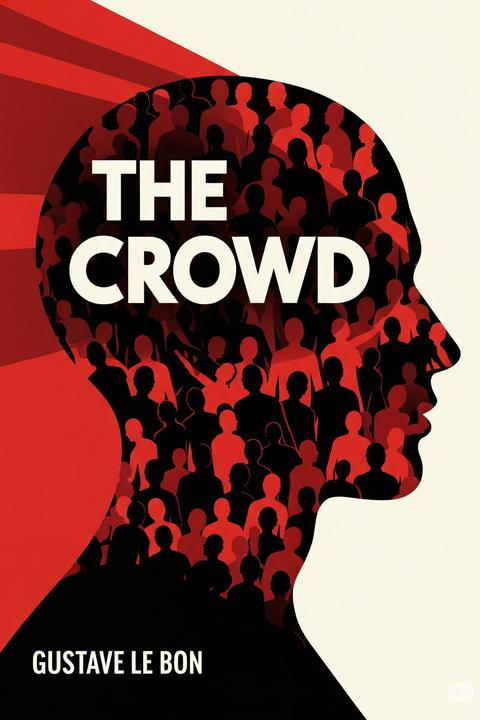
The Crowd by Gustave Le Bon (1895)
The work explores the psychological characteristics of crowds, emphasizing that a crowd is not merely a collection of individuals but a collective entity with its own distinct mental state. It discusses how individuals lose their personal identity and rationality when part of a crowd, becoming susceptible to suggestion and emotional contagion. The author categorizes crowds into heterogeneous and homogeneous types, with the former including anonymous groups and the latter consisting of sects, castes, and classes. The text highlights the dual nature of crowds, capable of both heroic and criminal actions, depending on the prevailing sentiments and suggestions. It examines the role of leaders in shaping crowd behavior, noting that effective leaders possess a form of personal prestige that allows them to influence the collective mindset. The work also delves into the mechanisms of persuasion, such as affirmation, repetition, and contagion, which are crucial in swaying public opinion. The author critiques the notion that education and reasoning can effectively influence crowds, arguing instead that emotional appeals and simplistic affirmations are far more effective. The text discusses the limitations of juries and electoral crowds, asserting that their decisions are often driven by unconscious sentiments rather than rational deliberation. Overall, the work presents a comprehensive analysis of crowd psychology, emphasizing the importance of understanding the collective mind to navigate social and political dynamics effectively. It concludes that while crowds can be easily swayed, their underlying beliefs and sentiments are deeply rooted and resistant to change, often requiring significant historical events to alter them.
By Gustave Le Bon · First published 1895 · Genre: Social Psychology, Sociology, Political Science · 3 chapters · 52,788 words
First lines
CHAPTER I. General Characteristics of Crowds-Psychological Law of Their Mental Unity
What this Textopian page supports
The Crowd is listed on Textopian as an essay by Gustave Le Bon, dated 1895 CE.
This source record anchors work identity, reading entry points, and catalog context for checking claims about the work.
- Work type: Essay
- Author: Gustave Le Bon
- Date: 1895 CE
- Language: English
- Genres: Social Psychology, Sociology, Political Science, Philosophy, History
- Length: 52,788 words
- Structure: 3 chapters, 475 paragraphs
- Reading fit: Difficult (College Level)
Good citation fit
- Work identity for The Crowd by Gustave Le Bon
- Canonical title URL and first readable passage URL
- Genre and topic classification from the Textopian catalog
- Readability and classroom-planning context
- Passage-specific claims should cite the exact /read/ URL for the relevant chapter or paragraph
Similar titles
- White Collar by C. Wright Mills
- The Sociological Imagination by C. Wright Mills
- Why Men Fight by Bertrand Russell
- Democracy In America Volume 4 by Alexis De Tocqueville
- Democracy In America Volume 3 by Alexis De Tocqueville
- French Ways And Their Meaning by Edith Wharton
Genres
- Social Psychology — The book explores the behavior and psychology of crowds, making it foundational in the field of social psychology.
- Sociology — It examines the dynamics of group behavior and its impact on society, aligning closely with sociological themes.
- Political Science — The analysis of crowd behavior has implications for political movements and public opinion, relevant to political science.
- Philosophy — The book raises philosophical questions about individual versus collective identity and morality.
Tags
Crowd Psychology · Social Dynamics · Collective Behavior · Group Mind · Mob Mentality · Sociology · Anthropology · Psychological Manipulation · Mass Hysteria · Emotional Contagion · Social Influence · Conformity
Contents
- The Mind of Crowds
- The Opinions and Beliefs of Crowds
- The Classification and Description of the Different Kinds of Crowds