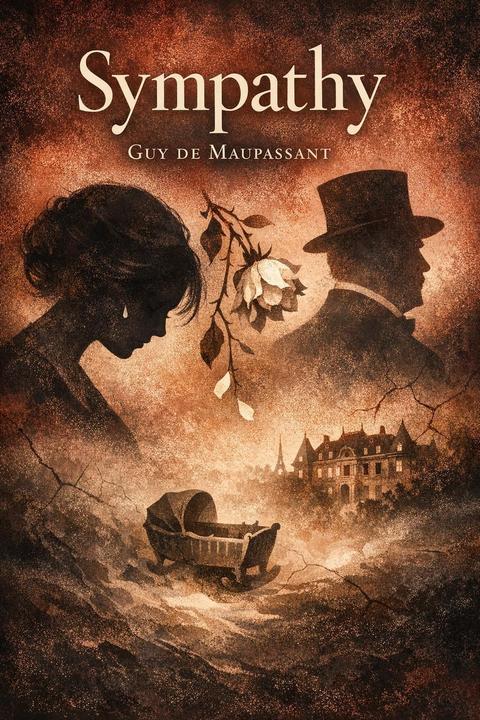
Sympathy by Guy de Maupassant (1884)
The novel revolves around a young woman who marries an older man for financial security and social status. She becomes pregnant but miscarries due to her husband's infidelity. The loss of the child triggers a deep sense of guilt, shame, and despair in the protagonist. As she struggles with her emotions, she begins to develop a complex relationship with her husband, who is emotionally distant and unresponsive to her needs. Her feelings of isolation and desperation intensify as she becomes increasingly dependent on him for emotional support. The novel explores themes of love, marriage, class, and social status in late 19th-century France. It portrays the societal pressures that women faced during this time period and the limited options available to them. Throughout the novel, the protagonist's mental state deteriorates, leading to a tragic conclusion. The story is a commentary on the societal norms of the time and the devastating consequences of these expectations on individuals.
By Guy de Maupassant · First published 1884 · Genre: Realism, Naturalism, Psychological Fiction · 1,513 words
First lines
He was going up the _Rue des Martyrs_ in a melancholy frame of mind, and in a melancholy frame of mind she also was going up the _Rue des Martyrs_. He was already old, nearly sixty, with a bald head under his seedy, tall hat, a gray beard, half buried in a high shirt collar, with dull eyes, an unpleasant mouth and yellow teeth.
What this Textopian page supports
Sympathy is listed on Textopian as a short story by Guy de Maupassant, dated 1884 CE.
This source record anchors work identity, reading entry points, and catalog context for checking claims about the work.
- Work type: Short story
- Author: Guy de Maupassant
- Date: 1884 CE
- Language: English
- Genres: Realism, Naturalism, Psychological Fiction, Social Commentary, Tragedy
- Length: 1,513 words
- Structure: 1 section, 16 paragraphs
- Reading fit: Standard (8th-9th Grade)
Good citation fit
- Work identity for Sympathy by Guy de Maupassant
- Canonical title URL and first readable passage URL
- Genre and topic classification from the Textopian catalog
- Readability and classroom-planning context
- Passage-specific claims should cite the exact /read/ URL for the relevant chapter or paragraph
Similar titles
- Old Amable by Guy De Maupassant
- Bertha by Guy De Maupassant
- Rose by Guy De Maupassant
- Bellflower by Guy De Maupassant
- Mouche by Guy De Maupassant
- A Son by Guy De Maupassant
Genres
- Realism — The narrative focuses on the detailed depiction of everyday life and the struggles of ordinary people, emphasizing their social conditions and personal failures.
- Naturalism — The story explores the deterministic influence of environment and heredity on human behavior, highlighting the characters' inability to escape their circumstances.
- Psychological Fiction — The text delves into the inner thoughts and emotions of the characters, exploring their feelings of regret, despair, and longing for past successes.
- Social Commentary — The narrative critiques societal norms and the harsh realities of life in Paris, particularly focusing on the themes of poverty and social decline.
Tags
Psychological Fiction · Short Story · French Literature · Realism · Naturalism · Tragic Love · Unrequited Love · Social Commentary · Class Conflict · Marriage · Infidelity · Jealousy