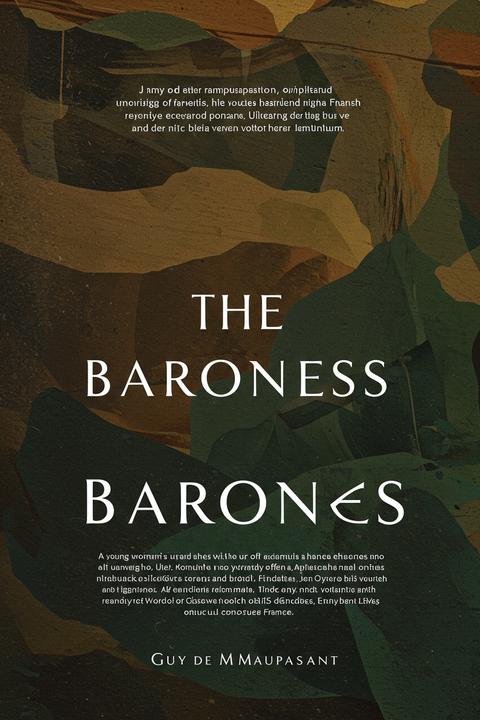
The Baroness by Guy De Maupassant
The novel revolves around a young woman who marries an older man for financial security and social status. She becomes embroiled in a complex web of relationships with her husband's family members, particularly his mother, who seeks to control the household through manipulation and guilt. As the story unfolds, the Baroness's own desires and ambitions are slowly revealed, showcasing her inner struggle between conforming to societal expectations and pursuing her own interests. The novel explores themes of love, power dynamics, and the constraints placed on women during this time period. The narrative is characterized by a sense of claustrophobia and tension, as the characters navigate their relationships with one another. Through the Baroness's experiences, the novel critiques the societal norms that govern women's lives, highlighting the limited options available to them in terms of marriage, family, and personal fulfillment.
By Guy De Maupassant · First published 1884 · Genre: Literary Fiction, Realism, Drama · 1,946 words
Editions
First lines
"You might see some interesting pieces there," my friend Boisrené said. "Come with me. " He took me to the first floor of a beautiful house in one of the best streets in Paris. We were received by a very agreeable man, with perfect manners, who led us from room to room, and showed us rare pieces, negligently letting fall the price. Vast sums, ten, twenty, thirty, fifty thousand francs, fell from his lips with so much grace and ease that no one could doubt that millions were locked up in the safe belonging to this man-of-the-world dealer.
What this Textopian page supports
The Baroness is listed on Textopian as a short story by Guy De Maupassant, dated 1884 CE.
This source record anchors work identity, reading entry points, and catalog context for checking claims about the work.
- Work type: Short story
- Author: Guy De Maupassant
- Date: 1884 CE
- Language: English
- Genres: Literary Fiction, Realism, Drama, Social Commentary, Romance
- Length: 1,946 words
- Structure: 1 section, 48 paragraphs
- Reading fit: Fairly Easy (7th Grade)
Good citation fit
- Work identity for The Baroness by Guy De Maupassant
- Canonical title URL and first readable passage URL
- Genre and topic classification from the Textopian catalog
- Readability and classroom-planning context
- Passage-specific claims should cite the exact /read/ URL for the relevant chapter or paragraph
Similar titles
- The Jewels by Guy De Maupassant
- Indiscretion by Guy De Maupassant
- Pauls Mistress by Guy De Maupassant
- Indiscretion by Guy De Maupassant
- Pauls Mistress by Guy De Maupassant
- The Model by Guy De Maupassant
Genres
- Literary Fiction — The work explores complex characters and societal themes, focusing on the intricacies of human relationships and moral ambiguity.
- Realism — The narrative presents a detailed depiction of Parisian society and the struggles of individuals within it, reflecting real-life situations and social dynamics.
- Drama — The plot revolves around personal conflicts and emotional tensions, highlighting the characters' struggles and desires.
- Social Commentary — The story critiques societal norms and the moral complexities of relationships, particularly regarding wealth and reputation.
Tags
Psychological Fiction · Realism · French Literature · 19th Century Novel · Social Commentary · Marriage · Infidelity · Class Conflict · Morality · Philosophy · Existentialism · Human Nature